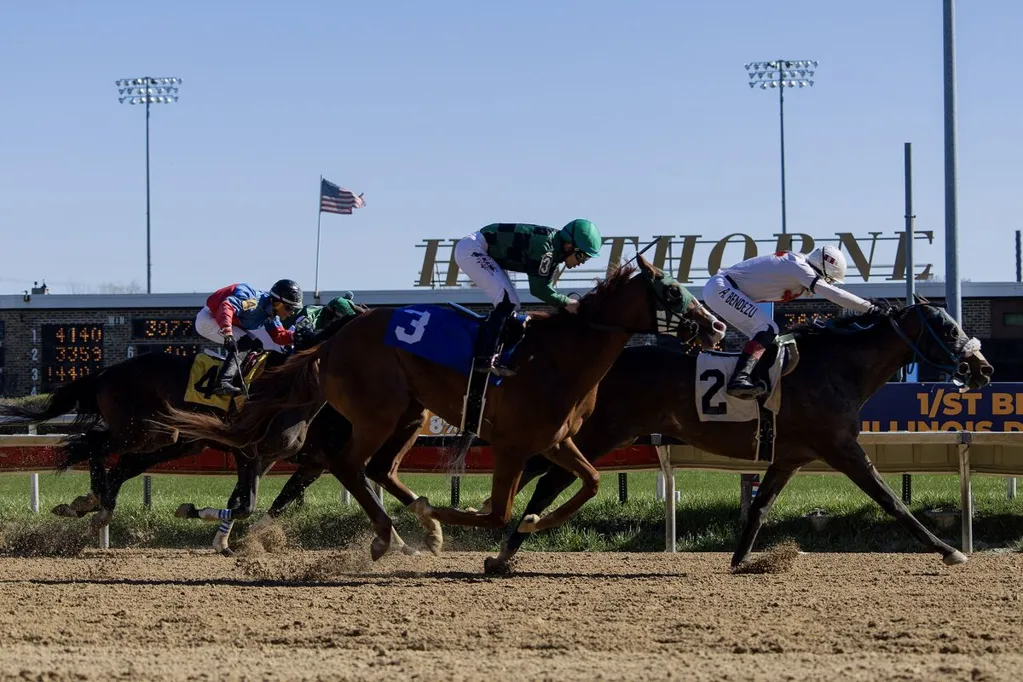
Horse racing was never really a glamorous business at Hawthorne Race Course. Built in 1891, it's a hardscrabble, little track tucked into an industrial zone just outside Chicago, a companion venue to the more chic Arlington Park on the city's north side.
But Arlington folded back in 2021 -- a victim of the sport's slow and steady decline -- and now Hawthorne, drowning in debt and cut off from fresh financing by its bankers, is on the cusp of suffering the same fate.
Its cash pile is so low that Hawthorne has been struggling to even pay out prize money to winning horse owners. Checks it sent out to owners have bounced in recent weeks, prompting state regulators to suspend its license to conduct harness races.
The latest news and analysis on M&A, IPOs, private equity, startup investing and the dealmakers behind it all, for subscribers only.
Hawthorne's CEO, Tim Carey, is scrambling to cobble together the financial backing he needs to re-open the track when its thoroughbred-racing season -- the more high-profile part of its business -- is scheduled to begin in late March. A long list of creditors, meanwhile, has lined up to demand payment on some $25 million in arrears the track has. Prominent among them: Churchill Downs Inc. ($1.6 million) and W.E. O'Neil Construction, which is waiting to be paid the $5.2 million it's owed for demolition work it did back in 2019 to tear down most of Hawthorne's grandstand and clear space for a casino (that never was built).
The horse-racing industry has been struggling for years. Most gamblers today prefer the faster-paced betting options available on their phones from Kalshi Inc., Polymarket and the sports-wagering sites. Casinos and lotteries lure away gamblers, too. Arlington is one of several major tracks that have closed in recent years across the US -- from California to Florida to Massachusetts.
Few, if any, tracks still operating today are in the kind of dire straits that Hawthorne is. The property has two years and over $110,000 in unpaid property taxes to Cook County, as well as two mortgages -- one for $6.3 million and another for $5 million, according to county records.
Representatives for the Illinois Thoroughbred Horsemen's Association and the Illinois Harness Horsemen's Association both said they're owed hundreds of thousands in state-mandated fees from Hawthorne.
Last month, the company's assistant general manager, John Walsh, told directors of the Illinois Racing Board that the Carey family and Hawthorne management were "disgusted by this turn of events" and that it "would never decide to write checks that didn't go through."
Walsh said that even though it happened to him. A reimbursement check from Hawthorne had bounced, he told the board, but his paycheck hadn't "yet."
Still, he said the company was working on a deal with "a new partner" that's trusted in the Illinois racing scene, one "who really wants all of this to succeed and move quickly." He didn't identify that possible partner or provide details on what that deal could look like.
Thoroughbred owners, having heard similar comments in the past, are skeptical.
"It's hard to watch what's happened here over the last seven years almost and still be optimistic," said David McCaffrey, executive director of the thoroughbred horsemen's association.
If there's a brighter future at Hawthorne, it will probably start at the slots rather than on the track. In 2019, Illinois lawmakers passed an expansion of gaming laws to allow for casino games at tracks, creating what are called "racinos" -- an approach that has reinvigorated the racing industry in several states.
The legislation was championed by the horsemen's associations and by Carey, whose family has owned Hawthorne since 1909.
Soon after, Hawthorne received a gaming license and ordered W.E. O'Neil to tear down the grandstand. But a deal to build the casino still hasn't been finalized. Carey didn't respond to multiple requests for comment.
"There is a readily available, proven, dramatically effective, legal antidote to our troubles," McCaffrey said. "Hawthorne is essentially -- I'm not gonna say flushing it down the toilet -- but they haven't been able to take advantage of it."
"It's killing the industry," he added. "So we're sort of a passenger on the plane, but this plane, make no mistake, is going down."