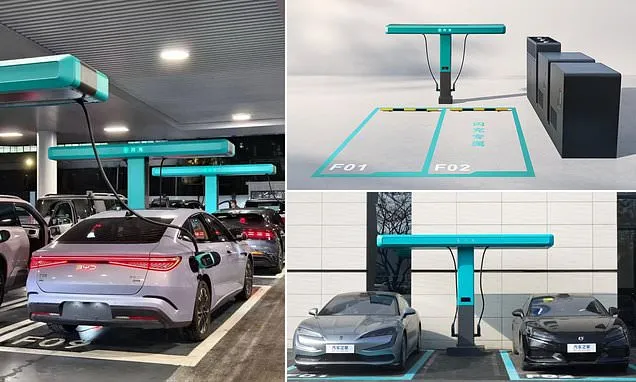
Chinese car giant BYD has unveiled its new charging forecourt that promise to provide a 'breakthrough' for electric car ownership.
The world's biggest EV seller - having recently overtaken Tesla - on Friday revealed its new Flash Charging station where electric car owners can boost batteries in a matter of minutes.
The devices can be deployed at forecourts laid out similar to a conventional petrol station - though instead of pumps there are T-shaped structures each with two connectors - or as standalone charging solution for two vehicles at a time.
The devices can deliver charging speeds of up to 1,500kW - three times faster than the most powerful EV chargers currently available in the UK.
It means EV drivers can top up their batteries from 10 per cent to 97 per cent in just nine minutes.
Some 4,000 of the stations are already in situ in China, with 20,000 in total promised before the close of 2026.
And the charging stations will be rolled out to other markets, including the UK.
Each forecourt will have a number of 1.5 megawatt Flash Charging stations, each boasting 1,500 amps of current and a 1,000-volt base architecture.
Already, BYD has 4,239 Flash Charging stations in its home nation and forecasts another 16,000 installations in 2026.
It is seen as the next step in rapid charging capabilities with the forecourt chargers even more potent than the single-unit 1,000kW Flash Charger devices already available across China.
Like the megawatt devices, only vehicles with a compatible battery can extract the full energy on offer.
The first of these is the new 29GT from BYD's subsidiary brand, Denza.
The luxury saloon - a rival to the Porsche Taycan - uses the company's most advanced Blade Battery 2.0, which promises a range of up to 644 miles based on China's own test cycles. However, this typically provides more optimistic estimations of range that the test used in Europe.
Each Flash Charging station will be powered by an on-site, ultra-fast-discharge energy storage systems (ESS) designed to limit the impact on the existing energy grid.
The ESS itself uses a battery that recharges at slower speeds, acting both as an 'energy reservoir' and a 'power amplifier' to enable high-power charging like never seen before.
The system has even been tested in extreme temperatures and was found to be capable of charging an EV battery from 20 to 97 per cent in -30 degree Celsius conditions in only 12 minutes.
In normal temperatures, it can charge a compatible EV from 10 to 70 per cent in just five minutes - comparable to the time it takes to fill the tank of a petrol or diesel car at a conventional fuel station.
To put their incredible charging capabilities into perspective, they are three times as powerful as Tesla's latest V4 Supercharger.
These are the fastest devices currently on UK roads, providing speeds up to 500kW, adding 172 miles to compatible EVs in around 15 minutes.
Around 4,000 of the Flash Charging stations have already been installed across China, with 20,000 in total promised before the close of 2026
The T-shaped charging platforms can be deployed at forecourts laid out similar to a conventional petrol station or as a standalone charging solution for two vehicles (pictured)
BYD says its Flash Charging stations will use the T-shaped overhead design not only for familiarity for drivers used to traditional filling station forecourts but because it 'removes many of the less appealing aspects of the recharging procedure'.
This includes cables getting wet and covered in dirt when they're drag across the ground.
While the manufacturer has confirmed it will make its stations available across various countries worldwide, it said more details will be provided 'in due course'.
But with the UK being BYD's biggest overseas market - registering 51,422 of its cars here in 2025 alone - Britain is surely in line to be among the first to get them.
Bono Ge, BYD's UK manager, has already revealed that flash charging will be available in Britain this year, with 300 of the 1,000kW flash charger devices promised in the next nine months.
Speaking at the launch of BYD's Sealion 5 plug-in hybrid (PHEV) SUV in January, he said: 'I can officially tell you, we plan to bring the technology to the UK, with a total of 300 flash chargers to be installed in the country within this year.'
He said the megawatt devices are capable of adding 250 miles of range in as little as five minutes, which is the equivalent of 1.2 miles ever second.
'The flash charging network will continue to grow into the future, but we need to cover a certain network size on a global scale before we can cover more of the UK,' he added.
'We believe 300 units is the right volume to start with before we see more vehicles utilise the technology.'
'In order to grow from 300 units, we need to check our utilisation for the current public charging network because we need to make sure we get charging price to reasonable level and not to make it more expensive for consumer.'
The new Denza 29GT - a luxury electric saloon car - will be the first model capable of extracting the full charging speeds available from BYD's Flash Charging
The Denza 29GT is expected to go on sale in the UK in April and be available as an EV or PHEV.
While the PHEV starts from around £45,000 in China, UK pricing has yet to be determined.
The fully electric variant uses an 800V architecture and is powered by three electric motors, with a 380bhp motor on the front axle and two 322bhp motors sending power to the rear wheels.
All three motors can operate independently, with the car's software working out where best to draw power from to maximise efficiency and handling performance.
It promises an eye-watering zero to 62mph time of just 3.4 seconds; supercar-rivalling acceleration.
Based on the China Light-Duty Vehicle Test Cycle (CLTC), the PHEV will have a market-leading EV-only range of 249 miles; while the full EV offers up to 644 miles between charges.
Though, as previously mentioned, the CLTC typically produces range figures between 10 and 15 per cent higher than the Worldwide Harmonised Light Vehicle Test Procedure used for type approval in Europe.
This means the EV-only range of the hybrid Denza will likely be closer to 210 to 225 miles; while a more reliable expectation for the fully electric variant is between 550 and 580 miles.