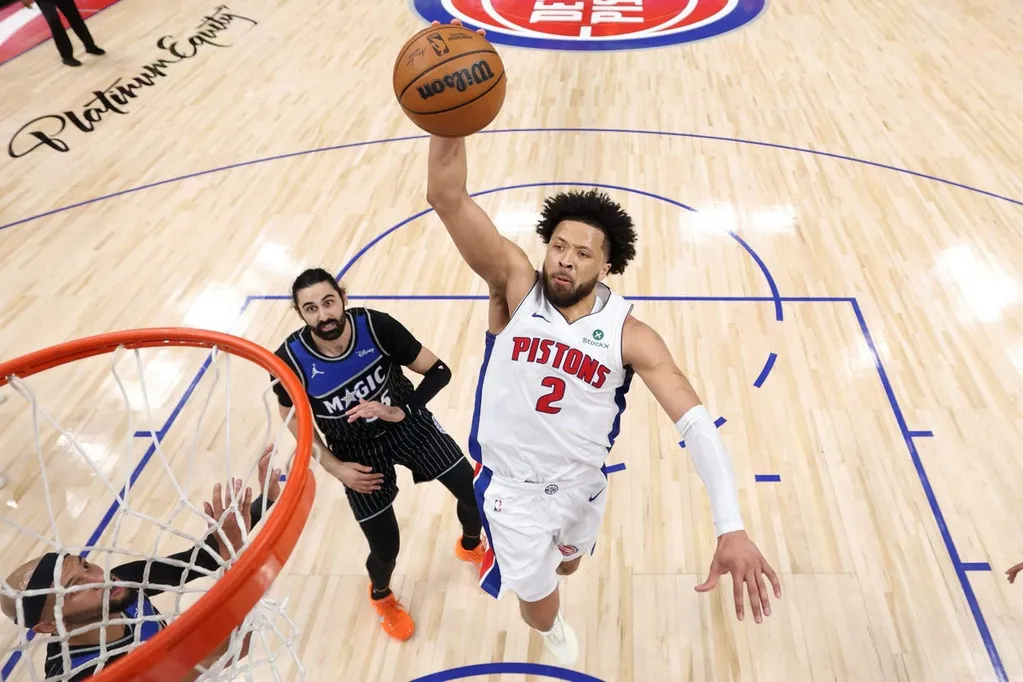
DETROIT -- Can you imagine, after Cade Cunningham's first two postseason games this year, if he still wasn't eligible for the NBA's Most Valuable Player award, or for any of the All-NBA teams?
Cunningham has become every bit the franchise player the Detroit Pistons dreamed he'd be almost five years ago, when they took him as the No. 1 pick in the 2021 NBA Draft. His magical season continued Wednesday, when he led the Eastern Conference's top seed on an incredible 30-3 run in the third quarter en route to a 98-83 win that evened the Pistons' first-round series with the eighth-seeded Orlando Magic.
He was everywhere: leading the break, throwing textbook passes to the opposite corner, finding shooters open off dribble handoffs, getting hockey assists. He fed Jalen Duren for a dunk and Tobias Harris for a floater and Duncan Robinson for a 3 -- and Duren, again, for a lob dunk. And when they couldn't get open, he scored himself.
The Pistons' defense stymied Orlando in the half court and forced multiple turnovers. Cunningham ingests such mistakes and turns them into transition opportunities he rarely fails to convert.
Game 2 for Cunningham included 27 points, 11 assists and six rebounds. That followed Game 1's 39-point effort.
Cunningham moved the game to his will, as the greatest players in the league do this time of year.
"It's the best," Cunningham said afterward. "It's what I love about basketball, honestly -- being out there, being in intense situations, making plays. I mean, we're just lucky to be here. We have the best job in the world. But then, to be in playoff basketball and to be playing for something and representing the city and all that stuff adds a lot more to it and makes it more fun."
The NBA is fortunate that the appellate process the Pistons undertook to make the case for Cunningham as eligible for the league's postseason awards was successful, as it was for the Los Angeles Lakers' Luka Dončić. Otherwise, all the morning yak/fake argument-fests on cable Thursday would feature still more excoriation of the league for its well-meaning but deeply flawed 65-game rule, which was designed to press players and teams not to keep stars out for too many games for rest or to deal with minor discomforts.
Egregious overuse of load management is one thing. But the NBA was standing on an absurd technicality in Cunningham's case. He played in 64 games, one short of the required minimum, after suffering a collapsed lung following a collision with Washington Wizards rookie guard Tre Johnson in a game on March 17. He missed the next 11 games before returning for Detroit's final three of the regular season, but fell one short, according to the rules. The independent arbitrator the league used to look at Cunningham's case determined that his punctured lung was a "condition," a source told The Athletic last week, rather than a basketball injury, leading to his winning the appeal.
He is now healthy. And dealing.
(No, I have not forgotten that Anthony Edwards, currently gimping it out for the Wolves against Denver on the knee that kept him from also hitting the 65-game minimum, had his appeal denied.)
It's one thing to dominate a January game against a tanking team -- or just one that stinks. To do it under the brightest lights and best competition, in the playoffs, brings a special aura to players who orchestrate such high-stakes games to their own syncopation.
"For us, it uplifts us, makes us go with him," forward Isaiah Stewart said. "For the other team, it's just a problem for them that they have to figure out. They changed their coverages (on Cunningham) and stuff, which helped free us up, and allowed us to make plays."
You cannot, in considering Cunningham and the Pistons, put aside the fact that just two years ago, they lost an NBA-record 28 games in a row. That season was so bad that owner Tom Gores, without hesitation, ate the remaining $65 million he owed former coach Monty Williams to pay off his contract, and brought in J.B. Bickerstaff to take over. From those ashes, Detroit has somehow pivoted, almost overnight, into this season's snarling, physical bunch that was one of the NBA's best defensive teams. It made Game 1, in which the Magic pushed Detroit around all night, even more incongruous.
The Pistons watched tape and stewed for two days. When Wednesday’s game hit the half tied at 46, Bickerstaff let his guys have it in the locker room. Someone apparently said ‘my bad’ once too often for the coach’s tastes when discussing how Orlando continually was beating the home team for offensive rebounds. Facing an 0-2 deficit, and an improbable 12th straight playoff loss at home dating back to 2008, Bickerstaff was choice with his words.
And Cunningham was equally discerning with his play. He wasn’t coming back from a sprained ankle. It got and kept his attention. The awards don’t mean as much as being back on the court, able to breathe without pain or wonder if the next hit to his ribs would put him back in the hospital.
“I’m just grateful to be here, grateful to be back, grateful to be back feeling the way I feel right now, whenever my team needs me,” Cunningham said. “So, all glory to God for sure. I just want to continue to go and represent.”
During the early afternoon hours Wednesday, the talk around the NBA centered on anything but the postseason games being played. Commissioner Adam Silver was defending the Blazers’ new owner, Tom Dundon, and the growing perception that Dundon’s frugal streak runs the approximate length of the Mississippi. Silver also suggested that while the Grizzlies would not, as LeBron James famously suggested a couple of weeks ago, be moving to Nashville, he wouldn’t mind at all if the team played some regular season games there. That was a pretty sweet call with the mayor of Memphis afterwards, I bet. There was also Charles Barkley, again railing about tanking, and the disclosure that the now-disgraced former co-founder of Aspiration was cooperating with the NBA’s investigation into the Clippers’ possible salary cap circumvention.
The Pistons’ star guard commanded the night, evened the series and brought attention back where it needs to be when the NBA is at its best -- on the court, and on the game’s elite talents.