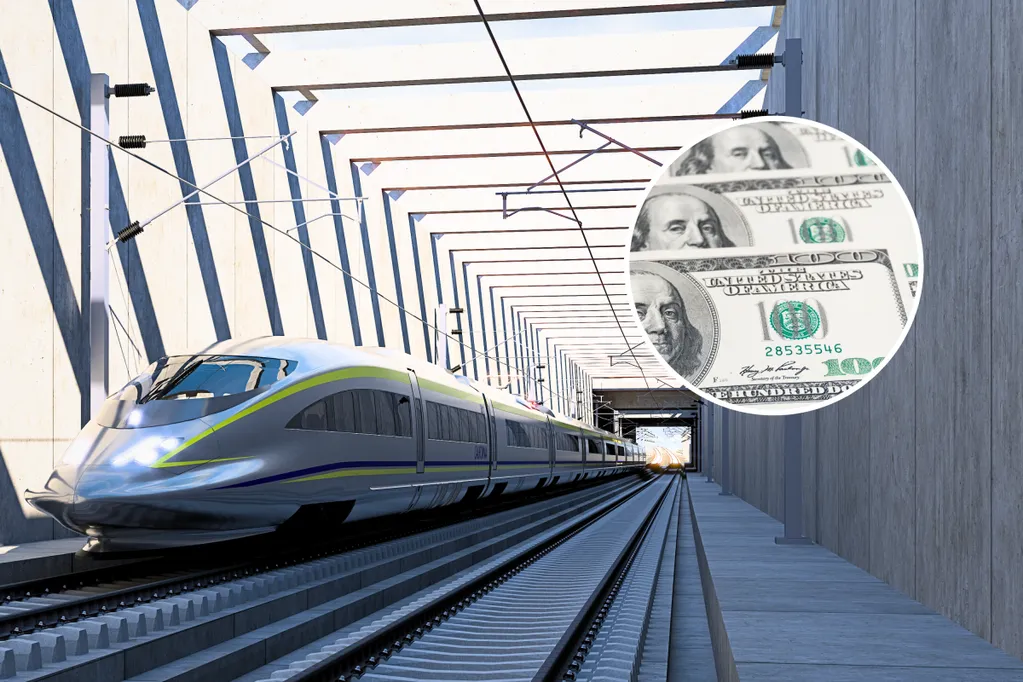
"Our country has never seen a fiscal disaster of this magnitude," independent Representative Kevin Kiley of California wrote on X on Monday, as debate reopened in Sacramento over whether the project can realistically be finished.
California officials revealed updated estimates showing the state's high‑speed rail system could cost as much as $231 billion, far above the $33.5 billion approved by voters in 2008.
The revised price tag comes as lawmakers review the California High‑Speed Rail Authority's 2026 draft business plan amid growing doubts about funding, timelines, and viability.
Taxpayers, future riders, and state budgets remain exposed as the project still lacks a clear funding path for even its next major construction phases.
Authority leaders have said attracting private investment will be key, arguing that a broader vision linking Los Angeles and San Francisco could make the system commercially viable.
Newsweek has contacted the California High Speed Rail Authority via email for comment.
The rail system was sold to voters as a tightly scoped, partially self‑funding project connecting San Francisco and Los Angeles, with strict cost and performance guarantees.
Nearly two decades later, costs have ballooned while core promises around speed, routing, and financing have steadily eroded.
Voters approved the high‑speed rail system in 2008 through Proposition 1A, which described a $33.5 billion project funded roughly equally by federal money, state bonds, and private investment.
California taxpayers were told their share would be capped at $9.95 billion, with trains carrying passengers between San Francisco and Los Angeles in under three hours, the California Globe reports.
Since then, revised business plans have repeatedly raised cost projections while narrowing the build‑out.
The first construction authorization, signed by then‑Governor Jerry Brown in 2012, released $5.8 billion for an initial Central Valley segment, including $2.6 billion in state bond funds and $3.2 billion in federal money.
No additional federal funding for the full system has been secured since.
Critics argue the project has drifted far from what voters approved.
The planned route now runs inland through the Central Valley rather than directly between the Bay Area and Los Angeles, while expected ticket prices have nearly doubled from early estimates.
Ridership projections have also fallen sharply -- from roughly 95 million annual passengers by 2030 cited in early planning documents to long‑term Authority estimates of about 36 million by 2060.
State Senator Tony Strickland said the latest revision reflects a breakdown in trust.
"What's been promised is almost like a three‑card monte saying this is only going to be $33 billion and now the total amount is $231 billion," he said, adding that lawmakers are being asked to accept constant scope and cost changes without a credible financing plan.
Strickland also questioned how the Authority plans to advance construction when current funding is insufficient even to complete the Merced‑to‑Bakersfield segment.
California High‑Speed Rail Authority officials say the project has reached a critical delivery phase and argue that its scale and economic impact are often overlooked in the cost debate.
In a previous statement shared with Newsweek via email, the Authority said the system is "the largest public infrastructure project in the Western Hemisphere," with 171 miles under design and construction and nearly 60 major structures -- such as bridges and viaducts -- already completed.
Officials say the project has created more than 16,000 construction jobs and generated nearly $25 billion in economic activity statewide.
The Authority also said the nation's first electrified high‑speed rail track and systems installation is scheduled to begin in the Central Valley later this year.
Chief executive Ian Choudri said the project now requires a long-term view similar to high‑speed rail systems elsewhere in the world.
"High‑speed rail anywhere in the world requires sustained investment and time," he said, adding that California is entering a new phase aimed at accelerating delivery and expanding into major population centers.
Choudri said the state has committed an additional $20 billion in funding through 2045 under Governor Gavin Newsom, which he described as providing stability to move construction forward and attract outside capital.
The goal, he said, is to reduce congestion and emissions while supporting long‑term economic growth.
A key focus, according to Choudri, is unlocking private investment by reframing the project around commercially viable segments.
"What we're asking is once we have private investors on board, they should be able to look at the full high-speed rail system phase one is, which is L.A. to S.F.," he said.
He added that simultaneous construction at both ends of the route could improve investor confidence.
"Can we unlock the private financiers' ability to look at the schemes of S.F. to San Jose to Gilroy and on the other end, look at L.A. Union Station?" Choudri said. "That is commercially viable and I can tell you, private sector is telling us that every day."
Despite those assurances, skepticism remains high among lawmakers, particularly after comments from Lou Thompson, the former chair of the Authority's peer review group, who recently wrote that the 2026 draft business plan shows the project "has reached a dead end."
Responding to Thompson, a California High Speed Rail Authority spokesperson told Newsweek, "These claims ignore the facts on the ground."
Transparency has also been a persistent concern.
Thousands of pages of public records were removed from the Authority's website in 2019, forcing journalists and researchers to rely on labor‑intensive public records requests to track project changes and spending.
While high‑speed rail projects around the world have a track record of going over budget, California now stands apart for the scale of its escalation.
The U.K.'s HS2 project -- often cited as one of Europe's most expensive infrastructure efforts -- was initially expected to cost about £37.5 billion for the full network.
Its current estimate for Phase 1 alone sits between £81 billion and £100 billion. Even at the high end, HS2 remains far below California's projected $231 billion total.
International data compiled by infrastructure researchers show cost overruns are common, particularly for rail megaprojects.
Studies of high‑speed rail lines in Europe found average overruns approaching 80 percent, with delays stretching more than a decade in many cases.
California's increase, however, represents a shift from a voter‑approved $33.5 billion project to one that could ultimately cost more than six times that amount.
Lawmakers are now weighing whether to continue funding the project as the Authority seeks private investors and revised timelines.
Under current projections, limited service in the Central Valley could begin in the early 2030s, with a full San Francisco-Los Angeles connection not expected until around 2040, assuming funding gaps can be closed.
For now, the project's future remains uncertain, even as its price tag continues to climb.