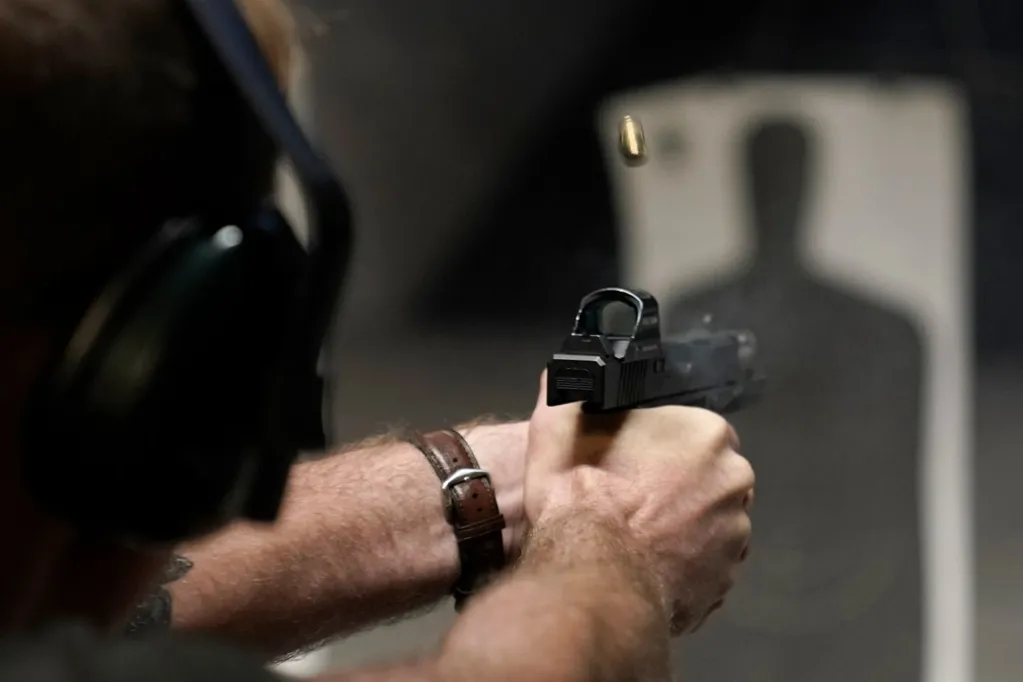
A federal appeals court on Friday struck down California's ban on openly carrying firearms in most parts of the state, ruling the restriction violates the Second Amendment.
In a 2-1 decision, a panel of the San Francisco-based 9th U.S. Circuit Court of Appeals sided with gun owner Mark Baird, finding that the state's prohibition on open carry in counties with more than 200,000 residents is unconstitutional. About 95% of Californians live in those counties, which have been subject to some of the nation's strictest gun-control laws.
The ruling partially reverses a lower court's 2023 decision that upheld the ban, which was challenged in 2019. While the panel largely agreed with Baird, it rejected his related challenge to licensing requirements in smaller counties that may issue open-carry permits.
Circuit Judge Lawrence VanDyke, appointed by President Donald Trump, wrote for the majority that California's law cannot stand under the U.S. Supreme Court's landmark 2022 decision in New York State Rifle & Pistol Association v. Bruen. That ruling, issued by the court's conservative majority, established a new test requiring gun restrictions to align with the nation's historical tradition of firearm regulation.
"This case unquestionably involves a historical practice -- open carry -- that predates ratification of the Bill of Rights in 1791," VanDyke wrote. He noted that more than 30 states generally allow open carry and that California itself permitted citizens to carry holstered handguns for self-defense until 2012.
"The historical record makes unmistakably plain that open carry is part of this Nation's history and tradition," VanDyke said.
Judge N. Randy Smith, appointed by former President George W. Bush, dissented, saying his colleagues "got this case half right" and arguing that all of California's restrictions comply with the Supreme Court's standard.
The decision is the latest in a wave of legal challenges to modern gun laws following the Bruen ruling. That case struck down New York's concealed-carry restrictions and prompted lawsuits nationwide targeting state and local firearm regulations.
California Attorney General Rob Bonta's office, which defended the ban, did not immediately respond to a request for comment. Baird's lawyer also had no immediate comment.
The state's open-carry ban applied to counties with populations over 200,000, effectively covering nearly all urban and suburban areas. Residents in smaller counties could apply for permits, but the appeals court said that distinction violated constitutional protections for most Californians.
Gun-rights advocates hailed the decision as a major victory, arguing that California's restrictions were among the most sweeping in the country. Supporters of the ban have long contended that limiting open carry reduces intimidation and helps law enforcement distinguish lawful gun owners from potential threats.
California still enforces other gun-control measures, including background checks, waiting periods and bans on certain assault-style weapons. In September, a separate 9th Circuit panel upheld a state law barring people with concealed-carry permits from bringing firearms into "sensitive places" such as bars, parks, zoos, stadiums and museums.
VanDyke's opinion emphasized that the Supreme Court's framework leaves little room for modern bans on practices deeply rooted in American history. "Open carry is not a recent innovation," he wrote. "It is a tradition that the Constitution protects."
The ruling underscores the continuing impact of Bruen on state gun laws and sets up potential further appeals. California could ask the full 9th Circuit to review the case or petition the Supreme Court for clarification on how far states can go in regulating public carry.
For now, the decision means California cannot enforce its open-carry ban in most counties, marking a significant shift in a state long known for strict gun regulations.