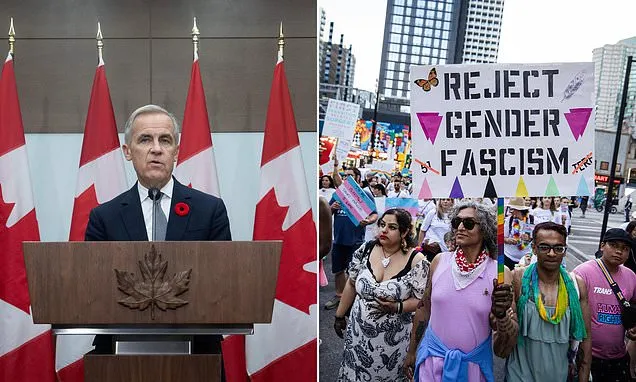
The Canadian government has been slammed for warning that referring to a transgender person by their former name is a form of 'emotional violence.'
Canada's official government website states that 'deadnaming,' or referring to a transgender or non-binary person by their birth name without consent, is an act of 'gender-based violence.'
The phenomenon is listed alongside other serious violations, such as sharing intimate images, pressuring someone into sex, assuming consent and engaging in controlling behavior.
The section titled, Women and Gender Equality Canada, also encourages people who see deadnaming in action to 'document and report' incidents.
The guidance has come under fire from critics who claim it diminishes other forms of violence especially against women and girls.
Deadnaming is presented among a series of hypothetical scenarios on the Canadian government's website which asks users to identify violence.
Before engaging, users are given a 'trigger warning' which further advises that it is 'okay to step back and focus on your safety and well-being' if the scenarios cause any upset.
'Someone from your school who transitioned and now identifies as a girl has been posting about her journey on social media,' the situation reads.
The Canadian government said calling a transgender person by their former name is considered 'emotional violence'.
The definition was included in guidance on the Canadian government's section titled Women and Gender Equality which provided hypothetical scenarios for detecting gender-based violence.
'People begin making negative comments about her appearance and deadnaming her online. When you mention it to a friend, they dismiss it as "just trolling." So - is this "gender-based violence?"'
If the user responds 'no,' the government provides a detailed explanation of the 'correct' answer.
'This is a case of technology-facilitated violence, where the person is experiencing emotional violence due to their gender, gender identity, gender expression, or perceived gender in the digital world,' the required answer reads.
'Deadnaming - using someone's former name without their consent and despite being advised of their true name - is a form of aggression that is demeaning and disrespectful, as it actively denies their identity.'
The government states that opposing the fundamental premises of gender ideology online may amount to 'technology-facilitated violence' and 'emotional violence' and urges Canadians to document such incidents.
If a trans person is referred to by their 'deadname,' the website advises reprimanding the offending person and privately checking in with the affected individual to see if they need support or comfort.
'Let her know that abuse is not okay and that it's not her fault,' the scenario states.
'She might not respond right away or may not want to talk about it at all, and that's okay - just let her know you care and are there to support her.'
Canadians are further encouraged to document and report the situation where appropriate, with the consent of the targeted individual, and to seek advice from trusted adults on how to proceed.
'Keep a record of messages, usernames, and any other relevant information. Report harmful content to the platform where it is appearing,' the explanation reads.
'Encourage her to block the individuals responsible so they can no longer contact her.'
The guidance was heavily criticized online after screenshots of the advice went viral.
'Here's a government of Canada website telling us that it's VIOLENT to "deadname" a trans person,' social media user Amy Hamm wrote on X, sharing screenshots of the website.
After Hamm shared the government page on X, the post went viral, with some users criticizing the framing and arguing that it minimizes violence against women and wrongly classifies verbal communication as violence.
'So ridiculous. There is no "emotional violence." Doesn't exist,' one comment read.
Another said: 'That's what happens when Reddit policy gets into government, never heard of that phrase anywhere but there first.'
'A poster child of a department that needs to be eliminated 100 percent,' a third response read.
A user added: 'Hurt feelings that occur from verbal communication is NOT in any way violence.'
The guidance was slammed after it went viral online with critics claiming it diminished other forms of violence against women.
'Minimizes actual violence against women,' wrote another. 'Because claiming equivalence is the goal.'
The finding follows a wave of mockery directed at a Canadian lawmaker for using the sprawling 'woke' acronym MMIWG2SLGBTQQIA+ during a press conference.
Leah Gazan, 53, a Member of Parliament, used the 17-character phrase earlier this month while condemning the $7 billion in budget cuts to two federal Indigenous departments, according to footage shared by Juno News.
She managed to smoothly reference the phrase MMIWG2SLGBTQQIA+, meaning: missing and murdered indigenous women, girls, and two-spirit, lesbian, gay, bisexual, transgender, queer, questioning, intersex and asexual.
The + represents all other identities not included in the nearly 20-character acronym.
The acronym's length and Gazan's ability to recite it flawlessly drew strong reactions online.
Some critics responded harshly, while others joked that it resembled a 'strong password' and wondered how she kept a straight face while saying it.
The Daily Mail has approached the Canadian government for comment.