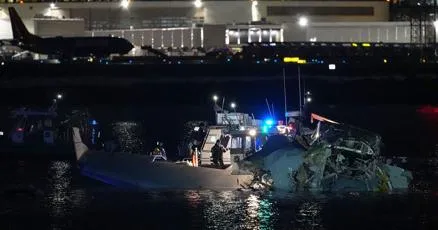
Washington (CNN) -- Multiple failures across different parts of the government caused an Army Black Hawk helicopter to collide with an American Airlines regional jet, operated by PSA Airlines, the National Transportation Safety Board concluded in a nearly 400-page report released Tuesday.
The January 29, 2025, midair collision near Ronald Reagan Washington National Airport killed 67 people, making it the deadliest commercial aviation accident in the United States in more than 20 years.
The NTSB's final report describes a chain of errors where policies and procedures in place to protect the public failed that cold, winter night.
"FAA's placement of a helicopter route in close proximity to a runway approach path; their failure to regularly review and evaluate helicopter routes and available data, and their failure to act on recommendations to mitigate the risk of a midair collision" were cited as part of the "probable cause" of the crash.
The board also placed blame on an "overreliance" on pilots visually looking out for other aircraft "without consideration for the limitations of the see-and-avoid concept."
The helicopter crew had been warned by the air traffic controller to look out for the jet and confirmed they saw it moments before the crash. It's not clear whether they saw the plane or mistook another aircraft for the jet.
The NTSB added the cause of the crash also included air traffic control's "degraded performance" because two positions had been combined in the tower, and there was no "risk assessment process ... which resulted in misprioritization of duties, inadequate traffic advisories, and the lack of safety alerts to both flight crews."
The report noted the Army's share of the cause was a failure to train pilots on the margin of error of altimeters, which show altitude, leading to the helicopter flying above the allowed height.
"These answers demonstrate that this tragedy was a result of many systematic failures, and that failed everyone on Flight 5342 and the Army helicopters and the air traffic controllers. This is part of a larger trend where we have to be the ones that put a stop to this," said Sen. Maria Cantwell, ranking member of the Senate Commerce, Science, and Transportation Committee at a hearing last week.
The incident heightened public attention to the safety of air travel in 2025 -- a year punctuated by the dramatic crash of a Delta Air Lines regional jet landing in Toronto and the fiery crash of a UPS cargo plane taking off from Louisville, Kentucky.
NTSB investigators formally made 50 safety recommendations in the final report, including 33 of them directed to the FAA.
The recommendations call for the aviation agency to implement time limitations for air traffic control supervisors, improve training, limit some commercial air traffic at busy airports, improve crash avoidance technology and amend helicopter route design criteria.
Within weeks of the January 29 crash, Trump administration officials announced changes to helicopter routes around Washington, addressing two of the NTSB's urgent recommendations. A multibillion-dollar overhaul to an aging air traffic control system was also promised.
While the NTSB cannot force the adoption of its safety recommendations, the board advocates for their implementation to prevent another crash.
One key subject of several recommendations involves improving crash avoidance technology. The report found "limitations" of "collision alerting systems on both aircraft" contributed to the accident.
The board has long urged all aircraft to have systems that would show pilots if another aircraft was getting dangerously close. In January's crash, the Army helicopter had a system to transmit its position, called "ADS-B Out," but it was turned off. The regional jet was transmitting its location with the system but neither aircraft had a way to receive information from the other. Equipping planes with "ADS-B In" could show pilots other aircraft nearby and help avoid them.
A few days before the one year anniversary of the incident, the NTSB held an hours-long board meeting to describe every failure on that night.
"This was preventable. This was 100% preventable," said NTSB Chair Jennifer Homendy during the meeting.
“They would have (seen the helicopter) with ADS-B In (and) gotten an alert at 59 seconds before the collision and been able to take measures to avert it,” she continued later during the board meeting. “For the helicopter crew, they had 48 seconds. They didn’t even know -- it is clear from the (cockpit voice recorder) they didn’t even know it was on the left.”
Sen. Ted Cruz, chairman of the Senate Commerce, Science, and Transportation Committee, has called for the system to be implemented on all aircraft. Sens. Cruz and Cantwell have co-sponsored a bill that would mandate the technology, but it awaits a vote from the House.
"The pilots would have been warned of each other's exact position nearly one minute before impact, and 67 people would still be alive today," Cruz said last week in the hearing.