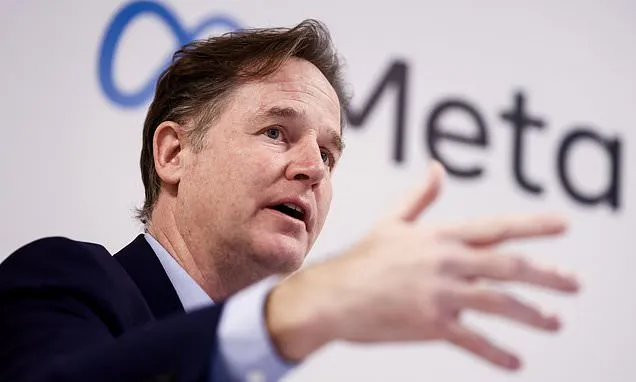
Former deputy prime minister Sir Nick Clegg has called for tougher regulation of tech firms - a year after he quit his high-earning job at Facebook parent firm Meta.
The ex-Liberal Democrat leader is reported to have made almost £15million from the sale of shares in Meta during his time as the tech giant's president of global affairs.
He has now branded social media a 'poisoned chalice' and the rise of AI a 'negative development'.
Sir Nick warned that engaging with 'automated' content appears to be 'much worse, particularly for younger people's mental health' than interactions with other humans.
He also criticised the 'TikTokification' of apps like Instagram, which is also owned by Meta.
The former MP said users were being 'bombarded' by short-form videos 'plucked from the deepest, darkest recesses of the internet'.
The comments mark an apparent shift in tone from Sir Nick, who announced he was leaving Meta in January last year.
The previous month, Sir Nick had hit out at the EU's 'needless regulatory complexity and delay around AI rules'.
He said these were holding up his plans to train Meta's AI models using people's public social media posts.
Sir Nick had previously criticised those who were 'dwelling on largely nonsensical fears' about AI.
In his latest comments, made during an evidence session of the cross-party Independent Commission on Community and Cohesion, Sir Nick said: 'If I was a regulator or actually in politics - I've always thought this actually, even when I worked in Silicon Valley - I would be way tougher with the big companies on the transparency that they must provide on these algorithmic systems which otherwise chop and change.'
He added: 'The recent advent of generative AI is doing something very, very profound, and in my view, potentially actually very negative when it comes to social media, because it means, actually, these apps are no longer social at all.'
'So if you use Instagram today, you are bombarded by short-form video recommendations, which are algorithmically recommended at you, plucked from the deepest, darkest recesses of the internet, because the system, the increasingly sophisticated AI system, thinks that you might look.'
Sir Nick continued: 'It's the TikTokification, if I could put it like that, of social media, which is very, very different to the social media that I, at least, was interested in when I moved to Silicon Valley in the autumn of 2018; which was human-generated content, and human beings using these apps to communicate with each other.'
'I think it is becoming an increasingly automated experience, where people are increasingly receiving, in a passive way, algorithmically recommended content, and that the content itself will increasingly be synthetic, too.'
'I think that is, in general terms, a negative development, because there is quite a lot, again, of clear academic evidence that passive consumption of content on social media is much worse, particularly for younger people's mental health, than interaction with other human beings via social media.'
Sir Nick said he still appreciated the 'democratising' effect of social media and that simply removing online platforms would be 'devastating' for users like small businesses.
But he added: 'Having said all of that it's a bit of a poisoned chalice, because that individual empowerment... comes, of course, with dramatic, excessive centralisation and aggregation of power in the hands of the small number of men who run these west coast and increasingly Chinese-based global behemoths.'
'So it is a really difficult trade-off in terms of power, because these apps generally tend to be quite individually empowering, but they also come at the cost of an immense amount of power being put in the hands of people who are not elected by anyone; and as we've seen have become increasingly active certainly in American politics.'
The commission was set up with the aim of examining and addressing community divisions across Britain in the wake of the 2024 summer riots.
It comes amid a furious row over the use of Grok - an AI tool embedded into social media website X - to create sexually explicit content, including child sexual abuse.
X last week limited Grok's image generation and editing features to only paying subscribers of the site.
But this only sparked further fury with X owner Elon Musk accused of 'monetising abuse' in a move that was branded 'insulting to victims' by Government ministers.
Ofcom is now carrying out an official investigation into X under the Online Safety Act, with ministers not ruling out banning the site once the regulator's probe is completed.