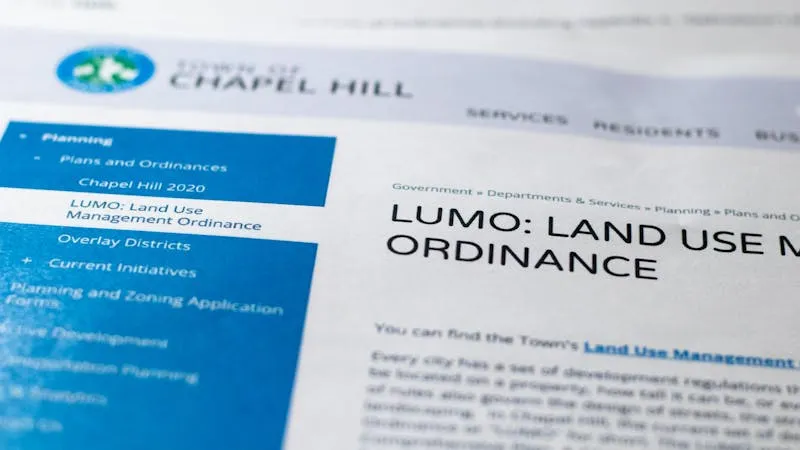
On Nov. 19, the Chapel Hill Town Council rejected amendments to the Town's Land Use Management Ordinance in a 4-4 vote. Had they been passed with a majority vote, the amendments would have loosened zoning requirements for duplexes, removed the minimum parking area requirement for new projects and reduced the concept plan review stage.
Chapel Hill Town Council members Theodore Nollert, Camille Berry, Paris Miller-Foushee and Melissa McCullough voted in favor of the amendments. Town council members Adam Searing and Elizabeth Sharp, alongside mayor pro tem Amy Ryan and Mayor Jess Anderson, voted against them.
The Town is currently rewriting the LUMO based on recent research findings and public feedback, and plans to consider adopting the new ordinance in spring 2026.
Nollert said that he was disappointed with the outcome of the decision. He said he feels that there must be changes to the LUMO to address issues of affordability and housing in Chapel Hill.
"I have been frustrated that we have not been able to act with more urgency to get a new LUMO to make amendments that will plug some gaps in the short term," Nollert said.
In the current LUMO, only single-family homes are exempt from the requirement of a maximum floor area of a building. One amendment would make two-family homes also exempt from this maximum floor area regulation.
Geoffrey Green, a member of Chapel Hill's planning commission, said the changes could have encouraged the construction of duplexes and multi-family homes.
"In 2023, the council voted to permit duplexes in all districts where single-family uses were allowed, and it was an important step," Green said. "However, it has also been an ineffective step, thanks to some of the restrictions that were placed on duplex developments."
Another amendment would have removed minimum parking space requirements for buildings of all uses. According to the ordinance, this change would make it easier to approve development projects and help achieve Chapel Hill's vision of reducing car dependency, as outlined in the Chapel Hill 2020 comprehensive plan.
Staff also proposed making the concept plan review stage optional in order to streamline the development process. Currently, all special development proposals require the developer to create a concept plan and present it for review to the town council and planning commission, with sections for public comment.
Chapel Hill resident Jennifer Layton said she did not know much about the LUMO before having issues with the Hillmont development project behind her house, which she said caused several trees to fall into her property.
Layton spoke during public comment at Wednesday’s meeting. However, she said that opportunities for public input can be inaccessible for some people, and that there is not always a simple resolution to a complicated process.
“I think it’s a little scary,” Layton said. “Because it does add the one chance you’ve got to try to stick up for your neighborhood and say, ‘Hey, have you thought about this? Have you thought about that?’”
Ryan was one of the council members that voted against adopting the ordinance amendments. She said that there were only a few parts of the amendments that the council disagreed on that prevented the ordinance from passing in its entirety.
“It’s been a long time,” Ryan said. “We’ve had some issues with the consultant, and it was supposed to be done long before this. So I understand why staff wants to bring us pieces instead of waiting to get the whole thing accomplished, because we really do want to move forward.”
The LUMO will remain as it is until the amendments are revised and presented to the council again in January.