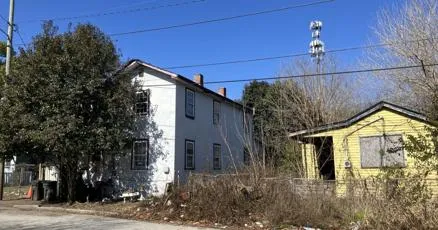
CHARLESTON -- City officials are eyeing two homes on the peninsula's East Side that they want to buy -- or condemn -- for affordable housing.
The properties at 74 and 76 Stuart Street back up to parcels the city is already in the process of purchasing from the International Longshoreman's Association. The site along Morrison Drive and Huger Street is earmarked for redevelopment as part of the city's ambitious plan to add 3,500 new affordable units by 2032.
On Feb. 5, City Council's Community Development committee unanimously authorized city attorney Julia Copeland to pursue the acquisition of the two Stuart Street properties "by all means necessary, up to and including condemnation."
City Council voted similarly back in June to take control of 76 Stuart Street, the larger of the two homes, where Copeland said there has been a "high level of police activity."
Last year, there were nine emergency calls to that address, according to information provided by the Charleston County's Consolidated Dispatch. The nature of the calls include "suspicious" activities, disturbances in progress or warrant service.
A man who said he lives in the two-story white cinder block home at 76 Stuart Street told the Post and Courier Feb. 6 that his sister owns the property and has told officials that she's not interest in selling.
The city's attempts to find the listed owner of 76 Stuart Street have been unsuccessful, Copeland said. She suspects that it may be considered heirs' property -- land that lacks a clear title because it's been passed down informally through many generations without a will.
The home built in 1935 last changed hands in 1975, according to online Charleston County property records. With three bedrooms and one bath covering about 1,600-square-feet, the home and property is valued around $300,000; property records show its 2025 tax bill totaling nearly $560 is overdue according to county tax records.
Next door at 74 Stuart sits a single-story yellow bungalow built in 1910 that Copeland said has been boarded up and is unoccupied. The two-bed one-bath home is less than 1,400-square-feet and valued around $280,000 according to property records. Owned by an LLC in good standing, the home appears dilapidated and has an outstanding tax bill of over $3,600.
Before condemning a property, it must first be appraised, Copeland said. Then the city will offer to buy it at fair market value.
The city has allocated $1.375 million for the purchase of "nuisance properties" on the East Side, according to a presentation shown during the Community Development meeting. The money comes from funds generated by the Cooper River Bridge TIF, or tax increment financing, district.
If the sales are unsuccessful, the city will then condemn the homes, and the people currently living there will likely be evicted, Copeland said.
Condemnation isn't a process that the city takes lightly, or often, she said.
"You just have to have a valid public purpose in order to condemn property," Copeland said.
In this case, she said, the dire need for affordable housing serves the public purpose.
The last time the city officials condemned property was two years ago when City Council agreed to pay $2.75 million for a tiny piece of waterfront property between Joe Riley Waterfront Park and the East Bay Dog Park.
Deja Knight McMillan, spokeswoman for the city, said the plan would be to renovate the historic homes and put them back on the market as part of the city's Homeownership Initiative that aims at helping people with moderate incomes own homes on the increasingly unaffordable peninsula.
Nearby, the city is slated to close on the $18 million purchase of 899 Morrison Drive on March 30, according to Mayor William Cogswell. The 2.5-acre parcel includes a building that houses the union's pension and welfare fund and a parking lot that serves Taco Boy. Combined those two leases bring in about $30,000 per month.
This site is vital to the city's affordable housing strategy and will house tenants from nearby Charleston Housing Authority properties while they are redeveloped -- another key part in achieving the housing goal the city set.