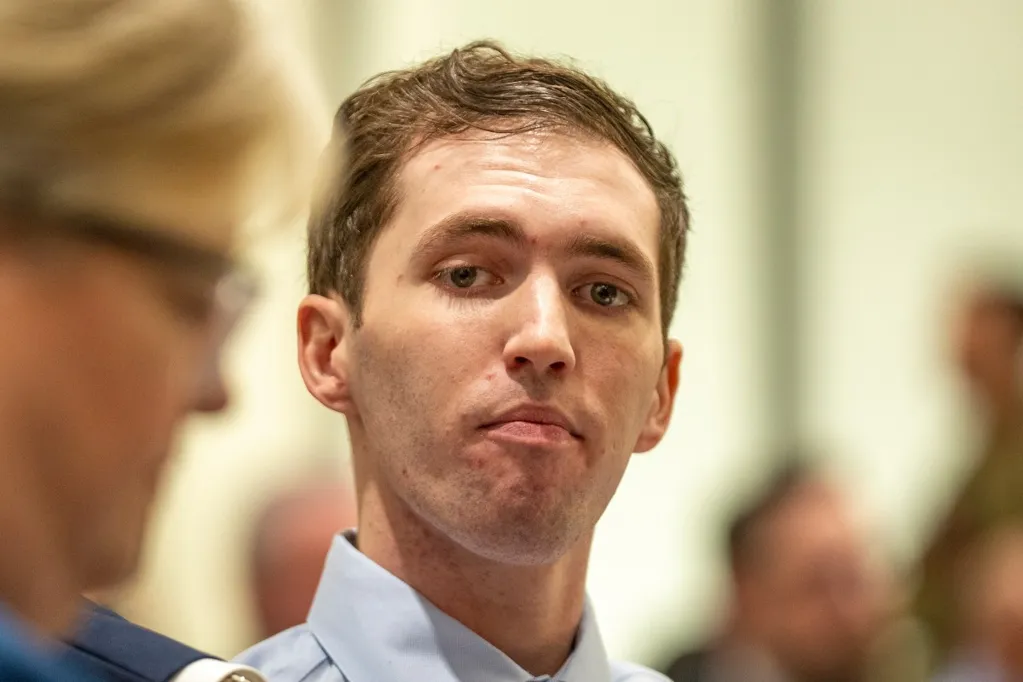
A transcript from a closed-door hearing in the capital case against Tyler Robinson, the man accused of killing conservative activist Charlie Kirk, is now publicly available.
On Sunday, Fourth District Judge Tony Graf Jr. announced that the court would release a partially redacted hearing, which took place on October 24. He said only 246 words were removed from the 80-page transcript.
On September 10, Kirk, 31, was fatally shot at Utah Valley University in Orem, Utah, during a question-and-answer session on campus. Days after the shooting, authorities arrested 22-year-old Robinson, whom officials said had confessed to the crime to his father. He is in custody on charges of aggravated murder, obstruction of justice and felony discharge of a firearm.
Attorneys representing several media outlets, including the Associated Press, had asked the court to make details of the sealed proceeding public, arguing that transparency was needed to maintain confidence in the judicial process.
In the hearing, Richard G. Novak, Robinson's defense attorney, asked for Robinson to be unshackled so he could take notes. He also asked for permission for him to appear in "civilian clothing."
He said: "Most of the hearings in this case will be public. And so for the public -- and I'm not even talking about cameras and microphones, especially cameras -- to see Mr. Robinson shackled at the feet, at the waist, at the hands, absent an individualized determination by the Court, offends the dignity and decorum of the courtroom."
Novak argued that Robinson posed no risks to people in the courtroom or himself, and that the courtroom was not a jail.
He said the case would be publicized by the media and could sway people's views about Robinson, adding: "He should not be depicted as a jail inmate. He should be depicted as a citizen of the United States with a presumption of innocence."
Deputy Utah County Attorney Christopher Ballard, a prosecutor in the case, said it was easier to identify Robinson in jail clothing when there were a lot of people in the room. He said the judge could ban the media from discussing Robinson's clothing to avoid affecting perceptions of him during the trial.
Days after the hearing, Graf ruled that Robinson could appear in civilian clothes but said he had to wear restraints for safety reasons.
Novak also raised concerns about the level of publicity surrounding the case and the affect it would have "on the fairness" of Robinson's trial.
Richard G. Novak, Tyler Robinson's defense attorney, said during the hearing: "We, meaning Mr. Robinson and his defense team, are very concerned that the nature, content, scope, pervasiveness, of the pretrial publicity, of the statements that have already been made by law enforcement officers, by lawyers, by the representatives of the state in this case, may have a significant impact on the fairness of his trial."
Prosecutors plan to seek the death penalty, and a preliminary hearing is scheduled to begin in May. Robinson has not entered a plea.