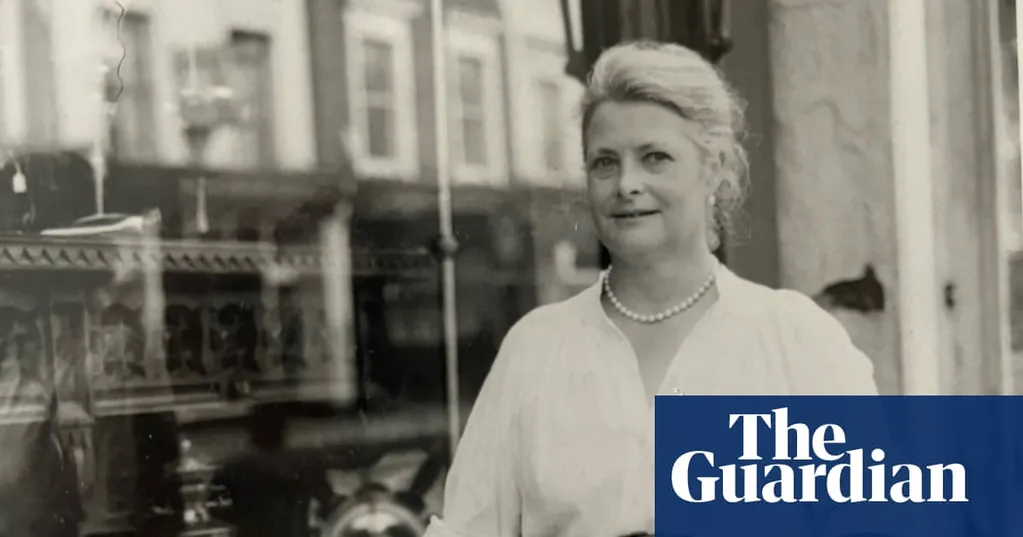
The art historian Charlotte Gere, who has died aged 88, encouraged a generation to appreciate life, paintings and works of art of the 19th century. In publications ranging from her groundbreaking Victorian Jewellery Design (1972) to a recent article, Home, Studio and Beyond: The Social and Professional Worlds of Six Victorian Artists, in the Clark Art Institute's exhibition catalogue A Room of Her Own (2025), she had an astonishing ability to capture the zeitgeist and captivate audiences. Many of her books became standard texts, frequently reprinted and cited.
The breadth of her reading gave Charlotte a profound understanding of the historical context in which objects were created, interior spaces conceived, and fashions in dress took hold; she was knowledgeable about society, taste and etiquette, and the circles in which the moneyed classes moved. But she was just as intrigued by the kitchens in grand houses and the introduction of mechanisation to ameliorate domestic conditions.
The daughter of Margaret (nee Cuthbert) and Charles Douie, Charlotte was born in London into a family with a background in the Indian civil service - her grandfather, Sir James Douie, served briefly as lieutenant governer of the Punjab. Her father was secretary of University College London and a writer known for The Weary Road, a memoir of his first world war service.
Charlotte was educated at Langford Grove school in Sussex and the Slade School of Art in London. In the mid-1950s she worked at the British Museum as an indexer in the Department of Prints and Drawings, where she met her future husband, John Gere, then assistant keeper of Italian drawings. They married in 1958, and together went on to create a collection of landscape oil sketches, currently on loan to the National Gallery.
In 1959 she met Charles Handley-Read, the pioneer collector of Victorian art and design, who was assembling material for a biography of the gothic revival architect William Burges (which was never realised). They became friends and in 1968 he recruited her to his team of helpers, tasking her with finding Burges's jewellery. At that time, no jewels by Burges had surfaced - they were known only through design drawings. Handley-Read particularly wished to trace the jewel created for the marriage in 1872 of Burges's great patron, the third Marquess of Bute, to Gwendolen Fitzalan-Howard. There was a preliminary sketch of it in one of Burges's notebooks but that was all. "Find it," he said to Charlotte in 1968 and she did, tracking it down to Spain with the help of the Bute family archivist.
It was because of that request, as she put it, that she "dared to embark on the study of Victorian jewellery design". She worked for Handley-Read until his death in 1971. Subsequently Charlotte recognised further Burges jewels, unidentified, in the salerooms. More appeared when Geoffrey Munn (with whom she authored Artists' Jewellery: Pre-Raphaelite to Arts and Crafts in 1989) made an appeal on the BBC's Antiques Roadshow, and she turned the rediscovery into a riveting detective story; it was the last of her publications to appear, in the journal of the Society of Jewellery Historians in October 2025.
In 1969 the Fine Art Society (FAS) organised an exhibition of the Birmingham School of artist-craftsmen, a subject with which she had a strong connection since four of the artists were members of John Gere's family. Charlotte was surprised and flattered to be asked to write the introduction; the cataloguing was a collaboration with Peyton Skipwith. A succession of projects with the FAS followed, including Architect-Designers: Pugin to Mackintosh (1981), written with Clive Wainwright of the V&A and Michael Whiteway, the foremost dealer in Victorian design. Subsequent books with Whiteway, Nineteenth-Century Design (1993) and on the designer Christopher Dresser (2004), were to follow.
She returned to the British Museum, this time as a staff member, from 1978 until 1981, to catalogue and display the newly arrived gift of 1,200 pieces of mainly 19th-century jewellery from Anne Hull Grundy, a formidable collector who knew Charlotte's books and had specified that Charlotte was to be involved. Neither the two-volume catalogue nor the display were easy tasks. Polaroids, then the only way of obtaining an immediate printed image, could not capture the detail adequately; so Charlotte sketched the layouts, some with up to 90 jewels, on A4 sheets, with such accuracy that each piece was clearly recognisable for the staff to pin them in place.
Her exhibition skills, coupled with her sensitive teamwork, brought her back to the museum in 1992-94 to help plan a new 19th-century gallery. A third stint as a volunteer in 2013-14 saw her reorganising and cataloguing the museum's collection of more than 2,000 prints of Queen Victoria.
If Charlotte believed something needed doing, she often did it herself. As editor in the 1980s of the journal of the National Art Collections Fund (now the Art Fund), she was behind the publication of The Fine and Decorative Art Collections of Britain and Ireland: The National Art Collections Fund Book of Art Galleries and Museums (1985), written with Jeannie Chapel, a 360-page guide with scholarly descriptions and detailed index.
Her geographical reach was as wide as her knowledge, and her projects ranged from editing a volume on European Decorative Arts at the World's Fairs for the Metropolitan Museum of Art in New York to an exhibition of watercolours of 19th-century interiors for the Musée de la Vie Romantique in Paris. A foray into Victorian fairy painting for a 1997 exhibition at the Royal Academy proved wildly popular. Her book Great Women Collectors (1999) with Marina Vaizey preceded the wave of gender studies of the 2000s.
Charlotte was elected a fellow of the Society of Antiquaries in 2005 and appointed OBE in 2003. She shared her knowledge generously and was a remarkable mentor to younger scholars and curators, often over decades. Many in key positions in museums and other institutions owe her their careers.
At her death a long article, The Botanical World in Victorian Jewellery, which she and I co-wrote, was with the editor. The relationship between the garden and the domestic space fascinated her. In her own garden in Chelsea, west London, the flowers and plants were carefully chosen yet delightfully informal. Friends would be given jars of home-made rosemary hair rinse. A special gift might be an exquisite watercolour painting of her own, depicting roses, gooseberries, or a frieze of grasses, all in minutely observed detail thanks to her training in botanical painting at the Chelsea Physic Garden. She was never happier than in her garden.
John died in 1995. Charlotte is survived by a son and daughter, a granddaughter, a step-granddaughter and two step-great-grandsons.