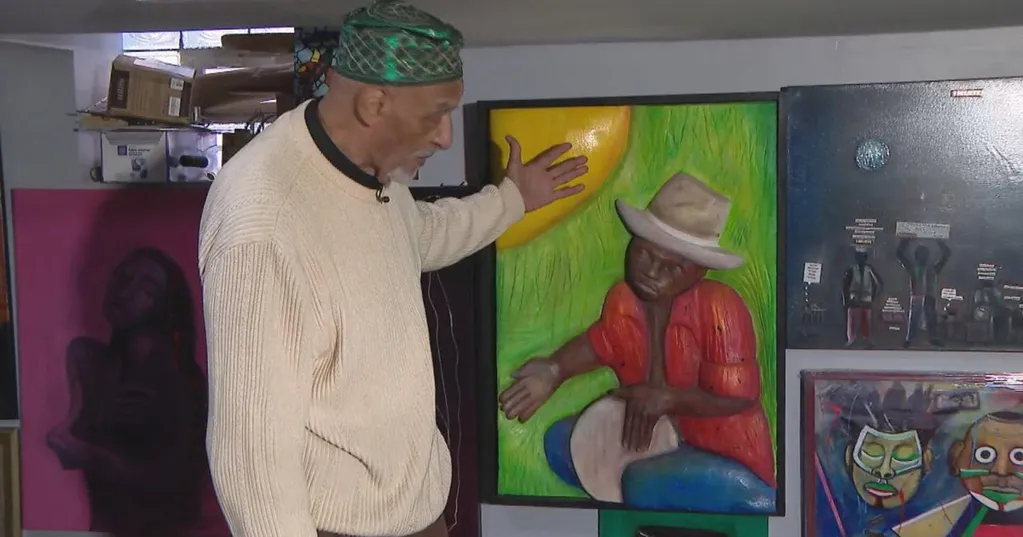
A Chicago artist and musician has seen it all and done it all; among his many qualities are curiosity and kindness.
Sura Dupart grew up in Bronzeville at 46th and Langley as one of 11 children.
"Wonderful time, very creative people," he said.
His family's creativity was the foundation for Dupart's life's work. His mother and sister played the piano. His father was a skilled carpenter who helped build the Ida B. Wells Homes.
Dupart took "the good stuff" from them all, mastering two forms of expression.
"I'm a musician, too, but I've always been interested in art all my life," he said.
Now 85 years old, Dupart came of age in the turbulent 1960s, when racial tensions exploded and voices cried to be heard. Dr. Martin Luther King Jr. came to Chicago to fight for equality in housing, education, and more, but Dupart also saw inequality in art.
"The whole plight of being a Black man on the South Side of Chicago, that inspired me," he said. "There was a lot of art there, but it was unrecognizable."
Dupart turned his frustration into determination. It started with painting and explorations in color - the brighter the better.
"I like abstracts, things just got a lot of color in it, because it's free," he said. "When you do portraits, things like that, you've got to have much more insight."
Then he ventured into sculpture.
"I learned metal sculpturing and got involved in wood sculpturing and then in stone sculpturing," he said. "You can take a piece of wood, put it in your hand, and all of a sudden you see something. It's a learning experience. I think in time, it improves. The more you do, the better it gets."
Back in the day, Dupart also was one of the original "Sun Drummers," who played music along beaches on the South Side.
"When I was 23, I said, 'Oh man, I'm going to be an artist and a musician,'" he said.
These days, you can find him doing his thing at the Woodlawn Tap in Hyde Park, with his band "Side Pocket Experience."
The only thing more noticeable about Dupart than his talent is his modesty. He won't tell you about his success, so we will.
In 2013, one of his sculptures won first place in a Black History Month competition at the Museum of Science and Industry. Another sculpture graces a school on the South Side.
There are so many more, but Dupart said what means the most to him is sharing his good stuff with others.
"If you pay attention in life, and you see something that you can do, either educate them or stimulate them to be a better person," he said. "They might have opportunity to do something good in their life, and that might inspire somebody else."