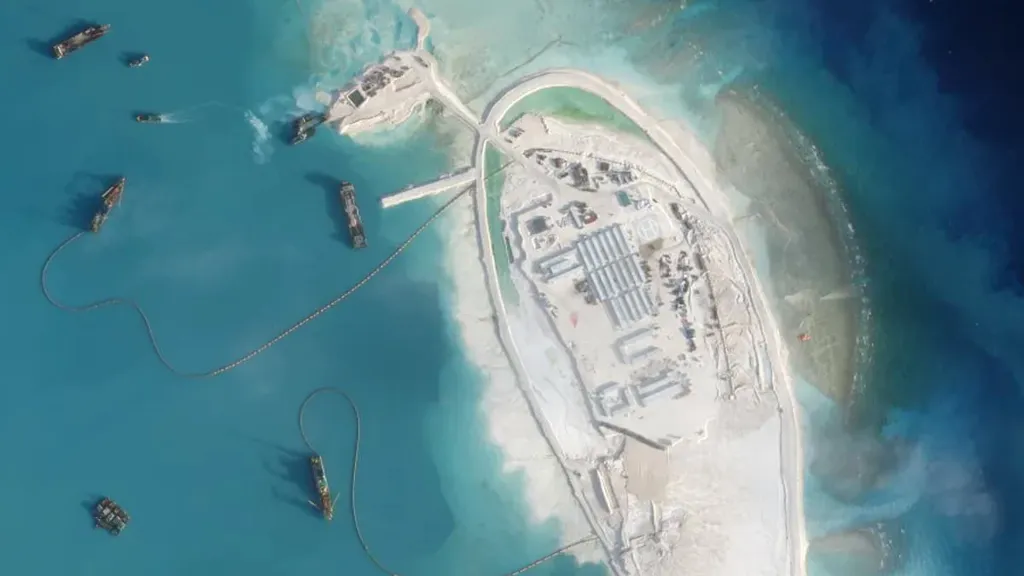
China have appeared to ramp up work on the Great Wall of Sand as dredgers get to work on turning disputed islands into military bases in the South China Sea.
New satellite images show more than 20 dredgers at work, picking up sand and mud from the seabed and bringing it onto the surface to lay a foundation for new construction.
Despite a 2015 pledge to stop the expansion, Work is taking place around the Antelope Reef, which forms part of the Paracel Islands and is also claimed by Vietnam and Taiwan.
Just two dredgers started the work on the island at first in December, but photographs now show a fleet of 22 high-tech 'dark dredgers' working on what one report describes as a 'massive industrial campaign'.
China claims virtually all of the South China Sea, but has had territorial disputes with neighbouring countries in the busy sea, which have been particularly concerned by the land reclamation projects.
Since 2014, China has been proactively strengthening its claims by transforming the islands and reefs into military bases.
Long runways have been built on three of the Spratly Islands; Fiery Cross Reef, Mischief Reef and Subi Reef, as well as on Woody Island in the Paracels.
The bases are also equipped with hangars and radar, meaning they are capable of deploying military aircraft across the South China Sea.
New satellite images show more than 20 dredgers at work, picking up sand and mud from the seabed and bringing it onto the surface to lay a foundation for new construction.
Despite a 2015 pledge to stop the expansion, Work is taking place around the Antelope Reef, which forms part of the Paracel Islands and is also claimed by Vietnam and Taiwan.
They have temporarily hosted anti-ship cruise missiles, have surface-to-air missiles and have hardened shelters capable of holding missiles. Their airfields are also capable of receiving fighter jets, the Times reports.
In 2015, China said it would stop militarising such bases in such way; however, this appears to have now resumed with work on the so-called Great Wall of Sand appearing to be ramping up.
'This activity at the reef appears to have already created several square kilometres of new land, with significant reclamation visible across more than 15 square kilometres of the once-empty reef,' said a report by the London-based Open Source Centre.
It added: '[A] modest start has since expanded into a massive industrial campaign ... these developments suggest reclamation activity is intended to extend across the reef's full length and will likely evolve into a multi-purpose outpost to enhance China's military presence in the region.'
China seized the Paracel Islands in 1974 from South Vietnam, a few months before its civil war defeat to North Vietnam.
Antelope Reef acts as a stepping stone between China's large Hainan island and Woody Island, whose airstrip hosts fighter jets and surveillance aircraft.
Beijing claims almost all of the 1.2million square miles of the South China Sea, a body of water vitally important to global trade and security, belong to it.
Under authoritarian President Xi Jinping, Beijing has continued to expand its reach into the South China Sea's strategically vital and resource-rich waters bordered by several Southeast Asian nations.
Each of these countries, including the Philippines, Malaysia, Brunei and Vietnam, all lay claim to different parts of the sea and a litany of small islands, shoals and reefs adrift within it.
But China insists it should own virtually the entire sea and its strategic outposts, including swathes of territory within the 200 nautical mile Exclusive Economic Zones (EEZs) off the shores of all its island neighbours.
At the heart of the tensions between China and the Philippines lies a scattering of rocks, shoals, reefs and atolls across the South China Sea, most notably the Spratly Islands and Scarborough Shoal, over which both countries assert sovereignty.
The Philippines bases its claims on proximity and the United Nations Convention on the Law of the Sea (UNCLOS), under which most of the contested features lie within its EEZ.
China, meanwhile, claims almost the entire sea via its so-called 'nine-dash line', a sweeping boundary drawn on a map in the 1940s that has no legal basis under international law.
That illegality was confirmed in 2016 when a Hague-based tribunal ruled overwhelmingly in favour of the Philippines, declaring China's claims invalid.
Western governments, including the UK, will regularly carry out 'freedom of navigation operations', sending ships close to the islands in a symbolic rejection of China's claim to the islands.
Just two dredgers started the work on the island at first in December, but photographs now show a fleet of 22 high-tech 'dark dredgers' working on what one report describes as a 'massive industrial campaign'
Long runways have been built on three of the Spratly Islands; Fiery Cross Reef, Mischief Reef and Subi Reef; as well as on Woody Island in the Paracels. The bases are also equipped with hangars and radar; meaning they are capable of deploying military aircraft across the South China Sea
Last September, HMS Richmond and USS Higgins passed between Taiwan and mainland China on Friday; prompting fury in Beijing.
Beijing accused the two allies of undermining peace in the region; saying that the move amounted to 'harassment and provocation'; according to military spokesman Senior Colonel Shi Yi.
But a spokesperson representing the British and American alliance said the two ships sailed through international waters.
It is not just China turning islands in the South China Sea into military air bases as Taiwan has one on Taiping Island; the Philippines on Thitu; and Malaysia on Swallow Reef.
Vietnam also has a 1,300m runway on Spratly Island and is looking to overtake China as it builds new land and military facilities at a rapid pace.
Images published last year by a United States think tank show that artificial land has been used to expand all 21 Vietnamese-occupied rocks and sandbanks in the Spratly Islands.
Earlier this week, 11 jobs advertised as 'community workers' were listed by the local government body that administers the South China Sea to work on eight of its reefs and islands.
This includes Woody Island, the administrative centre of the disputed territories.
The job description says that candidates should be aged between 18 and 35 years old, have a university degree, be 'dedicated to island and community service' and be physically and psychologically adaptable.