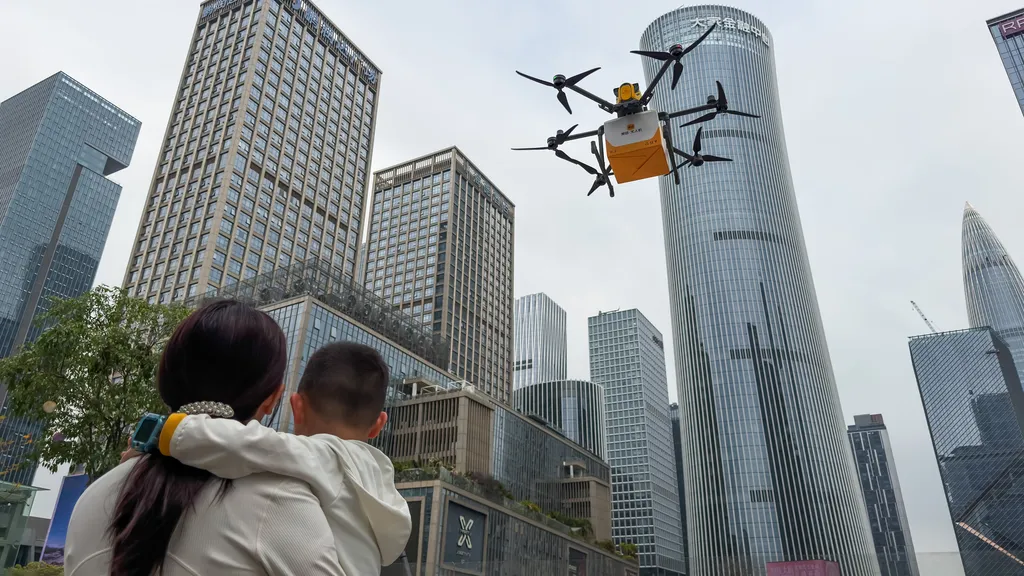
The Chinese government tightened rules to curb what it described as illegal drone use, but some users say the changes are now restricting too many flights.
China dominates the global drone industry. But it is fast becoming one of the toughest places to fly one.
New regulations are sharply tightening rules for recreational and civilian operators. Since January, officials have ramped up the penalties for unauthorized flying of drones to include possible jail time. Starting in May, all drones must be registered with the owners' real names, requiring operators to link their flight equipment to their official identification or cellphone number.
Permits will be required at least a day in advance in restricted zones, which cover most cities. The rules make an exception for small drones flying below 400 feet in some open areas, but those areas are very limited.
Flight data will also be transmitted to the government in real time.
Last week, the city government in Beijing went a step further, adopting a near-total ban on drones within the capital's limits. Under the rules, also set to go into effect in May, drones or their key components may not be sold, rented or brought into Beijing. People entering the city from other provinces will have their bags inspected.
Existing drone owners will be exempt if they register their drones with the police by April 30, though they are also prohibited from having more than three drones at the same address. Drones for special functions, like counterterrorism and research, may be granted exceptions.
China has required drones to be registered and limited to certain areas since 2024. But as the crackdown has escalated in recent months, many drone users say overzealous enforcement has grounded most flights, even for what they believe are legitimate uses. Chinese social media platforms are filled with accounts of users being questioned, fined, detained and having their drones confiscated by the police across the country.
The crackdown has prompted a meme on Douyin, TikTok's Chinese sister app, featuring a parody of a marketing slogan by the Chinese drone giant DJI -- "Don't let the sky wait too long" -- recast as "Don't let the police wait too long." A clip featuring the track has been liked and shared more than 60,000 times.
As of the end of 2025, China had more than three million registered drones, according to official statistics, a 50 percent increase from 2024.
The Ministry of Public Security said that tighter regulations were necessary to protect public safety, noting the risks of drone information systems being hacked as well as incidents in which drones had flown at a high altitude, even threatening civil aviation safety. It cited a case in which it said an operator had flown a drone within 800 meters, or about 2,600 feet, of a civil aircraft, and another in which it said a user had flown a drone into a no-fly zone near an airport to film planes' landing paths. Last year, two drones collided midair and crashed onto a Shanghai skyscraper.
"The skies are not above the law,"
the ministry said.
Officials also said the rules would help pave the way for China's "low-altitude economy," the term the government has used for its plans to expand commercial drone usage for purposes including food delivery, power line maintenance and farming. Those plans were highlighted in China's latest five-year plan, the Communist Party's economic road map.
Because the government wants to maximize the economic potential of low-altitude airspace, it must first create a better management system for that space, said Li Mo, the director of the Low-Altitude Economy Research Center at the Hong Kong University of Science and Technology.
"Much like tidying the living room before hosting guests, we need to first put the airspace in order before embracing larger-scale, low-altitude economy activities,"
he said, though he acknowledged that the restrictions could cause short-term confusion.
China may also be weighing potential national security risks. The wars in Ukraine and Iran have made clear the damage that even inexpensive drones can do.
The effectiveness of consumer drones in Ukraine to conduct surveillance and strikes "undoubtedly raises concerns in Beijing about this risk to the physical security of its senior leaders," said Drew Thompson, a former Pentagon official who is now a senior fellow at Singapore's S. Rajaratnam School of International Studies.
(China, as the world's largest consumer drone manufacturer, has also been a major supplier of drones or their components used in those conflicts. Beijing says that it strictly controls the export of so-called dual-use objects like drones that can be used militarily, but Ukrainian officials say Chinese companies have cut them off while still supplying Russia.)
As the crackdown widens, a dozen drone users reached by The New York Times said the rules were hindering routine and lawful flights. Most agreed to speak on the condition of anonymity for fear of harassment from the police.
Cat Yang, a Shanghai resident, said she received preliminary approval from the city government for her school-age son to fly a drone, but she was denied final clearance on the day of the flight. She said the police had offered no explanation. “The police even made fun of me, telling us to buy a toy instead,” Ms. Yang said.
Another drone owner, from northern China, said that he had submitted more than three dozen applications, but that only two were approved.
Those approvals were limited to flights below 30 feet and within line of sight. He said the authorities had told him to obtain additional consent from a military airport they said was in the vicinity. When he tried to call the airport, no one answered.
In Beijing, two residents said they received calls from the police as soon as they powered on their drones, even before the city's new rules were announced. Another said officers had come to their home to ask about drones they had not flown in years.
The rules have chilled the market. Multiple drone dealers have told Chinese media that their business has fallen precipitously in recent months, while online listings for used drones have surged.
DJI, the world's biggest drone manufacturer, is also facing pressure abroad. The United States moved in December to ban foreign-made drones on national security grounds, barring new DJI products from the market. DJI responded with a lawsuit in February, seeking to overturn the decision. (The company did not return a request for comment.)
Some experts have called for more flexibility. The chairman of Xpeng, a Chinese electric vehicle manufacturer that is investing in flying cars, recently proposed delegating some airspace management to regions, rather than the central government, to better stimulate the low-altitude economy.
In an online video, Wang Yadi,the president of a drone-related business groupin Huainan,a city in Anhui Province,notedthe conundrum facingthe industry:"We haven't developedthe low-altitude economy yet,but alreadythe sky is locked up."
A 35-year-old drone enthusiast based in northeastern China said he had invested about $2,000 in his DJI drone and related equipment, hoping to start a photography business. But after more than two dozen flight applications were rejected, he abandoned the plan.
Song Zhongping, an independent military commentator in China, offered a different argument for why the government should loosen up: Expanding access to drones would help nurture a reserve of drone operators for future wars.
"If ordinary people can use drones and practice using them in peacetime, that will greatly help in selecting more skilled drone operators during critical moments,"
he said.
Vivian Wang contributed reporting. Siyi Zhao contributed research.