April 17 (Reuters) - As U.S. Vice President JD Vance returned to Washington last weekend after unsuccessful peace talks in Pakistan over the crisis in the Gulf, China's Foreign Ministry was preparing for a bumper slate of visitors including Russian Foreign Minister Sergei Lavrov and the leaders of Spain, Vietnam and the United Arab Emirates.
With the U.S. this week declaring its own military "blockade" of the Strait of Hormuz, and Iran continuing to demand cryptocurrency payments to guarantee vessels' safe passage, Beijing is stepping up diplomatic efforts to present itself as a wider global power broker.
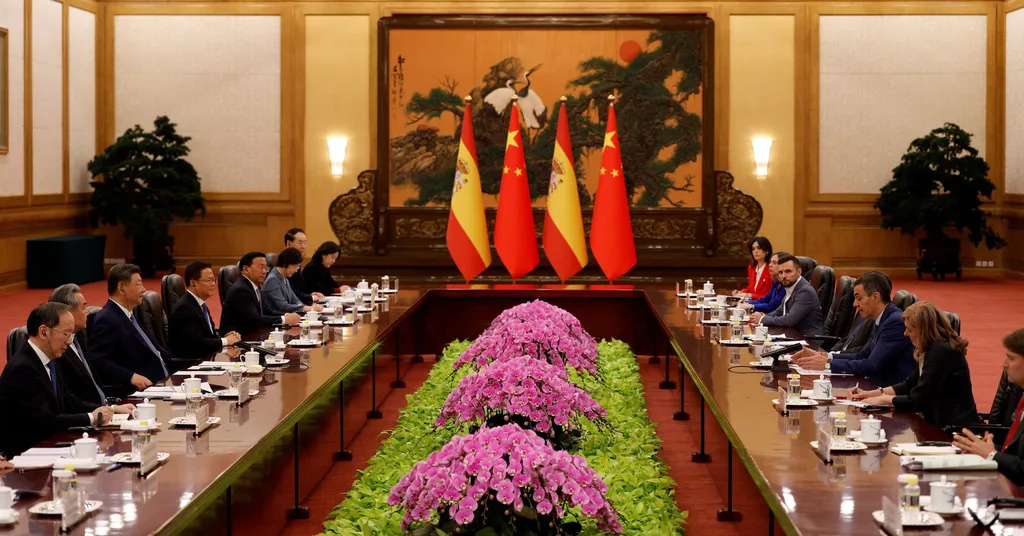
That includes presenting itself as a global voice of sanity and stability against a "regression to the law of the jungle", as Xi put it on Tuesday as he met Spanish Prime Minister Pedro Sanchez.
But it also includes tough military and diplomatic messaging in Beijing's immediate environment, where it has further escalated growing tensions with Japan, moving vessels to prevent the Philippines from reaching a long-disputed shoal, and an assertive and very public outreach to Taiwan's opposition Kuomintang party ahead of 2028 elections.
In the process, Beijing has subtly but swiftly redefined its primary Taiwan narrative and, perhaps even more importantly, its timescale for potential future action.
Whereas U.S. officials have warned for years that Beijing has been building up its military with the explicit goal of being ready to invade by 2027, China's new narrative has refocused attention on Taiwan's election the next year, pushing harder than ever the concept that a Kuomintang victory would avert conflict and offer much closer relations.
If the incumbent Democratic Progressive Party wins again, Beijing is now setting the tone for further confrontation - on one hand, pushing any future U.S. administrations to abandon the island to its fate; on the other, tearing up relations with Japan over its comments on the future of Taiwan.
The reasons are not difficult to see. Official Chinese statements have blamed new Japanese prime minister Sanae Takaichi, particularly for comments in November that a Chinese takeover of Taiwan might constitute a "survival-threatening" situation for Japan.
Chinese officials and news outlets are also expressing concern that Tokyo might look to acquire nuclear weapons - something that might make it almost impossible for China to risk an attack against Taiwan or indeed Japan itself.
Takaichi's government says it remains committed to Japan's non-nuclear status. But it is keen to strengthen international relationships wherever possible, inviting more than 30 ambassadors from NATO and other nations to Tokyo from Wednesday to step up cooperation in defence and a host of other areas.
On almost every other front, however, Beijing is making diplomatic inroads. In a heavily promoted meeting in Beijing last week, new Kuomintang leader Cheng Li-wun pledged to invite Xi to Taiwan if she wins the 2028 election.
Meanwhile, the DPP government is working on its own defences, nervously eyeing a repeatedly postponed Trump-Xi summit for signs that the Chinese leader might press the U.S. to dial down its support for Taiwan, perhaps in return for help in calming the Gulf.
BEIJING SEEKS 'CAREFUL LISTENERS'
Exactly what Beijing is up to when it comes to Iran remains vague; Chinese officials and media outlets have so far angrily denied CNN reports that Beijing has given Tehran weapons in the current crisis. Other analysts note that, as when supporting Russia in Ukraine, China prefers to deliver "dual use" civilian components that can be used in arms manufacture rather than delivering whole weapons or systems.
U.S. President Donald Trump has pledged to impose new tariffs on Beijing if arms shipments are proven, a move that would further damage already dwindling global growth. The prospect of letting the rest of the world blame the U.S. for the current global mayhem, meanwhile, is something China is grabbing with both hands.
U.S. behaviour, not only in the Middle East but also over Greenland, has made much of Europe reappraise its relationship with Washington. European Union foreign policy supremo Kaja Kallas described U.S. actions in the Middle East as second only to Russia's invasion of Ukraine in its damage to the international system.
Whether that prompts European and other nations to embrace Beijing, however, is an open question. Britain criticised Russia and China together for vetoing a U.N. Security Council resolution from Bahrain condemning Iran's obstruction of ships in Hormuz and demanding the strait be reopened.
Trump's decision to impose his own blockade this week - with its implication that U.S. warships will intervene to stop Chinese and other vessels carrying Iranian and other energy - seems to have played into Beijing's hands, just as his import tariffs did, by allowing China to grab the agenda as a supporter of free trade.
Some Chinese pundits now enthusiastically predict more of this to come: the Trump administration grabbing the headlines while, behind the scenes, a whole new architecture of international relations takes shape in which nations work around the U.S. to try to secure their vital interests.
It is an environment in which many incidents and confrontations of considerable importance go almost unreported, from Pakistan's military clashes with Afghanistan to suspected Iranian drone strikes on energy infrastructure in Azerbaijan, a nation that has become increasingly critical to European energy supplies in recent years.
"China is increasingly seen by many as a major country that has consistently emphasised peace, development, sovereignty and dialogue," Chinese international relations academic Mabel Miao Lu wrote in the Communist Party-run Global Times this week, after returning from the Baku Global Forum in Azerbaijan. "That does not mean all concerns about China have disappeared. It does mean that more people are listening carefully when China speaks."
LESSONS TO LEARN FOR CHINA AND OTHERS
The lesson Beijing would most like the rest of the world to learn might be that when or if China's military moves to take control of Taiwan - either because it has been invited in by the Kuomintang or because Xi's patience has finally run out - the rest of the world should not get involved, whatever Japan or the U.S. might do.
At the same time, many countries will have concluded that action such as that taken by the U.S. in Iran, or Russia in Ukraine, triggers massive and immediate global dislocation - and, although the energy shock of conflict in the Gulf has been profound, the supply shocks of a major war in the Pacific could be far worse.
While the U.S. may not have gained what it wanted from Operation Epic Fury, as with strikes on Tehran's nuclear programme last June, the Pentagon has delivered a lesson to other potential foes that the U.S. military retains a level of expertise in complex operations that Beijing has never trialled in anger.
Xi's confidence in his own military may only be mixed at best judging by the number of senior military commanders removed in recent months and years - although China's sheer manufacturing capacity may still keep Pentagon planners up at night their worries compounded by recent high usage of limited precision weapons stocks.
Beijing's other major problem is that so far at least Taiwan's always complex politics may not move in the direction that it wishes. It is far from clear whether KMT leader Cheng's embrace of Beijing will win over voters—and even if it does her language of rapprochement still stops well short of calling for annexation by China.
Nor is it clear that Beijing will do better in its efforts to isolate the new government in Tokyo where for now it looks to be making little if any progress. European and Pacific nations' worries about future U.S. policy have if anything made many of them more enthusiastic than before about working with Japan or South Korea.
Beijing has also yet to find its own way through the Gulf situation. Chinese-owned and -flagged oil tankers have periodically made it through Hormuz - but at nowhere near the pre-crisis rate. And the global supply chains on which China also depends are already looking rocky.
Beijing may yet have to reach some kind of deal with Washington as it struggles to extricate itself from another Middle East war - perhaps even through the so-far deadlocked U.N. system - to pressure Iran to let more ships through.
The Middle East crisis has without doubt created opportunities for China but also delivered warnings for an ambitious coming superpower.