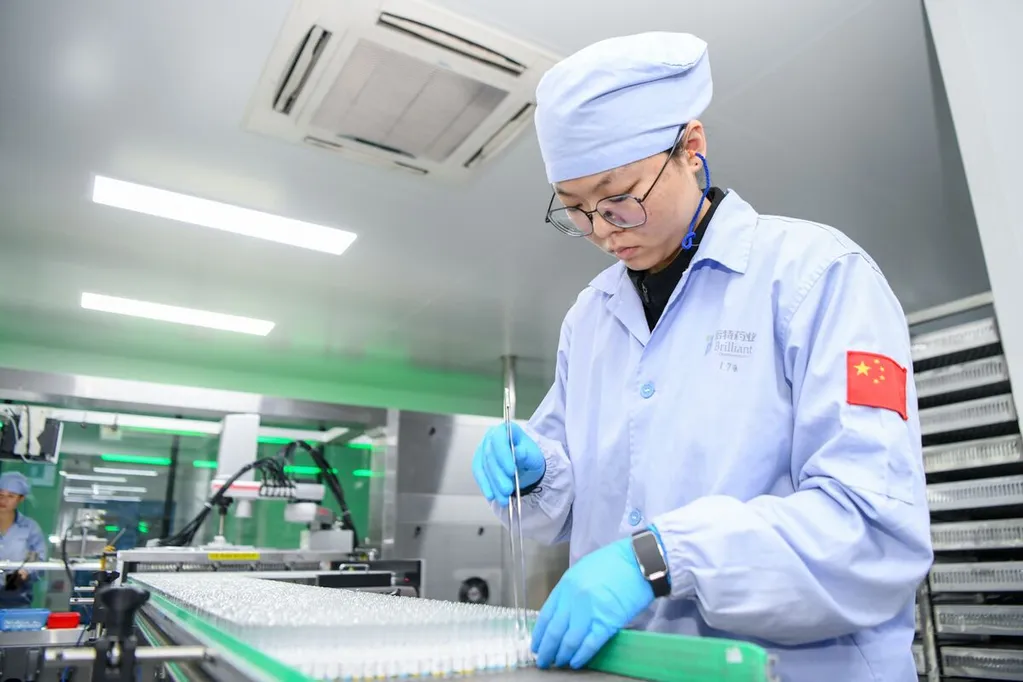
The old pharmaceutical order anchored around cutting-edge advances from the West has quietly disappeared. What we have now is a bipolar industry centered on the US and China—with implications for patients and policymakers worldwide.
China has closed the gap on the number of research studies being conducted and, in certain cases, even moved ahead on developing new treatments. Global drugmakers understand this shift very well—having inked hundreds of billions of dollars in deals over the past five years to license promising Chinese innovations for sale overseas to replenish their coffers.
US President Donald Trump, in particular, needs to reconsider the wisdom of demanding another year of cuts to America's biggest science agencies—which fund research that can eventually seed commercial breakthroughs—and the resulting brain drain of top scientists. Strategic rival China is putting technology, including pharma, front and center of its economic plan. It outspent the US on R&D as early as two years ago, according to the Organization for Economic Co-operation and Development.
Those investments have fueled a furious pace of growth. Chinese early-stage drug programs, which affect future approvals and capital-raising, numbered around 800 in 2015, according to a study published last month by the prestigious Journal of the American Medical Association. By 2024, they exceeded 6,000—up more than 600%. During the same period, the number of projects in the US grew from around 5,000 to 7,000; however, its global share of such programs declined from half to a third.
That trajectory continued into 2025, according to data crunched by the study's co-authors So-Yeon Kang and Yunan Ji of Georgetown University. While full-year figures weren't available, China overtook the US in the second quarter. Chinese growth was the main driving force in the near-doubling of such research projects globally over the past decade.
There are many reasons for China's meteoric rise in the pharmaceutical sector, a trend that has gotten much less media attention than Beijing's ambitions in semiconductors or artificial intelligence. Its potential to improve global health outcomes, including new obesity treatments that may be more effective than Ozempic, can't be overestimated.
The country has a vast pool of patients, enabling clinical trials to be completed at half the cost in a shorter amount of time. Regulatory reforms have streamlined the approval process for all drugs. A growing number of researchers trained overseas have returned. And Western pharmaceutical companies have come courting with capital to support a system originally conceived with public funding. Last year, a record $133 billion in licensing deals were signed, up from $50 billion in 2024, according to Bernstein Research.
Although the Georgetown researchers focused on the quantity rather than quality of research, other studies suggest that China is making inroads in frontier biotechnology. In 2025, for the first time, it launched more novel medicines—substances that work in ways not previously used to treat disease—than any other country, according to pharmaceutical intelligence provider Citeline.
The US has the overall edge, for now, in quality. According to Rebecca Liang and Ellie Li of Bernstein Research, 17% of China's total pharma development pipeline last year was composed of so-called "first-in-class" treatments—pioneering drugs that employ entirely new ways of treating diseases, often serving unmet needs—compared to 37% in developed markets. Still, Liang told me, that gap is shrinking.
All of this will likely result in better and cheaper medicines. But overseas patients could face delays in accessing new drugs. Western doctors may not participate in early trials running in a country with a largely homogeneous population. As a result, regulators will have to ensure additional studies are conducted on diverse populations before approving treatments.
As with anything at the intersection of the US and China, geopolitics is likely to come into play. In order to burnish its global credentials as politically stable, Beijing should refuse to weaponize its pharmaceutical supply chains, for example by limiting the export of raw materials used to make medicines. Washington should refrain from enacting restrictions on treatments of Chinese origin. But the US must also beef up its own long-term research efforts to better compete with a surging rival.
China's influence will only grow. The world needs to find ways of channeling those innovations to improve access to effective treatments for all.