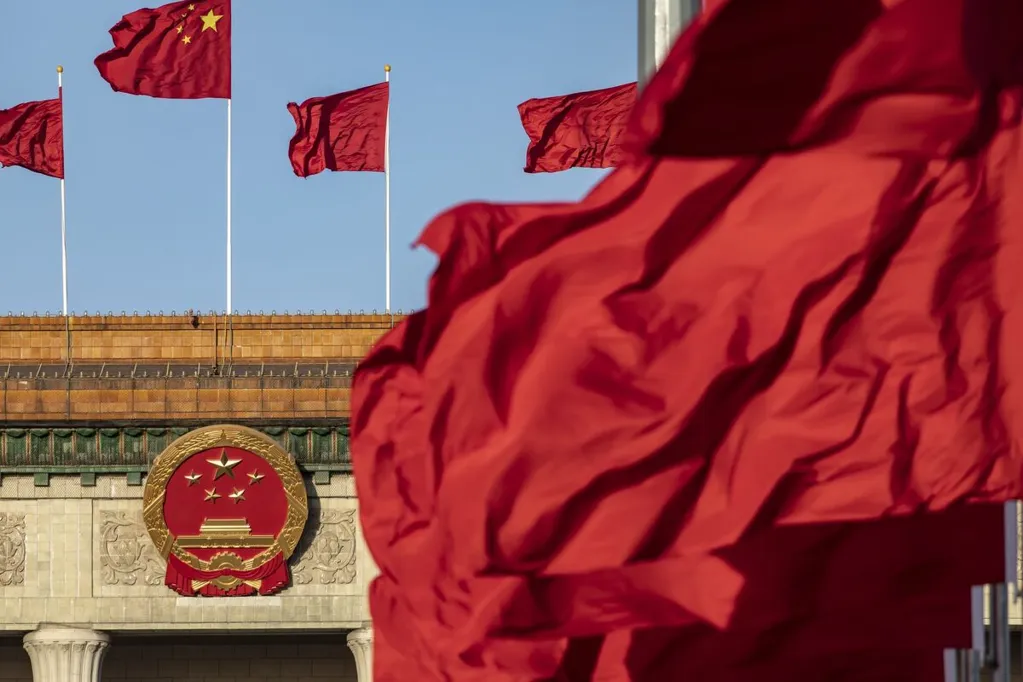
China kicks off its most important annual political meeting next week, with investors seeking clarity on how Beijing intends to press ahead with its tech ambitions while reviving a fragile consumer economy.
At the weeklong gathering of the National People's Congress starting March 5, officials are expected to set a 2026 growth target of 4.5% to 5%, down from around 5% in recent years -- a sign leaders may tolerate slower expansion as a property slump and deflation continue.
The meeting takes on added importance as policymakers will outline priorities tied to a new five-year plan. Investors will look for details on how Beijing intends to support innovation and rekindle momentum in Chinese stocks, which surged last year thanks to AI but have been subdued this year. They'll also be seeking concrete measures to boost domestic demand -- an oft-repeated goal that's light on specifics so far.
The policy meeting "could provide a fresh catalyst for stocks, which have been lackluster this year amid a lack of policy support," said Marvin Chen, a strategist at Bloomberg Intelligence. He noted that cyclical and property stocks have historically delivered the strongest gains in the month following the event.
Here are the key areas traders and analysts are watching ahead of the meeting:
Technology
From DeepSeek in early 2025 to a surge in robotics shares, tech stocks have powered China's market rebound. Investors are now seeking reassurance that the rally still has further to run.
An AI "scare trade" has rattled tech shares globally, triggered by potential disruptions to the economy. In China, the pressure has fallen on traditional Internet giants, with money moving out of Alibaba Group Holding Ltd. and Tencent Holdings Ltd. into smaller firms seen as more direct AI beneficiaries like MiniMax Group Inc. and Knowledge Atlas Technology JSC Ltd.
"Technology will remain a key focus for capital allocation," according to a note by China International Capital Corp. Beyond established AI supply-chain leaders, the analysts see potential winners in cloud computing, smart driving and quantum technology.
Consumption
Reviving domestic demand has been a consistent theme in recent high-level policy meetings. The shift comes as more countries push back against China's cheap exports, raising the pressure on Beijing to rely less on external demand.
"We see meaningful likelihood of enhanced consumption support that goes beyond consumer durables," said Homin Lee, a senior macro strategist at Lombard Odier in Singapore.
Investors rotated into consumer sectors earlier this year amid concerns about stretched tech valuations, but the rebound proved short-lived in the absence of a sustained pickup in consumer demand and prices.
The CSI 300 Consumer Discretionary Index and CSI 300 Consumer Staples Index both rank among the least favored sub-sector gauges in China this year.
'Anti-Involution'
China launched the "anti-involution" campaign in 2025 to curb cut-throat competition marked by overcapacity and price wars. The government pushed industries such as solar and electric vehicles to shift their focus toward quality and innovation, rather than mere volume.
Early signs show the drive is gaining traction. Prices in parts of the solar and materials supply chains have rebounded, and shares of photovoltaic companies have climbed to near a two-year high.
While excess capacity remains an issue, UBS Group AG says the campaign could help steer the economy toward a reflationary environment in 2026.
Still, investors will be weighing policymakers' resolve to keep curbing excess capacity while balancing growth and employment pressures.
Property
A multiyear property slump has been a major drag on China's economy, and reversing that would require much stronger policy intervention. Officials will likely reaffirm support for a new development model centered on higher-quality housing and market stabilization, with further easing likely left to local governments, according to Citigroup Inc.
Shanghai recently eased homebuying rules, and Beijing and Shenzhen are expected to follow suit.
Morgan Stanley analysts including Stephen Cheung cautioned it may be too early to turn positive, flagging risks of policy disappointment at the NPC, more profit warnings and a renewed slide in home sales.
Bonds
In the bond market, attention will be on the fiscal budget and how much supply pressure government issuance may create, especially at the long end. Beijing is expected to ramp up sales of ultra-long special sovereign bonds to support domestic demand and stabilize growth. Morgan Stanley estimates issuance could reach 1.5 trillion yuan ($219 billion), up from 1.3 trillion yuan last year.
China's yield curve has already steepened on accommodative monetary policy and larger debt quotas. The spread between 30- and 10-year government bond yields widened to more than 40 basis points at the end of 2025, from 24 basis points a year earlier, reflecting concerns about supply-demand imbalances in longer-dated debt.
Yuan Internationalization
The Communist Party's proposal for the next five-year plan through 2030 included a pledge to "push forward the internationalization of the yuan." That's a bolder stance compared with the previous plan, which called for advancing the goal in a "stable and prudent" manner.
Investors will look for signals on how China plans to capitalize on waning confidence in the US dollar and advance Xi's ambition for a "powerful currency." The onshore yuan remains near a three-year high against the greenback, despite a modest pullback after the People's Bank of China's latest effort to cool the rally.