Industry Insight from Ethical Corporation Magazine, a part of Thomson Reuters.
April 21 - "It's a crazy crop, and a crazy market," says Belinda Borck, public affairs lead at Tony's Chocolonely, reflecting on the rollercoaster ride that cocoa prices have experienced over the last three years.
From an average price of around $3,000 a tonne, prices quadrupled to $12,000 a tonne by the end of 2024, only to drop back to pre-hike levels today.
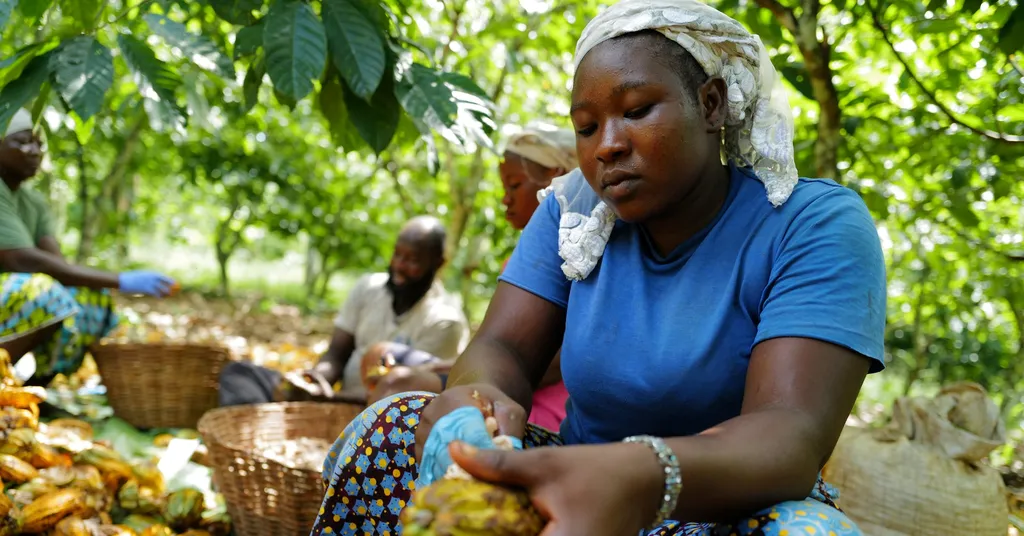
This volatility has left the millions of smallholder farmers who grow 80%-90% of the world's cocoa reeling, as manufacturers cut back on the size of the chocolate bars they produce and the amount of cocoa they use while consumers buy less chocolate.
A previous glut has also left farmers with unsold stockpiles of beans, while state regulators in key producing nations such as Ghana and Ivory Coast, which set cocoa prices, have struggled to keep up with the volatility, recently setting high farmgate prices that cocoa buyers have shunned.
It's little surprise that the latest edition of the annual Chocolate Scorecard dedicates a whole section to what it calls the chaos of the chocolate sector.
Produced by Be Slavery Free, a coalition of civil society organisations, the scorecard describes a sector under pressure on numerous fronts, as illegal mining destroys farmland, higher temperatures and disrupted rainfall caused by climate change affect growing seasons, and crops are attacked by a huge rise in pests and diseases.
The UK Cocoa Coalition has been set up to bring some stability and resilience to the market by pushing for the introduction of the UK Forest Risk Commodities Regulation (UKFRC).
The UK is one of the world's largest markets for chocolate confectionery, and the coalition brings together leading traders, manufacturers and retailers with a UK footprint, including Ferrero, The Hershey Company, Barry Callebaut, Tony's Chocolonely and Marks & Spencer, alongside NGOs including the Rainforest Alliance and Fairtrade Foundation.
The regulation is part of the Environment Act 2021 but has been ignored by successive governments; delays that the coalition says have deterred investment in supply chain traceability. It will place a requirement on the importers, processors and retailers of "forest-risk commodities" to prove that they are not linked to illegal deforestation.
Secondary legislation is required to make the regulations operational. It is expected to apply to businesses that import over 500 tonnes of key "forest-risk commodities" per year. According to a government statement in 2023, these would include cocoa; though the coalition is seeking confirmation that cocoa will be included.
Borck says while individual companies are already acting to protect forests and strengthen farmer livelihoods, working together in a coalition is the best way to solve the sector's long-term problems. "Companies can't solve illegal deforestation and ongoing human rights violations alone, but with strong, aligned legislation, we can shift the system together," she says.
Importantly, she adds, the coalition wants to avoid over-burdening smallholder farmers with the cost of compliance by sharing responsibility across the supply chain, with companies supporting producers through fair pricing, investment and meaningful engagement.
Owen Gibbons, senior manager for global advocacy and public affairs at Rainforest Alliance, points out that cocoa farmers are the least resilient actors in the supply chain. They work on the front line of the climate crisis and suffer disproportionately from market volatility.
Voluntary standards and certification schemes can only achieve so much, he continues, which is why the coalition is pushing for greater due diligence to become mandatory in the UK.
Adopting the regulations chimes with corporations' current desire for accountability and transparency, which they recognise as essential for maintaining their social licence to operate and consumer trust.
"The UK is home to leading chocolate brands and millions of consumers who want confidence that the products they buy are not driving the destruction of vital forests," he says.
In a statement, a spokesperson for Ferrero said, "Action by a handful of companies, while important, will not deliver the scale of change needed; mandatory due-diligence legislation can both create a level playing field and mobilise the entire value chain around the same ambition, unlocking far greater collective impact."
"Meeting regulatory requirements, such as deforestation-free sourcing and enhanced due diligence, relies on capabilities like farm-level traceability and strong supplier engagement."
To help minimise trade barriers and compliance costs, the coalition is also pushing for the legislation to align with the EU Deforestation Regulation (EUDR), which is due to be implemented by the end of the year.
Borck says this is an opportunity for the UK to catch up and even exceed the EU, and to ensure the UK doesn't become a "dumping ground" for illegal cocoa.
Research by Be Slavery Free shows that just 73% of cocoa currently entering Europe is deforestation-free, with over one million tonnes coming from deforested and unknown sources.
Co-director Carolyn Kitto said in an email that companies are starting to abandon farmers who aren't compliant with EUDR, leaving them without support or alternatives.
Instead, Kitto wants to see more companies investing in farm traceability systems, such as farm polygon mapping and GPS data collection, as well as training for farmers in what the new regulations actually mean.
"Several companies have adopted explicit policies of keeping non-compliant farmers in their programmes, placing them on support pathways rather than excluding them," she explains.
That doesn't make the problem disappear, she adds, because they don't just stop growing cocoa; "They sell into opaque markets with no monitoring, no support and no incentive to protect forests."
"Companies that invest in farmer readiness aren't being charitable - they're being smart. A traceable, supported supply chain is a resilient one," she adds.
Borck says that the last couple of years have been unprecedented, but "I don't think cocoa will disappear... we all love chocolate too much."
"What we are seeing at the moment is opportunity for lasting change," she adds, "and an appetite across the industry to take actions that have a real impact on the lives of cocoa farmers."