Bertie Wooster always attributed the unrivalled IQ of his manservant Jeeves to a steady diet of fish. Sole and sardines featured heavily -- hence his size 14 in hats.
Researchers at King's College London appear to have scientific evidence to prove that Bertie was bang on the beezer.
Neuroscientist Professor Sand-rine Thuret explained, on How To Keep Your Brain Young, that our grey matter is constantly generating new neurons, or cells, at around 700 a day. But a diet rich in omega-3 fatty acids, found in flaxseeds, walnuts and (best of all) oily fish, can boost this by up to 20 per cent.
That's more than an extra 100 brain cells a day. Do that for a year or two, and you'll be solving quadratic equations in your head over breakfast.
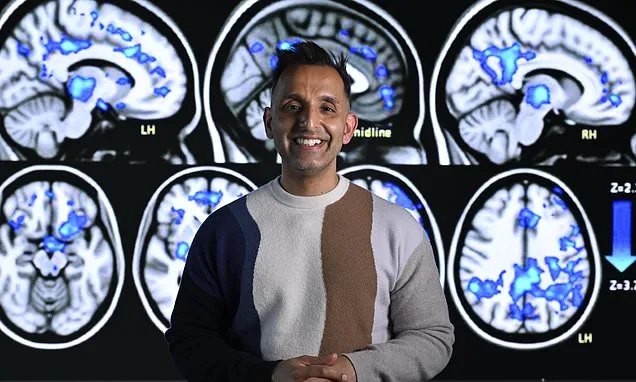
This one-off report, presented by Dr Amir Khan, was laden with suggestions for exercising the cognitive muscles -- so many that half of them were barely explained. Apparently, standing on one leg and closing an eye is guaranteed to make you smarter, though quite how it helps, we did not learn. Good news for Long John Silver at any rate.
The smell of wet earth after rainfall is supposedly a fillip for the faculties too. 'Caused by a chemical called geosmin, it's been shown to boost serotonin,' Dr K claimed, 'one of the happy chemicals.'
I'm not sure about that. If it's true, a wet January would be the most cheerful time of year.
Much of the advice was focused on what we eat. Fermented foods such as sauerkraut or pickled cabbage are good for the brainbox, as are blueberries, packed with flavonoids which reduce inflammation.
Some experts believe diet is so important that they refer to the stomach as our 'second brain' -- an encouraging viewpoint, after Christmas overindulgence, for those of us who can barely haul our trousers up around our intellects.
But if you can eat yourself brighter, you can also scroll yourself stupid. A quarter of Brits admit we're addicted to our smartphones, checking them obsessively day and night.
I'm surprised it's only 25 per cent. Visit any restaurant, and no one's talking or looking at each other -- they are all absorbed in their phones, blanking each other across the table.
Young father Joey from Yorkshire told Dr Khan that, at home, his phone obsession means he even ignores his young daughters. 'You know it's not healthy,' he said, 'but it’s just the norm.'
Excessive smartphone use eats away at our attention span, the doc said. If he'd gone on to explore whether this is behind the surge in attention deficit hyperactivity disorder (ADHD), this might have been a valuable observation.
Instead, he was sidetracked by a possible phone addiction treatment involving psilocybin, the hallucinogenic compound in magic mushrooms.
Joey tried a simpler, drug-free cure. He locked his phone in a box. Problem solved.