The U.S. Coast Guard has launched an internal investigation after a swastika was discovered drawn on a bathroom wall at its primary recruit training center in New Jersey, prompting a forceful response from the service's top officer, who told anyone embracing hate or extremism to leave.
In a statement Monday to The Washington Post, Adm. Kevin Lunday, the Coast Guard commandant, made clear that the symbol -- long associated with Nazi Germany and white supremacy -- has no place in the Coast Guard.
"Anyone who adheres to or advances hate or extremist ideology -- get out. Leave. You don't belong in the United States Coast Guard and we reject you," Lunday's statement said. "We will not allow anyone to put a stain of hate on our United States Coast Guard."
The hand‑drawn symbol was found Thursday evening inside a men's restroom at the training center in Cape May, the Post reported. An instructor reported the discovery, and the drawing was quickly removed. Lunday was briefed on the incident Saturday and traveled from Washington to Cape May, where he addressed roughly 900 recruits and staff members, according to the newspaper.
The Coast Guard Investigative Service has been directed to examine the incident, officials told the Post, though no suspect has been publicly identified. In a notification to Congress, the service said the act violated its core values and constituted criminal conduct.
Newsweek has reached out to the USCG via email on Monday afternoon for comment.
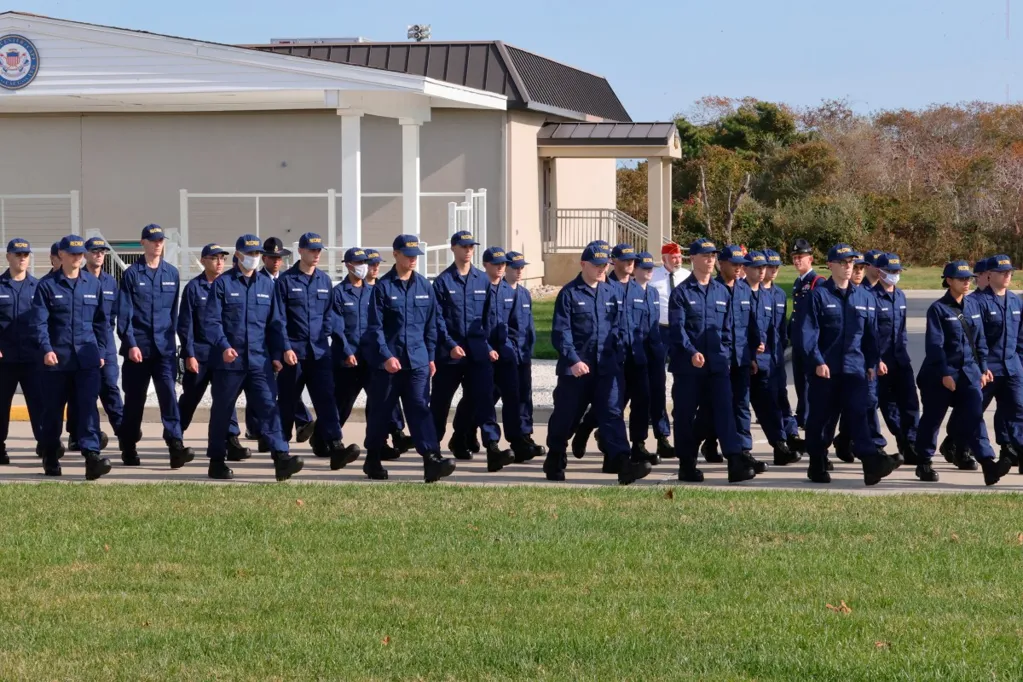
The Coast Guard Training Center in Cape May, New Jersey, is the service's sole enlisted recruit training facility and the entry point for all new enlisted members of the Coast Guard. Often referred to as the birthplace of the enlisted corps, the base trains thousands of recruits each year through an intensive basic training program before they are assigned to operational units across the country.
Established as a military installation in 1917 and transferred to the Coast Guard in 1924, the center has served as the hub of Coast Guard enlisted training for decades and remains one of the service's largest bases.
The discovery comes after a controversy late last year involving the Coast Guard's workplace harassment manual. In November, the service faced criticism after revising language in the manual to describe swastikas and nooses as "potentially divisive" symbols rather than explicitly prohibited ones. The wording sparked public backlash and congressional scrutiny.
At the time, Lunday -- then serving as acting commandant -- said the symbols were banned, but the revised language remained in the manual when it officially took effect. The Coast Guard promptly removed the wording.
In the months since, Coast Guard personnel have said the earlier language did not reflect the service’s values.