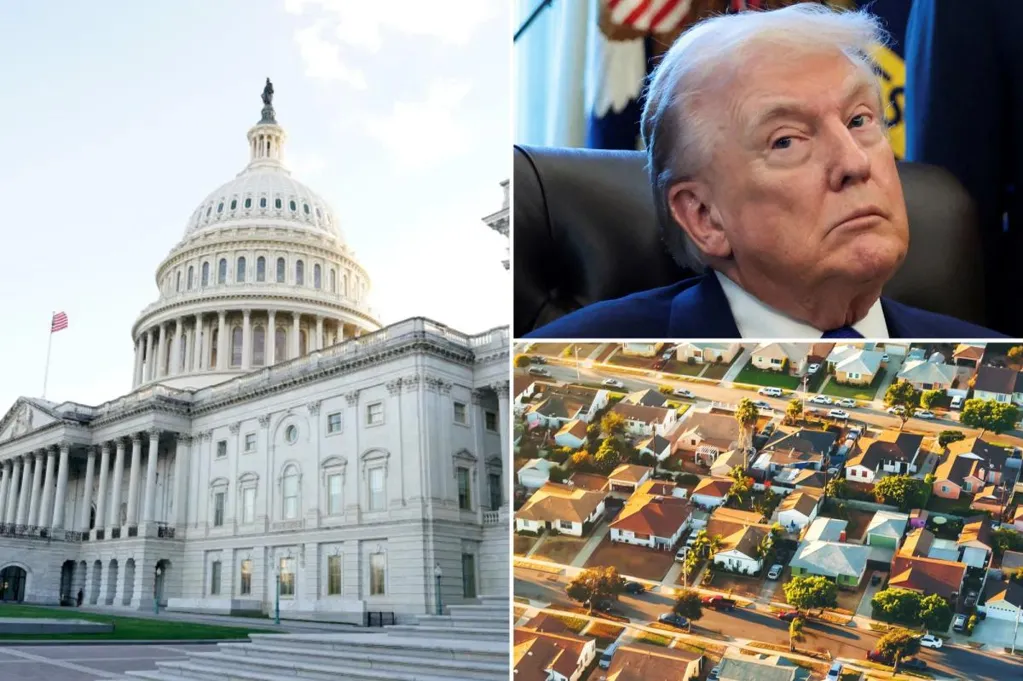
President Donald Trump's bid to block large institutional investors from buying single-family homes was left out of a sweeping bipartisan housing package that sailed through the House Monday in a 390-9 vote.
The "Housing for the 21st Century Act" passed without including the White House-backed restriction, despite a late push from the Office of Management and Budget.
At its core, the fight over whether to bar large institutional investors from buying single-family homes goes to the heart of one questions millions of Americans are asking: why is it so hard to afford to a house?
With home values up more than 50% since 2019 and sales slumping to a 30-year low, first-time buyers are increasingly competing not just with one another, but the deep-pocketed firms able to pay in cash. Supporters of restrictions argue that giving families priority could ease pressure on prices and restore access to homeownership, while opponents warn that limiting investors risks disrupting capital flows and housing supply.
In a formal statement to The Post, Davis R. Ingle of the Executive Office of the President said the administration is "pleased that Congress has begun working on legislation that would help make housing affordable for Americans," noting the bill "builds on the President's priorities by improving Federal housing programs, streamlining data collection and modernizing the environmental review process."
But the administration made clear it views the legislation as incomplete.
While acknowledging that some Trump priorities were included, Ingle said the bill "still lacks other presidential priorities, particularly a ban on the purchase of single-family homes by large institutional investors. This is a key priority that will do much to drive down the cost of single-family homes."
As first reported by the Wall Street Journal, Trump officials had urged Republicans to attach the investor ban to housing legislation moving through Congress. Lawmakers, however, advanced the broader supply-focused package without adding the amendment.
French Hill, chairman of the House Financial Services Committee, pushed back on suggestions that he had outright rejected the proposal.
In a statement provided by his office, Hill's deputy communications director said, "Monday's 390-9 vote on the Housing for the 21st Century Act is a testament to all the work that House Financial Services Committee members have put in over the last 13 months to address housing challenges for the American people. This package is a strong foundation to build upon as we work to get a bill signed into law that reflects the priories of both chambers of Congress and President Trump."
According to Hill's office, no formal proposal text was received from the White House before the vote, and the bill moved under suspension -- a process that typically does not allow amendments. The executive order also gave the Treasury 30 days to define key terms such as "large institutional investor" and "single-family home," definitions that are still pending.
Still, the issue is far from settled.
Marlin Stutzman, a Republican from Indiana, is drafting separate legislation and said leaving the provision out of Monday's bill was "nothing intentional towards the White House."
"There's a lot of support for the proposal that President Trump put forward," Stutzman said. "In fact, I just spoke to the White House staff before coming back here to the office to say there's a strategy and a plan. It's just a matter of ... congress is big and clumsy, and we're just getting the language put together, getting the bill filed."
Stutzman framed the push as part of a broader effort to ease financial strain on households.
"The American people have been through so much over the last five years because of COVID and the Biden administration. They need a break. They need a reprieve," he said. "President Trump is making proposals to help the American people, which ultimately helps the American economy."
Importantly, Stutzman is not advocating a blanket prohibition. Instead, he's proposing a structure that prioritizes families without completely locking out investors.
"One of the things that I've tossed out there is for a 100-day waiting period -- so that if the house is on the market longer than 100 days, then institutional investors could come in and be a part of the purchase," he said. "But at least just let American families be at the front of the line rather than housing developments being bought up by institutional investors first."
He also suggested allowing institutional buyers in rent-to-own scenarios.
"That would be another, scenario that I would be open to that if the institutional investors bought it, that they already had buyers for it in a rent to own situation," he said, adding,"That's in the language that I'm proposing."
If the president backs the measure, he added,"there's going to be some good support for it."
The debate has drawn attention from major institutional landlords, including Blackstone, one of the largest owners of single-family rentals in the US through acquisitions such as Home Partners of America and Tricon Residential.
In a statement to The Post, a Blackstone spokesperson said,"Our ownership of US single-family homes represents about 2% of our real estate [assets under management] and 0.5% of the overall firm. We have also been a net seller of homes over the last decade -- with our holdings down more than one-fifth. That said, we believe our current portfolio is poised to continue to perform quite well and operate at the highest standards for residents."
Institutional investors account for a relatively small slice of the nation's housing stock, but their presence in certain fast-growing markets has fueled political backlash, especially among younger voters, as home prices continue to skyrocket.