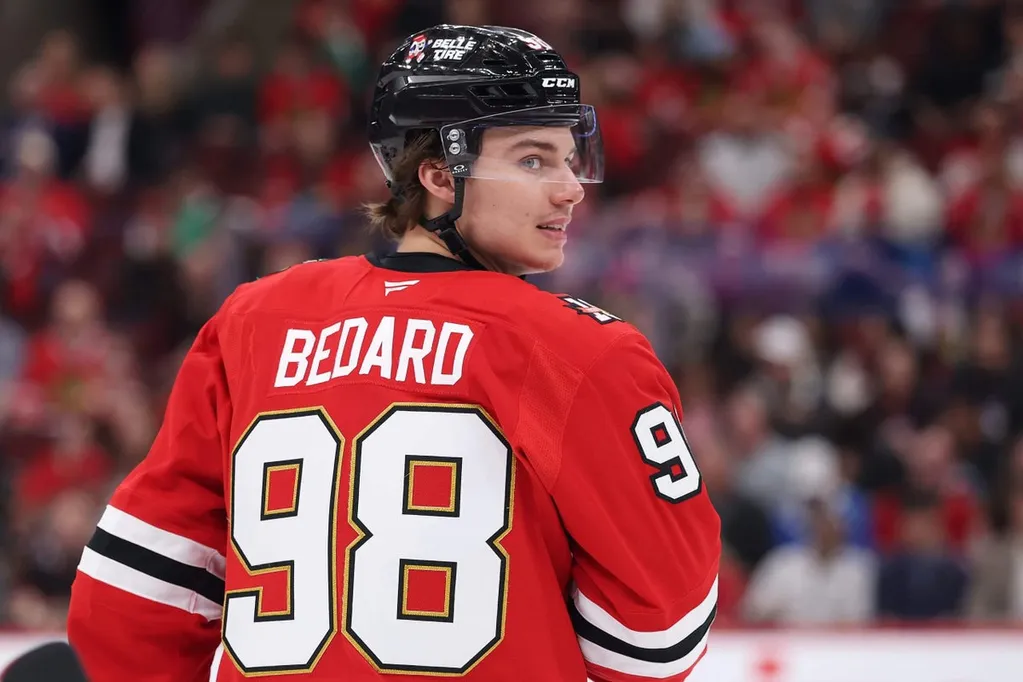
CHICAGO -- Back in 2015, Patrick Kane and Jonathan Toews became the first Chicago Blackhawks to be paid eight-plus figures. Soon, Connor Bedard will join them.
Where exactly those eight digits will fall is largely in Bedard's hands. The Blackhawks and their general manager, Kyle Davidson, will have some thoughts on what Bedard's second NHL contract should look like -- they probably prefer eight years -- but Bedard is in the driver's seat at the negotiating table.
Can the Blackhawks really say no to any of Bedard's asks? Since being drafted No. 1 in 2023, he's altered the franchise's trajectory in every way. It's a question of how much he wants them to pay for that.
Bedard has given a spiraling Blackhawks fanbase hope and excitement again. From a business perspective, he's helped the team avoid becoming a blip on the city's sports radar, as it was nearly 20 years ago. Bedard has kept the Blackhawks afloat even as they've gone nine seasons without hosting a playoff game. Despite the franchise's decline, which includes a current run of four consecutive bottom-three finishes, the Blackhawks have thrived financially. They finished fifth in attendance this season, drawing nearly 19,000 fans per game, and continue to be invited to the NHL's marquee events. Bedard's jersey sales topped the league for the second time in the last three seasons. Any social media post centered around Bedard has a chance of going viral. He made what could have been a painful transition from Kane and Toews quite smooth.
On the ice, Bedard is developing into the superstar the Blackhawks needed for their rebuild. Without him, Davidson's plan would have looked different. Bedard reached 30 goals for the first time in his career this season and was right on pace with the league's best before a shoulder injury derailed his numbers. Over his first three NHL seasons, he's scored or assisted on 30 percent of the Blackhawks' goals.
All in all, Bedard has proven he's worth whatever the Blackhawks give him on his next deal.
"We couldn't be happier with how Connor has shown up every single night, the way he competes, the way he now leads this team in many ways," Blackhawks chairman and CEO Danny Wirtz said recently. "Our intention is to absolutely get him signed and to have him be a Blackhawk for a long time."
Bedard could ask to be the league's highest-paid player come next season.
That probably wouldn't excite the Blackhawks as much as Bedard’s agents, but it wouldn’t be unreasonable. You can’t say Kirill Kaprizov, who will have the league’s highest cap hit at $17 million next season, is any more important to the Minnesota Wild than Bedard is to the Blackhawks.
There’s been no indication Bedard will seek that much, though both sides have been careful not to play their cards in public. When Bedard was asked about specific numbers at the end of the Blackhawks’ season, he pretended as if the discussion was above his pay grade, but he did hint that he understands the deal’s significance in a larger team context.
“I don’t know, I’m not smart enough to be doing numbers or anything like that,” Bedard said. “I think there is that sort of setting the (precedent) of a lot of our guys. Obviously, Frankie (Nazar) was the first young guy to sign long-term, Vlasy (Alex Vlasic) as well. So, you think about that.”
Vlasic was the first of the new generation of Blackhawks to sign a long-term contract, a six-year deal with a $4.6 million cap hit beginning in 2024-25. Nazar took care of his second contract last offseason, a year before his entry-level deal was set to expire, and agreed to a seven-year extension with a $6,599,991 cap hit.
Now it’s Bedard’s turn. No one within the Blackhawks expects his contract to be as team-friendly. He’s likely to become the team’s highest-paid player next season and for as long as he’s with the organization.
So, what’s fair? Back in November, when we last projected Bedard’s next deal, we worked between two figures: Evolving-Hockey’s $10.6 million projection and a $16.9 million market value. A few things have changed since then. That projection was from the 2025 offseason, and the salary cap has gone up. A more current mark is from AFP Analytics, which projects eight years at a $13.2 million cap hit.
As for his market value, that dipped slightly when his injury cooled his early-season hot start. Now, Dom Luszczyszyn’s model has his value closer to $14 million.
Restricted free agents generally are not offered their true market value. The teams usually have most of the leverage. The Blackhawks have a potential negotiating tactic to get Bedard’s average annual value below that, giving them a better chance of gaining surplus value: the fact that Bedard hasn’t put together a full elite season. Still, it’s hard to envision Chicago putting up too much of a fight over any ask from Bedard.
Whatever risk there might have been that Bedard wouldn’t pan out diminished this season. There’s always a chance he won’t meet the high expectations, but the Blackhawks don’t seem concerned. Even if he ages like John Tavares or Jack Eichel, a $13 million price tag will be more than fine, especially with a rising cap. Since Kaprizov’s $17 million AAV extension last September, another eight players have signed deals worth at least $10 million AAV. Bedard is bound to join that tier. The question is how far over that line he will go.
That could be influenced by other young stars signing contracts around him. In October, Utah’s Logan Cooley, who was drafted a year before Bedard, signed an eight-year, $80 million contract that kicks in July 1. More will follow: Leo Carlsson and Adam Fantilli, two franchise cornerstones who were drafted right after Bedard in 2023, are due for new contracts this offseason.
More than anyone, though, we need to look at San Jose Sharks center Macklin Celebrini. He was the No. 1 pick the year after Bedard and arrived with plenty of hype, too. Celebrini has produced at a higher rate than Bedard in his first two NHL seasons and put himself in the Hart Trophy discussion this season, but the two players were neck-and-neck among the league’s points leaders before Bedard’s injury in December.
Celebrini has another year left on his entry-level deal, but he could agree to a second contract beginning July 1. If he agrees to extend early -- especially if the Sharks want to get the full eight years before the CBA limits new contracts to seven years in September -- that could set the bar for up-and-coming superstars.
There is a chance Bedard’s new contract is done long before Celebrini’s. Bedard recently said he’s open to meeting with Davidson whenever it’s convenient. That could happen as early as this month. But even if Carlsson, Fantilli and Celebrini’s contracts aren’t complete when Bedard begins his negotiations, there are plenty of other comparables.
All the numbers might not match up, but with Bedard’s age -- he doesn’t turn 21 until July 17 -- and the effect he’s had on and off the ice in a major hockey market, he could seek about 12 to 15 percent of the salary cap ceiling. If Bedard agrees to eight years on his extension, the Blackhawks will be more accepting of the percentage. Even if Bedard seeks a shorter-term deal, the Blackhawks will still probably have to stomach whatever he wants. Shorter deals didn’t affect Auston Matthews’ percentage with the Toronto Maple Leafs: he signed his second contract for five years starting at 14.27 percent of the cap; then came back and signed a four-year extension starting at 15.06 percent of the cap.
There are some reasons to think Bedard will ask for a long-term deal. For one, it’s common for NHL players, especially No. 1 picks, to ask for that in their second contracts. Of the 10 No. 1 picks drafted before Bedard from 2014 to 2022, eight signed second contracts of seven or eight years. The two who didn’t were Matthews and Rasmus Dahlin, who signed a three-year extension with the Buffalo Sabres before agreeing to an eight-year deal on his third contract. The closing window on eight-year deals could motivate Bedard and/or the Blackhawks to maximize the contract.
The reality is the Blackhawks could pay Bedard $20 million a season in a short-term deal and still not get anywhere near the cap ceiling. In recent years, Chicago has taken on large contracts from players permanently on long-term injured reserve and overpaid veterans just to get the cap floor. It’s banking on Bedard’s cap hit for the 2026-27 season helping the team get closer to the floor again. Those financials aren’t expected to change too much for the Blackhawks in the near future either.
Ultimately, Davidson is mindful of the long run. He wants to sign Bedard at a reasonable salary to allow the Blackhawks flexibility for years to come. Davidson has made 11 first-round picks, including Bedard and Nazar, and 25 picks in the first three rounds over the last four years. If the Blackhawks’ rebuild goes as Davidson hopes, he’ll have plenty of other significant contracts to figure out. Some of that has been delayed because Davidson drafted three defensemen (Kevin Korchinski, Sam Rinzel and Artyom Levshunov) in the first round in his first three drafts; those defensemen are still finding their feet in the NHL. Whether it’s them, 2025 No. 3 pick Anton Frondell, this year’s No. 4 pick or any of their other emerging prospects, there is legitimate reason to be concerned about the cap puzzle in five years even if he isn’t feeling any restraint now.
Davidson recently framed Bedard’s extension within the rebuild’s big picture.
“In the end, there’s only so many dollars to go around,” Davidson said in April. “You want to build a deep team. You want to build a team you feel is a championship roster, which is why we do this. So we want to get it right. You want to make sure both sides feel like there’s common ground there.”
Publicly, Davidson and Bedard have said they want what’s best for both sides.
“But at the end of the day,” Bedard said that same day, “it’s just seeing what fits the team best, what fits me best and just going from there. I’m very open to however they see it and what they have to say.”
The Blackhawks can talk about being fair to Bedard, but they’re actually hoping Bedard is fair to them.
Chicago would love nothing more than for Bedard to sign a long-term contract and leave some money on the table. There are no guarantees the Blackhawks would use the saved money to better the team, but they spent to the salary cap during their three Stanley Cup championship seasons in the 2010s, and Wirtz has said he’s willing to do it again if justified.
For now, Bedard’s individual contract will be justified regardless of the cost. Will his cap hit come in at $11 million? $13 million? $15 million? $17 million? That answer should come soon.