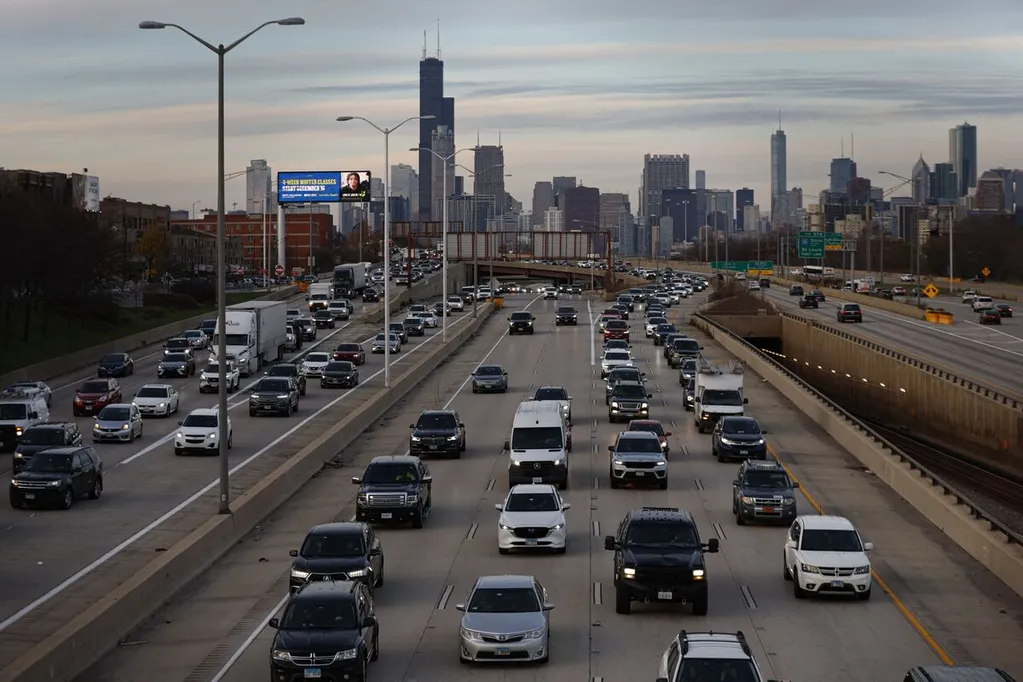
A report proposed installing tolls along I-294, which encircles the city and its adjacent suburbs, and some leaders are intrigued by the managed lane approach, which could introduce traffic-based charging on highways such as I-55 and I-90.
A little more than a year ago, New York City became the first North American city to implement congestion pricing, with vehicles charged $9 to enter Manhattan south of 60th Street during weekdays. That triggered a showdown between New York Governor Kathy Hochul, who championed the program, and President Donald Trump, who repeatedly vowed to kill it.
Eight hundred miles to the west, leaders in Chicago were keeping a watchful eye. "It was very exciting to watch all the drama in New York," said Elizabeth Scott, principal policy analyst at the Chicago Metropolitan Agency for Planning.
A number of Illinois civic organizations argued that congestion pricing could ease traffic and buttress transit across Chicagoland, much like in the Big Apple. A regional planning group issued a report proposing a cordon with fluctuating tolls along I-294, which rings the city and its inner suburbs. Streetsblog Chicago and the Chicago Policy Review posted enthusiastic articles; the editorial board of the Chicago Tribune weighed in from the other side. Chicago Mayor Brandon Johnson said in an interview that congestion pricing is something the region "should explore."
But Chicago isn't a perfect stand-in for New York City. As in many US cities, its traditional business district, known as the Loop, is struggling to regain its pre-Covid vitality. Retail occupancy in the area ticked upward in 2025, but more than one in four available spaces remained vacant at the end of the year. For congestion pricing to work in Chicago anytime soon, the policy would need to address the major highways where traffic is much more of an issue.
"Chicago's congestion problem is primarily on the expressways accessing downtown," said Ian Savage, a professor of economics at Northwestern University, "rather than with circulation within the Loop itself."
Visiting the Windy City a few weeks ago, I found that the local buzz around congestion pricing has subsided from a year ago, but interest remains—as do the thorny policy challenges that caught local leaders' attention. It won't happen right away, but America's Second City may yet follow New York's lead on urban road pricing.
Arguments for congestion pricing first emerged in the 1950s when economists outlined the potential benefits of tolls that scale with traffic levels. Raising the cost of driving during peak times, they explained, would encourage those with flexible travel plans to drive earlier or later or switch to transit. Residents and employers would gain faster roadways as well as new funding to improve the mobility network. (Due to the nonlinear relationship between traffic volume and vehicle speeds, removing a small number of cars from a gridlocked road can have an outsized impact on travel times.)
Singapore became the first global city to adopt congestion pricing in 1975, followed by London, Stockholm and Milan. New York City's first-in-the-Americas implementation came after years of study, and it has paid off to the tune of $550 million in revenue in 2025, allowing the city to issue $15 billion in bonds to support transit projects. Traffic is moving faster, air quality has improved and retailers inside the congestion zone are seeing more visitors.
In principle, Chicagoans would also enjoy substantial upsides from traffic-based tolls, particularly because their regional highways regularly rank among the slowest in the nation. A recent academic paper found that congestion pricing in Chicago might speed up car travel even for suburbanites who never venture downtown. And traffic-based fees are not an entirely alien concept in the region: Chicago already imposes a $1.50 surcharge on ride-hail vehicle trips that begin or end in high-traffic areas close to Lake Michigan. As far back as 1980, a city report about air quality stated that "tolls could theoretically be used to encourage motorists using a congested roadway to switch to a less-congested alternate route."
In 2007, Chicago received a federal grant to explore the mechanics of road pricing, culminating in a 2010 report that found mixed public support: While many locals were intrigued by managed lanes, in which drivers entering a roadway choose between tolled "express" lanes that cost more at peak times and free lanes that are slower, most opposed congestion charges that would apply for all vehicles entering a cordon or traversing a highway.
Local chatter around congestion pricing reached a crescendo last year, thanks to New York's high-profile implementation and the Chicago Transit Authority's gaping budget deficits. But in the end, legislators in Springfield averted a transit collapse by passing a bill that allocates $1.5 billion in annually recurring revenue, largely from gasoline tax revenues, toward Chicagoland's public transportation.
With the transit emergency out of the headlines, elected leaders have moved on. "We don't really have that ax hanging over our head anymore," said Paula Worthington, a lecturer at the University of Chicago's Harris School of Public Policy.
Meanwhile, the city's CBD remains stubbornly un-congested. "Pre-Covid, we absolutely could have made the case for cordon pricing," Worthington told me over hot chocolate in a mostly empty food court within the Loop. "Now we just don't have enough people here." For the moment, at least, the idea of charging cars to come downtown seems like a political non-starter.
But tolling the CBD is just one way to introduce traffic-based charging, and it may not be the most compelling one.
A report issued last year by Chicago's Metropolitan Planning Commission proposed installing tolls along I-294, which encircles the city and its adjacent suburbs. Worthington, for her part, is intrigued by the managed lane approach. Roadways such as SR-91 in Orange County, California, and I-66 in Northern Virginia -- heavily used commuter routes -- currently use dynamic tolls during peak hours to keep traffic flowing. She reeled off potential Chicagoland candidates such as I-55, I-90, the Eisenhower Expressway and North Lake Shore Drive (which is already undergoing a redesign). "There is a real upside to thinking about it," she said. "The interstates and highways that take you into the city are almost always jammed."
Scott, of the Chicago Metropolitan Agency for Planning, believes that congestion pricing remains an attractive idea but it needs a forcing mechanism to command politicians' attention. With a transit lifeline secured, the next big opportunity could come in around two years when Illinois considers a new capital program to fund surface transportation.
"Most of our highways were built during the 1950s and '60s, and they're coming to the end of their useful life," Scott said. "They pretty much all have to be rebuilt. How are we going to pay for that?"
Compounding the challenge, Illinois faces a long-term decline in fuel tax receipts—its traditional source of infrastructure money—due to the shift toward electric vehicles and the retirement of older gas guzzlers. CMAP recently published a policy paper arguing that Illinois should adopt road user charges that scale with miles driven—and could rise with traffic levels too.
Worthington agreed that a new transportation bill in Springfield would open a window to pursue congestion pricing, particularly since the state's financial support for regional transit relies on falling gas tax revenues. "It's not a long-run, robust source of money," she said. New toll revenue could provide a financial backstop.
But any move to implement congestion pricing will not be decided by leaders in Chicago and Springfield alone because new tolls almost certainly would require sign-off from the federal government.
"It's very difficult to imagine any American city not having to go through a federal approval process," said Stephanie Pollack, who led the Federal Highway Administration under President Joe Biden. Given the Trump administration's ongoing fight over Manhattan congestion pricing, support for launching new programs elsewhere seems unlikely. But no administration lasts forever.
Pollack suggested that Illinois officials take a crucial first step by joining the federal Value Pricing Pilot Program, whose current participants include 10 other states . They could also amend Illinois' Toll Highway Act to clarify which public entity would be responsible for managing a future congestion pricing scheme.
At the same time, state and local leaders could decide what kind of traffic-based tolling program they want to consider. If the preference is for a cordon, where should its boundaries lie? If it's managed lanes, which highways? Having those conversations now will make it easier to secure future federal approval.
There is one other open question: Will a major public figure make implementing congestion pricing their personal mission, much like New York's Governor Hochul and ex-governor Andrew Cuomo (and 20 years earlier, London's Mayor Ken Livingstone)?
"I'm not aware of a champion at this time," said Worthington. "A lot of leaders like the idea, but I don't think it's front and center." Widespread skepticism around ambitious transportation ideas lingers from Chicago's notorious 2008 sale of its street parking meters to private investors, she says. Although Johnson expressed interest in congestion pricing a year ago, he has said little about it since. (The mayor's office did not respond to a request for comment.)
Scott is optimistic that urban road pricing will eventually recapture the imagination of regional policymakers. "The congestion-management aspects could be incredible, and then there are the benefits in terms of walkability, reducing emissions and speeding up buses that go through the Loop," she said. "I don't think people appreciate how significant the quality-of-life improvements could be."
Rachel Cole, head of Northwestern University's transportation library, provided research assistance.