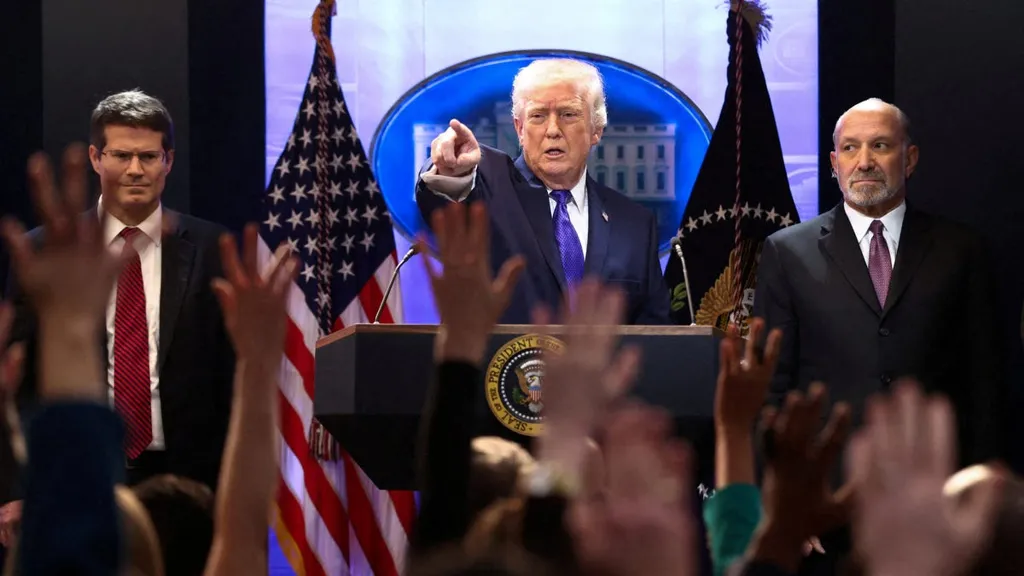
President Donald Trump announced he signed an order to impose a 10% global tariff after expressing disappointment in SCOTUS tariff decision.
After the Supreme Court ruled against President Donald Trump's sweeping tariffs on imports, some Democrats are demanding that refunds be sent to Americans, the latest hypothetical plan to redistribute tariff income back to everyday Americans.
The nation's highest court on Feb. 20 ruled that Trump doesn't have the power to unilaterally impose the tariffs he has enacted under an emergency powers law, which he has used as part of his foreign policy strategy with ever-changing rates on targeted countries.
Democrats including California Gov. Gavin Newsom and Illinois Gov. JB Pritzker have demanded refunds of at least $1,700 per household, with Pritzker sending the Trump administration an invoice for that amount per family in his state.
"Donald Trump has been illegally taxing your groceries, furniture, and cars for over a year. Time for a refund," Newsom said.
Their idea follows months of speculation about Trump's long-floated plan to send $2,000 tariff rebate checks to some Americans. The fate of that plan remains unclear.
Meanwhile, Trump has announced plans to enact tariffs using different legal mechanisms.
Tariff rebate checks long floated amid skepticism
Americans have felt the impact of tariffs, from higher costs for products they regularly buy to surprise tariff bills in the mail. The average American family has paid more than $1,700 in tariff costs as of January, according to a report by Democrats on the congressional Joint Economic Committee. The nonpartisan Tax Foundation said in a report earlier in February that the tariffs cost each household an average of $1,000 in 2025.
When Trump first started referencing the idea of rebate checks for Americans, it seemed like a welcome relief for some. Some said they would believe it when they see it.
The checks have never had a certain path forward, experts have said. Tax analysts have said the revenue generated by tariffs wouldn't have been enough to send $2,000 to Americans, and the details of the checks, including how and when they would be sent, have been up in the air.
"It's not clear to me they were ever going to happen," said Steven Durlauf, an economist and director of the Stone Center for Research on Wealth Inequality and Mobility at the University of Chicago Harris School of Public Policy.
Trump first suggested that tariff revenue could be used to send checks to Americans in 2025. Since then, the amount of the proposed checks and their timeline have varied. In a Jan. 7 interview with the New York Times, Trump appeared to forget he had pledged them altogether; then said the checks could be $2,000 and be sent to Americans of "moderate" income toward the end of 2026.
But the checks tied to tariff revenue were never likely to happen, Durlauf said. There's no precedent or clear legal basis for a president to distribute tariff revenue to Americans in the form of checks; so if any kind of stimulus check were to happen, it would probably come from some other funding source under Trump's control, he said.
Stimulus checks sent early in the COVID-19 pandemic were authorized by Congress during exceptional circumstances, Durlauf pointed out. To the contrary, personal rebate checks have already been floated in Congress but haven't moved forward. In July 2025, Sen. Josh Hawley, a Republican from Missouri, introduced the American Worker Rebate Act to give at least $600 to qualifying individuals out of the revenue earned by tariffs; but the act didn't receive further action in committee.
And though Trump suggested that checks sent to military members over the holidays for $1,776 were coming out of tariff revenue, they actually came from military housing funds allocated by Congress to the Defense Department.
Businesses win a victory in their fight for refunds
The Supreme Court decision was a win for thousands of companies, including importers like Costco, Revlon and Goodyear Tires, that sued to recover billions in tariffs that were already collected.
The Trump administration has said in court that the companies would get their refunds if the Supreme Court overturned the tariffs. But those refunds could be a long way off still. Treasury Secretary Scott Bessent told Reuters in January that repayments could be spread out over weeks or even a year.
"It would be a complete mess, and almost impossible for our Country to pay," Trump previously said on social media of the prospect of refunds." On Feb. 20, he said during a news conference that the Supreme Court didn't address how refunds would work.
For Americans wondering if the need to repay revenue from the tariffs will dash hopes of a stimulus check, Durlauf said the cause and effect is not quite that straightforward. Tariff revenue wasn't likely to pay for checks to begin with, and they were probably only linked to tariff revenue by Trump to regain support after tariffs proved unpopular, Durlauf said.
"The bottom line is, it was not so likely before, and it's less likely now," Durlauf said of the refund checks to taxpayers.
Contributing: Bart Jansen, Maureen Groppe, Kinsey Crowley and Daniel de Visé; USA TODAY; Reuters
(This story has been updated to add new information.)