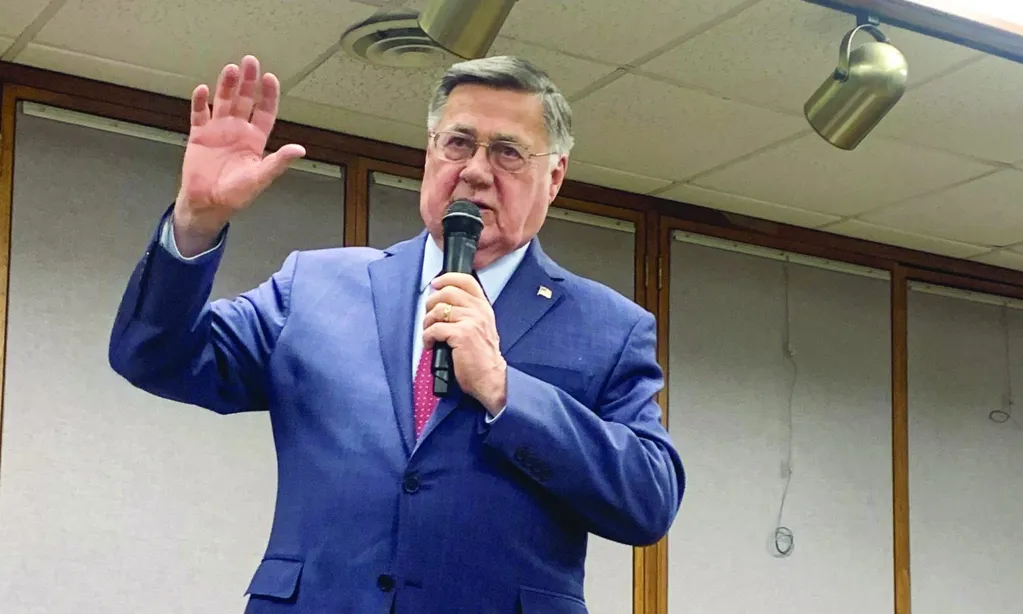
Suffolk County Executive Ed Romaine (R) visited the Village of Port Jefferson on Feb. 9 to address its residents. Invited by the Port Jefferson Civic Association, Romaine spoke on a range of topics, including water quality, development and the Lawrence Aviation site.
Lawrence Aviation
Last month, a bill facilitating an easement of the Greenway Trail from the New York State Department of Transportation to the Metropolitan Transportation Authority failed in its final stages after Romaine made it clear that he would not allow, or fund, a bridge for a hypothetical bypass. The DOT insists a plan for a bypass be folded into any plan for Lawrence Aviation property. In 2023 then-Suffolk County Executive Steve Bellone (D) passed a resolution claiming financial responsibility for a bridge for the bypass should the DOT decide to build it. While officials have made it clear that the chances of a bypass happening are slight, Romaine did not want to take the chance. He said that he does not want to "leave [the Greenway] in the hands of the DOT."
"There is going to be no bypass highway from Port Jefferson to Setauket," he said. "Absolutely not."
Romaine said the Greenway should be transferred to a different owner -- Suffolk County, Town of Brookhaven or another organization so as to ensure its preservation.
Gyrodyne
In August, Gyrodyne, the owner of the 63-acre property at Flowerfield Fairgrounds in St. James, sold 49 acres of their property to the real-estate development firm B2K Development. This sale is part of their plan to build a medical office building, a 250-unit assisted-living facility and a sewage treatment plant on the land.
Romaine, who urged the Town of Smithtown planning board against approving the subdivision during his period as TOB supervisor, reiterated his opposition.
"I don't want to see a sewage treatment plant there because of the impact on Stony Brook Harbor," he said. He added that, if possible, he will acquire the land to preserve it.
"If we can preserve the 49 acres at Gyrodyne, then we will do that because we do not need more development," he said.
Sewers
With the majority of the county reliant on cesspools, Romaine said water quality is a "huge concern."
"We're looking to build some sewers in some key areas, but I am only interested in building tertiary sewers," Romaine said. Secondary sewer treatment cleans water of pollutants by using biological processes. The system uses bacteria to break down organic matter. Tertiary treatment further cleans the water through filtration and chemical disinfection, and is the final stage before the water can be directly reused. This would allow the water to be immediately reintroduced into the environment and recharge Long Island's aquifer. Water treated in district 21, SUNY at Stony Brook and in district 1, the Port Jefferson sewer district (the oldest sewer district in the county), is discharged into the harbor.
Long Island drinking water is sourced from the aquifer, so recharging the aquifer is an essential process for our water supply.
Romaine noted that, by improving treatment, the county would be able to reuse water for other purposes. For instance, the county could use the treated water for golf course irrigation, where the water will recharge the aquifer as well as fertilize the golf course. "What we would need to do is build a pump station to pump it up to your golf course," Romaine said. "[It will] save you a ton of money on irrigation, save you a ton of money on fertilization and it will take that and recharge our aquifer."
"We need to recharge our aquifers. I am a huge believer in this. We have to find a way. We should not be pumping out to the ocean or to the south," Romaine said.
Improved water quality is tied to land use, as Romaine pointed out in his opposition to the development of Flowerfield Fairgrounds. For past decades researchers and environmental advocates have worked to reduce nitrogen levels in Stony Brook Harbor. At a water quality forum on Feb. 3, environmental leaders warned that further development would be destructive to the Long Island Sound.
When asked about the TOB landfill, Romaine emphasized the need for recycling markets to incentivize recycling and avoid the "garbage crisis that we're facing." He did not expand on the landfill's future, except to promote the transportation of trash by rail instead of by truck. He said the state government would be responsible for remediation of the landfill and it's impact on the environment.
"The state has failed to do what they should do," he said in regards to the landfill.