On a dark winter evening, a woman waits for a train on a deserted platform. A man arrives and sits right beside her, making her feel uncomfortable and unsafe. A new application of laser technology is being developed to spot this happening and determine when it is an innocent act - and when it is a threat.
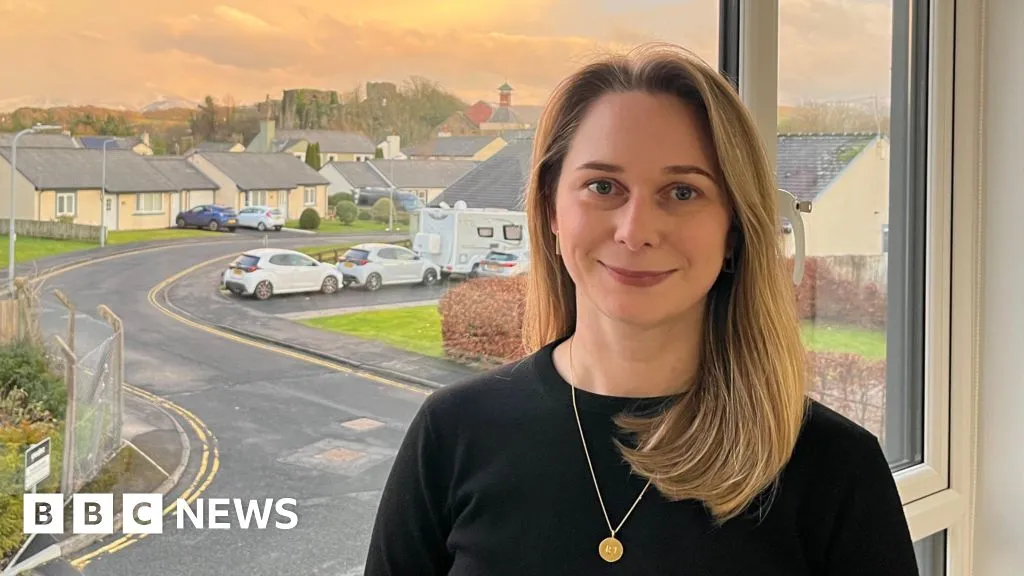
"Throughout my entire life the onus has always been on the woman to protect herself," says Rosie Richardson, a technology company product and strategy director.
She is in the early stages of developing a tool to quickly identify behaviour like lurking and tailing, and direct help when it is needed.
"I think we have to develop solutions that put the responsibility back into other places like public authorities, owners of spaces, police forces," she says.
The tool is being developed by Createc in Cockermouth, Cumbria, but it is based on a system the company already uses to monitor crowds at airports and railway stations, including King's Cross in London.
It tracks people using laser technology, showing each as a dot on a screen.
If unusual behaviours are detected, for example a large group of people moves suddenly or in an unexpected way, security teams on the ground are alerted and can check if there is a problem.
"It means you now have eyes on that [situation] and you can make a judgement based on your security training that that's a threat or not a threat," Richardson says.
She says there are specific patterns of behaviour in predators - loitering in an area or following someone - which the technology can detect.
Richardson has experience of unwanted predator attention, which she has waived her legal right to anonymity to share. She was just 12 and had been watching a stage of the Tour de France.
"I had a horrible man sexually assault me in a crowd and then just wander off, and nothing happened," she says. "He was walking through the crowd and just sexually assaulting people as he went.
"It's that kind of bystander effect - no-one was really doing anything about it, but lots of people saw."
It angers her to know these assaults happen daily but she believes technology of the type she is developing may help spot the pattern of a predator and lead to intervention before anything happens.
The idea is, on that deserted railway platform, the lasers would spot the unnecessarily close choice of seat, registering it as unusual and a potential threat. Security teams would then be alerted and could either direct CCTV for a closer look or send staff in person if needed.
Richardson says the technology in use at train stations and airports has enabled the company to use real-life data to map a pattern of behaviours.
"It uses, effectively, laser beams and very clever maths," she explains.
The system spots patterns of movement and only goes in for a closer look if, based on what it knows about how threatening behaviour manifests, it is deemed suspicious.
"It's just an indicator that someone should be looking at that environment and making sure that person is okay," she says.
Richardson believes this could have spotted her childhood sexual assault.
"When you look at a crowd from the top down, you can see normal bystanders, normal spectators, but you can also see people moving strangely," she says.
"You can see when someone moves into a crowd and everyone else steps back from them because they're behaving oddly."
Looking at the people in her life and her friendship group, she says it is rare to find a woman who has not felt unsafe while out and about.
"Pretty much everyone I know has gone through some kind of unacceptable experience in a public space with a man - it's just everywhere."
Richardson accepts CCTV alone is limited, as it may not operate well in low lighting and the field of view can be restricted. Concerns have also been raised about privacy in relation to constant observation.
But the system she is developing does not use cameras and, instead, monitors crowds as anonymous dots on a map. Only when it spots a potential issue are CCTV cameras directed on the individuals, or security personnel sent to the scene.
"Our aim there is to respect public privacy - so really understand that people don't want to be continually monitored when there's no need to be - but also make spaces safe," she says.
The process has undergone simulated trials and will soon move to tests in real-life scenarios.
Dr Emma Cunningham, a criminology expert at the University of East London, says technology comes with its own limitations and, for women to truly feel safe, a real societal change is needed.
She says it is normal for women to plan their daily movements with safety fears in mind, but that needs to stop.
"For those women and girls who despite these concerns and plans are attacked, then attitudes need to change from victim-blaming to perpetrator-blaming," she says.
She says there is an "epidemic" of violence against women which is especially evident when looking at domestic violence statistics.
Figures from the Office for National Statistics and the charity Women's Aid suggest about one in four women experience domestic abuse in their lifetime, with an average of more than one woman a week killed at the hands of a male partner or ex-partner.
This, Cunningham says, is indicative of a culture that needs to change.
"Education and work with young people to challenge misogyny, sexism in everyday life remains vital too," she says.
While cameras and technology may help when it comes to safety in public spaces such as train stations, Cunningham believes they "are not a substitute for being able to voice concerns to another person".
Much more research is also needed into what makes public spaces safe and whether the measures being introduced can reduce violence, she says.
While Richardson is passionate about tackling violence against women and girls, it was a male victim who put her on this career path.
When she was seven, her older brother was killed on the street during an altercation.
"I can viscerally feel what it's like to feel the ripples of the effect of something like that happening in real life," she says. "I think that is one of the major motivators for me and a big driver to make a change.
"If [our technology] was to help in one single incident, however severe, then that's your life's work achieved."