Authorities in Cyprus have urged residents to reduce their water intake by 10% - the equivalent of two minutes' use of running water each day - as Europe's most south-easterly nation grapples with a once-in-a-century drought.
The appeal, announced alongside a €31m (£27m) package of emergency measures, comes as reservoirs hit record lows with little prospect of replenishment before the tourist season starts.
"Everyone has to reduce their consumption," said Eliana Tofa Christidou, who heads the country's water development department. "Whether that is in the shower, brushing their teeth or using a washing machine. Times are critical and every drop now counts."
It was, she told the Guardian, the Mediterranean island's worst drought in living memory with dam inflows at their lowest since 1901, when hydrological records first begun. Vast tracts of land across the country have been baked dry, with prime forest areas desiccated and dying fast.
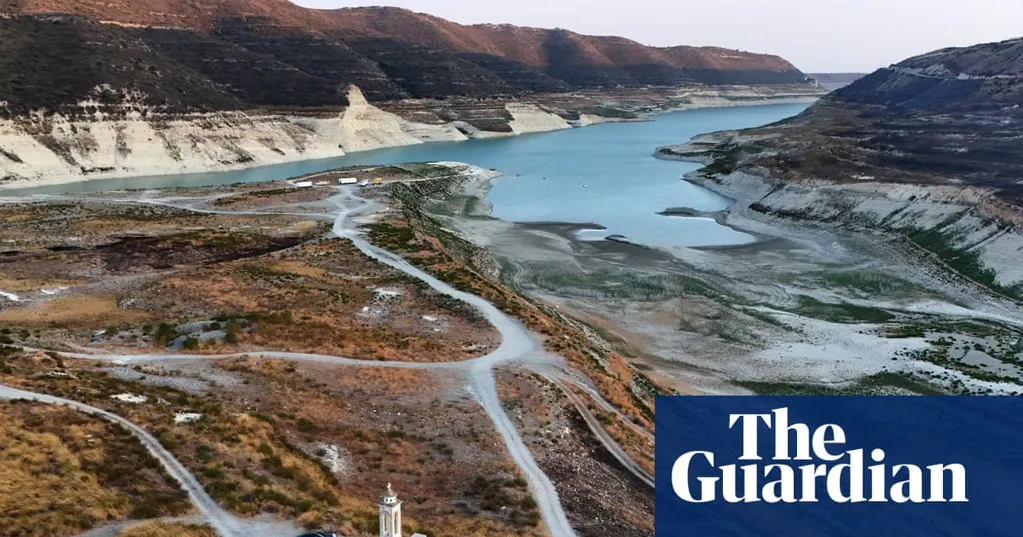
As other parts of Europe have this winter been lashed by rain, the sight of the church of St Nicholas in the Kouris reservoir, where water levels are reported to have dropped to just 12.2% of capacity, offered further proof of the worsening crisis.
If the reservoir was full, the monument would be submerged. Its appearance in what is by far the largest of a 110-strong reservoir network has demonstrated the scale of the emergency. Water reserves in February stand at 13.7% of total storage capacity compared with 26% this time last year, a figure officials were then calling dire.
And the situation could get a lot worse in the EU member state with the highest water stress levels. Temperatures in the region are rising 20% faster than the global average in the climate crisis, according to the Mediterranean Growth Initiative, a data analysis platform. "This accelerated warming is putting severe pressure on freshwater resources, which are rapidly running dry," it says.
Soaring demand has intensified the island's plight: annual rainfall has dropped an estimated 15% since 1901 while water needs have jumped 300% due to population growth and tourism. Three million tourists - nearly three times the resident population of Cyprus - visit the war-split country's internationally recognised south each year.
Tofa said a public awareness campaign would be rolled out this month with the aim of saving water.
"The mean per capita consumption of water in Europe is 120 litres per person per day, but in some areas of Cyprus, being that much hotter, we have mean per capita consumption of 500 litres per day," she said. "We're preparing guidelines, a campaign, that will show people how much water should be used in household activities, like taking a shower, so that consumption can be kept to around 140 litres per person per day."
The drive will supplement other measures such as wastewater reuse and fixing water leakages, prevalent in up to 40% of local networks. Households will also receive financial support to invest in water-saving tap appliances.
The latest emergency package is the sixth to be announced. Cyprus has made water scarcity a priority of its EU presidency and allocated €200m to improving infrastructure, with the government scrambling to install desalination plants to meet drinking water needs.
Two portable desalination units were donated last year by the United Arab Emirates. "The plan is to have 14 units in operation, most by the end of 2026," said Tofa. "Working 24/7 we installed two in a matter of months last year."
But criticism is also mounting. "The right measures were not taken at the right time," said Charalampos Theopemptou, an MP for the Movement of Ecologists - Citizens' Cooperation party and the chair of the environment committee in the Cypriot parliament. "Twenty years ago when scientists were predicting temperatures in Nicosia being on a par with Cairo by 2030 and Bahrain by 2045, we all knew what was coming."
Desalination plants were not only costly but risky, he warned. "They need a lot of energy and pose a danger to marine life if saline waters returned to the sea are not properly dispersed. We should have been finding ways, much earlier, to reduce water demand. It's a disgrace, for example, that public spaces are still covered by grass and that we have so many swimming pools and golf courses."
Emblematic of the explosive situation are farmers who, hardest hit by the measures, have been ordered to reduce irrigation by 30%. "Farmers are besides themselves," said Lambros Achilleos, a prominent unionist. "There's a lot of angst, a lot of depression, with many being told to turn to new, less water-intensive crops. How do you tell farmers in their 50s and 60s who have families to feed to do that? There's going to be a big problem in society and all because successive governments failed to take action that could have avoided all this and protected the environment long ago."
Fadi Comair, a professor of applied hydrology and water resource management at the Cyprus Institute in Nicosia said it was essential measures were taken now when a worst-case climate scenario could not be ruled out in the decades ahead.
"Our research and modelling shows that, in the worst case, the increase in temperature will be 4.5 degrees by 2100, not 1.5 or 2 degrees ... We'll have a collapse of agriculture, drought will lead to the mass transfer of populations and we won't be able to secure food," he said.