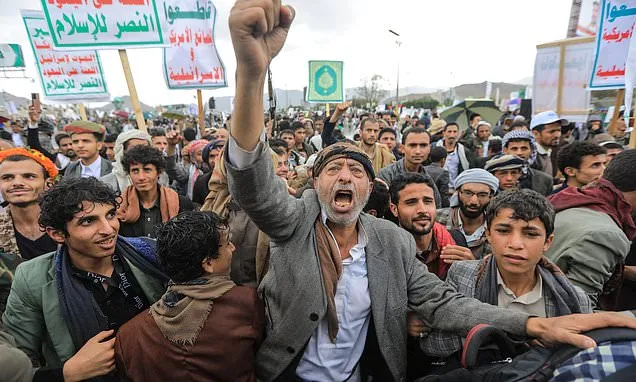
The world is lurching towards a new era of mass warfare in which ever more advanced technology is deployed in the service of increasingly primitive ideologies. Nowhere is this clearer than with the Houthis of Yemen.
In recent days, the terror group has launched ballistic missiles at Israel, claiming to have targeted military sites, though Israel says only a limited number were fired and all were intercepted.
Officially known as Ansar Allah (Defenders of God), the Houthis are a clan from the remote mountain province of Saada in Yemen's north west, rooted in the Zaydi branch of Shia Islam.
The group emerged in the 1990s under Hussein al-Houthi, a man profoundly influenced by Iran's 1979 Islamic Revolution, and his tenets remain its ideological bedrock. Killed by the Yemeni government in 2004, he was succeeded by his equally fanatical brother, Abdul-Malik al-Houthi, who leads the movement to this day.
From a few thousand fighters in the early 2000s, the UN now estimates their forces to be in the hundreds of thousands.
With a structure modelled on another Iranian proxy, Hezbollah in Lebanon, the Houthis control key parts of Yemen, including the capital, Sanaa, most of the country's north west, and - critically - the Red Sea coastline.
This is what makes the Houthis uniquely dangerous. A militia born in a mountain backwater now sits astride one of the vital arteries of global trade.
With Hamas and Hezbollah both severely degraded, they have become Iran's most potent proxy. Tehran supplies training, intelligence and increasingly sophisticated weaponry, including ballistic missiles, anti-ship systems and long-range drones, while the Houthis provide Iran with strategic reach into one of the world's most economically sensitive regions.
The implications are enormous. The Houthis already threaten the narrow Bab el-Mandeb Strait at the mouth of the Red Sea, through which roughly 12 per cent of global trade passes, including a significant share of energy shipments.
If that chokepoint were effectively closed - alongside disruption in the Strait of Hormuz - the result would be a de facto blockade stretching from the Persian Gulf to the Suez Canal.
The group has signalled its readiness to do just that - and torch global energy markets already strained by disruption in the Strait of Hormuz. While the Hormuz blockade primarily affects the energy sector, disruption in the Bab el-Mandeb would have yet broader ramifications for global goods trade - with catastrophic global economic consequences.
Since November 2023, the Houthis have attacked more than 190 vessels in the Red Sea, a route carrying around 10 per cent of the world's oil and nearly $1trillion (£755 billion) in goods annually. The cumulative effect has been severe: shipping traffic through the Red Sea has dropped dramatically, with most vessels rerouted around the Cape of Good Hope, adding thousands of miles, weeks of transit time and substantial costs to global trade flows.
The truth is that the Houthis may be a gang of quasi-medieval thugs, but they are also smart and innovative.
The group has become the first non-state actor to deploy anti-ship ballistic missiles in sustained operations, combining them with cruise missiles and long-range drones to create a persistent threat.
Even the US Navy - the most capable maritime force in the world - has been forced into near-constant interception operations to defend commercial and military vessels. The Houthis' arsenal is a hybrid of old and new. Soviet-era Scud and Tochka ballistic systems (which enter the upper atmosphere before descending to their target) sit alongside Iranian-designed Quds-series cruise missiles (which fly low), while domestically deployed drone platforms such as the Samad series can reach targets up to 1,500km (900 miles) away.
Shorter-range systems, including the Qasef family of drones, provide additional flexibility for regional strikes.
Increasingly, these weapons are manufactured locally. Intercepted shipments last year revealed precision lathes, robotic welding systems, laser engravers and circuit board production equipment: industrial weapons infrastructure in one of the poorest regions on Earth.
But the Houthis' most effective innovation is economic.
They are waging a war of ruthless cost asymmetry.
Drones costing tens of thousands of dollars are routinely intercepted by defensive systems costing millions.
In the opening weeks of Operation Rough Rider, the US campaign launched in March last year to suppress Red Sea attacks, Washington expended roughly $200 million (£150 million) in munitions to counter comparatively cheap threats. That's something else they learned from their Iranian mentors.
During the mullahs' 12-Day War with Israel in 2025, Tehran repeatedly launched Shahed-136 drones costing around $20,000 (£15,000) that forced Israel to respond with defensive Arrow missiles costing $3.5 million (£2.7 million) each.
Some of this barbaric terror group's activities defy belief. The group has reportedly revived slavery in Yemen, for example, while the UN has deemed 'credible' reports that boys as young as 13 have been arrested for 'indecent acts' - meaning homosexuality - or in 'political cases', when their families don't comply with Houthi ideology. Minors share cells with adult prisoners.
Inevitably, they enjoy oppressing women. Women can travel only with a male guardian (mahram) and cannot move within Houthi territory without written male consent, even for work. (This also applies to female UN employees.)
In 2018 the Houthis covered female faces on billboards and the heads of mannequins in bridal shops. In some cases, armed gangs seized mannequins from stores because they 'aroused desire'.
The Yemeni Coalition for Monitoring Human Rights Violations (YCMR) documented 1,181 violations against women by Houthis between 2017 and 2020 alone.
In one 2021 case, a female detainee was forced into sexual intercourse with multiple men at a Houthi detention centre as preparation for use as a sex slave for 'important clients'.
Then there is the usual litany of kidnappings, torture, bombings and the displacement of thousands.
The Houthis have also planted landmines indiscriminately near homes, schools, mosques, markets and water sources. The YCMR has recorded more than 1,929 civilian deaths and damage to more than 2,872 public and private facilities as a result of Houthi landmines over six years of conflict.
Now, they are at war once again.
In a recent statement, the Houthis said they would continue to 'carry out their military operations in the coming days until the criminal enemy ceases its attacks and aggression'.
The question is no longer whether they possess the capability to disrupt global trade or widen the conflict: they have already demonstrated both.
The question is whether they will choose to escalate further, and whether the world is prepared for the consequences if they do - not least the devastating Israeli response that would follow.
The Houthis were once a local insurgency from an isolated corner of Yemen.
Today, they are a strategic player with the ruthlessness and skillset necessary to shape the trajectory of a global crisis. And they are only just getting started.