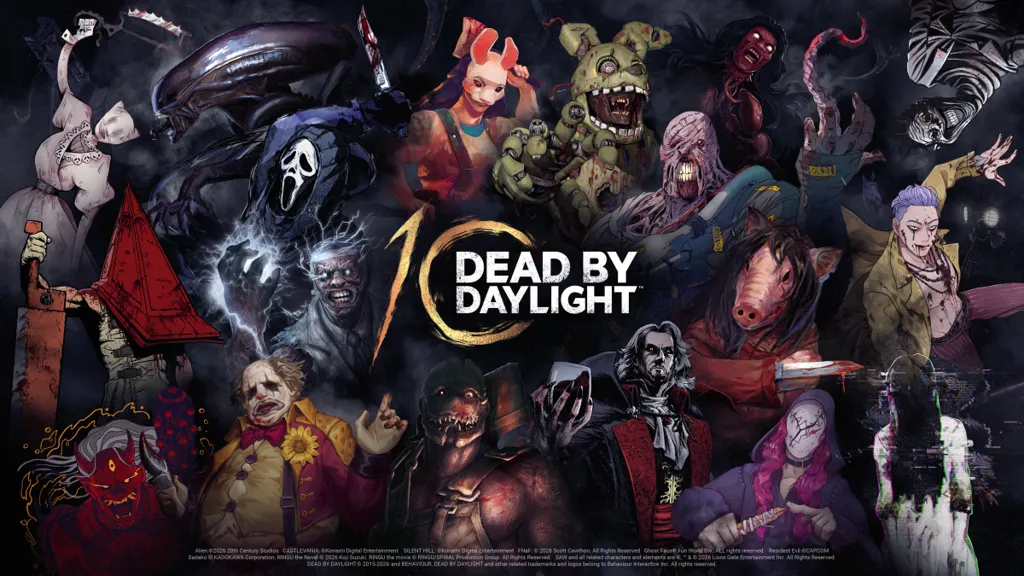
Dead by Daylight has never been able to exist in a static state. Over the last decade, the developers at Behaviour Interactive (It Has My Face, Blight Survival, The Casting of Frank Stone) have transmogrified the nearly decade-long running game into an ever-living horror macroverse; one shaped by player behavior alongside community involvement to focus on one of the most well-designed multiplayer experiences. What started as a lean, asymmetric experiment has grown into a sprawling universe that now includes narrative spin‑offs, a steady mix of licensed icons and original killers with interconnected lore, and even a forthcoming feature film from Blumhouse.
I had the immense fortune to sit down with Aude Laliberté, Dave Richard, and Mathieu Cote of Behaviour Interactive for a wide‑ranging conversation on where Dead by Daylight has been and where the train's next stops may be. We talked about literary horror influences, cosmic ambiguity, and why leaving unanswered questions can be a healthy intent; but we also dug into the practical realities of maintaining a ten‑year‑old live service game. From balancing the chaos‑heavy modes like 2v8 to experimenting with community‑driven chapters; Behaviour's leadership was generously candid about the trade‑offs, missteps, and lessons that only come with a game project that has stayed fresh on the hook for over ten years.
What emerged was a clear picture of a studio that understands Dead by Daylight's greatest strength; not just in reworked killers or exciting new licenses, but the uneasy space between the community, balancing their certainty and imagination, and finding ways for their horror to linger longer.
Nazmul Roosevelt, Newsweek: Dead by Daylight's universe feels unusually literary for a multiplayer horror game. Was Stephen King an intentional influence from the beginning?
Dave Richard, Behaviour Interactive:
Very early on, when we were still a very small team, Stephen King was already on our minds; particularly The Dark Tower. We were all fans, and we were interested in how those books connected different ideas and worlds without over‑explaining them. At the time, we didn't know the game would grow this large, but we built it with the hope that, if given the chance, we could eventually go deeper into that kind of storytelling.
The idea was to start small and leave room. When you're working with cosmic horror, being vague at the beginning is not a weakness; it's an advantage.
Nazmul Roosevelt: The Entity and its realm remain intentionally ambiguous even after a decade. Why keep so much undefined?
Mathieu Cote, Behaviour Interactive:
Every time you answer a question, you should open three more. That's how the mystery survives. If you close everything off, the universe stops feeling alive.
We leave narrative threads hanging on purpose so that, years later, we can come back and connect them in ways that feel meaningful. When players discover those connections, it feels earned.
Dave Richard:
That's very similar to reading Stephen King. You'll read a book and suddenly realize it connects back to The Dark Tower, and you wonder whether it was planned all along or assembled later. It doesn't really matter; what matters is that it works and that it feels like a good story.
Nazmul Roosevelt: Dead by Daylight is fundamentally a multiplayer game with limited space for traditional storytelling. Is that why projects like 'The Casting of Frank Stone' exist?
Dave Richard, Behaviour Interactive:
Narrative has always been a core pillar for us, even though the stories inside matches are created by the players themselves. That makes it difficult to tell deeper stories through gameplay alone.
Mathieu Cote,Behaviour Interactive:
Exploring other formats; single‑player games, comics, and now film; lets us tell stories in ways the core experience can't. The Casting of Frank Stone was especially interesting because it was our first fully narrative, single‑player project set in this universe.
We had a lot of questions going in. Should we use familiar characters or create new ones? How much lore should we reveal? How do we make sure it fits with everything else and doesn't limit future ideas?
Nazmul Roosevelt: What surprised you most about the response to The Casting of Frank Stone?
Dave Richard:
Honestly, that it exists at all. Seeing it finished and out in the world is still kind of amazing to me.
Mechanically, that style of game may age over time, but the story itself holds up. For us, it felt like one of our cinematic sequences made interactive, and players responded well to that.
When looking back to Behaviour Interactive's previous games, working respectfully with license‑holders to bring their properties into interactive worlds has always been the mission. There were standout licensed titles on the PlayStation 2, GameCube, and Xbox that showcased an early understanding of tone and adaptation rather than simple brand recognition. Scooby‑Doo! Mystery Mayhem in particular captured the off‑kilter atmosphere of the franchise as it existed across direct‑to‑DVD films, television, and live‑action reinterpretations. At the time, the studio was operating under its original name, Artificial Mind & Movement (A2M), and it built a reputation on translating established characters into games that felt curated rather than disposable. That approach extended to collaborations with Disney as well; with projects like Chicken Little being a great example of how they would balance gameplay accessibility with identity, with mechanics and narrative familiarity. Long before Dead by Daylight introduced Behavior Interactive's original horror mythology, the groundwork was already there; a studio learning how to inhabit other worlds without flattening the emotions and atmosphere that help them resonate in the first place.
Nazmul Roosevelt: Modes like 2v8 embrace chaos, but players worry about balance; especially for older killers. How do you approach that tension?
Dave Richard:
Chaos is one of our pillars. Some modes are meant to be competitive, but others are meant to be fun in a looser sense. 2v8 gives players space to experiment without feeling like every match has to be optimized.
That said, we have limited resources. We prioritize updates based on what's played the most, what's most broken, and what the community is asking for. All killers and perks eventually get attention; we just can't do everything at once.
Nazmul Roosevelt: Features like the automated Bloodweb have been divisive. How do you balance convenience with player choice?
Dave Richard:
Choice is important, and it's still there. The automated Bloodweb doesn't remove the manual option.
What we won't do is reward people for avoiding quality‑of‑life features. That would be like offering incentives for not using accessibility options. These tools exist to remove friction, not to take anything away.
Nazmul Roosevelt: How do you protect the survivor experience without making killers feel punished for playing efficiently?
Dave Richard:
We rely on three things. Internal intuition; what feels right to us as designers. Community perception; what players feel, even if it's not always backed by data. And then the data itself.
Perfect balance isn't the goal. The goal is for the game to feel fun. If something feels bad, even if it's technically fair, that matters.
Nazmul Roosevelt: If you could go back to the game's launch and give yourselves advice, what would it be?
Dave Richard:
Learn how to process feedback. Early on, we were exposed directly to everything, all the time, and we didn't have the experience or the support systems to filter it properly.
Over the years, we added community teams, marketing, and PR; people who understand how to translate feedback constructively. That buffer changed everything.
Mathieu Cote:
Surround yourself with people who know how to do that work. It makes a huge difference.