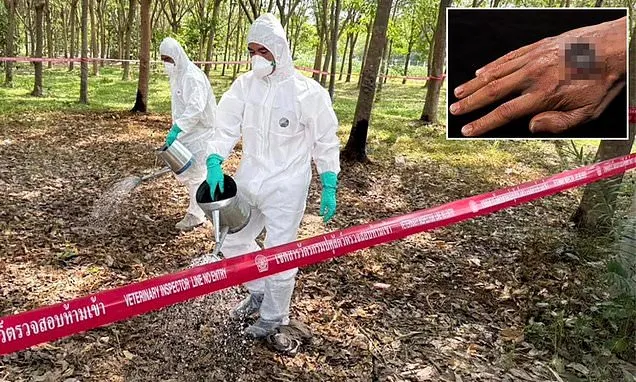
Most Americans assume they will never be exposed to anthrax.
But scientists are now warning that the deadly bacteria may be quietly lurking beneath someone's home -- in their local soil.
Anthrax, which can trigger blisters, dark sores and is fatal in nearly all cases if left untreated, is caused by the bacterium Bacillus anthracis.
Hannah Kinzer, a PhD candidate in public health at Washington University in St Louis, warned that the organism was present in much of the soil across the US, normally just within the first six inches of the surface.
The bacteria that cause deadly anthrax disease persist in the earth.
In the soil, they hang out and can form communities around plant roots. They also interact with neighboring micro-organisms.
For many, anthrax is imagined as a white powder, such as that sent through the mail during the 2001 anthrax attacks in the US that killed five and sickened 17.
But Kinzer said that, in reality, the bacteria is invisible to the naked eye, and often lies undetected in the soil, particularly in pastures and old burial sites.
She wrote in The Conversation: 'Once the spores take the form of bacteria, they can also mount an aggressive offensive. Anthrax bacteria can cleave vital proteins with toxins and wreak havoc on their cellular adversaries.'
Cattle, deer and other large herbivores disturb the bacteria and unintentionally eat the anthrax spores along with their food. They can also be exposed to it through a cut.
For animals, anthrax normally infects cattle, which happens after the animals ingest a large number of spores during grazing.
In their bodies, the bacteria release spores that cause severe internal bleeding.
The cattle can die within 48 hours of infection, and their bodies then decompose, returning the anthrax spores to the soil.
Kinzer said that this is the typical lifecycle for anthrax, and added that human infections are accidental and not typically part of its life cycle.
The anthrax bacteria rarely cause an infection in humans -- with health officials saying the risk of soil anthrax causing an infection is low.
Researchers in Nebraska say that this is because a human must be exposed to a high number of virulent spores to cause an infection.
These spores must also enter the body through one of three routes: Either a cut or scrape in the skin, being breathed in or ingested in a sufficient dose.
In most cases, infections in humans are only recorded after someone handles leather or wool, inhales spores or eats undercooked meat from an infected animal that has died.
There are no recorded cases of anthrax spreading from human-to-human.
In the US, only nine cases have been confirmed in humans since 2006. There has not been an outbreak since the bioterrorism attack with the contaminated letters in 2001.
Warning signs of an anthrax infection emerge from one day to two months after someone is exposed to the spores.
Patients may develop small, itchy blisters, painless sores on the face, neck, arms or hands, heavy sweats, chest pain, and a red face and eyes.
Within weeks, patients can develop the fatal complication sepsis or swelling of the membranes covering the brain and spinal cord, triggering major internal bleeding that causes death.
Infections can be treated with a 60-day course of antibiotics or a three-dose anthrax vaccine.
Doctors warn, however, that the treatment is not always successful.
For patients who were infected with anthrax via inhaled spores, only about 55 percent survive after treatment.
For those infected via eating contaminated food, only 60 percent survive after treatment. In skin infections, treatment clears virtually all infections.
In her comment piece, Kinzer warned that the bacteria preferred soils rich in alkalines, calcium and nitrogen, which are found across large areas of the western US.
But she also warned that, if these conditions were not present, the bacteria could persist in spores in the soil for 50 years or more, waiting for the right conditions.
The bacteria is also very difficult to kill as it can survive dehydration, radiation and toxic chemicals.