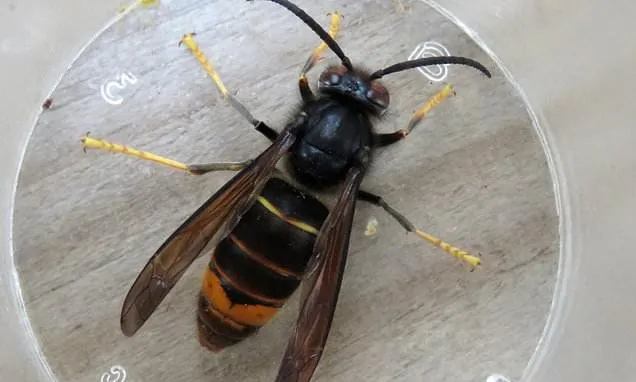
Britain could be losing its fight against an invasion of Asian hornets that prey on native bees and can be fatal to humans, an expert has warned.
Ian Campbell, from the British Beekeepers' Association (BBKA), says the UK is at a 'tipping point' in the battle to stop the hornets spreading - following a sharp increase in the number of nests this year.
He said each hornet nest is capable of consuming over 11kg of insects a year - and the species can prove fatal for people with certain allergies, too.
'The record number of nests found this year is alarming,' he told the Daily Mail.
'We are very concerned that the yellow-legged hornet could become established in the UK.
'The discovery of nest relatedness over the last two years is concerning as this is how establishment begins.'
Officials are now investigating whether the insects have become formally 'established' in Britain for the first time.
It follows the discovery of two second-generation nests earlier this year, which indicate the species is becoming more settled in the UK.
Asian hornets are distinguishable by their bright yellow leg tips, thin yellow stripes on their upper abdomen and a vibrant orange face.
The number of Asian hornet nests discovered has rocketed this year, with more than 160 nests found and destroyed.
Asian hornets, also called yellow-legged hornets, can kill up to 50 honeybees a day and are capable of a painful sting.
They are distinguishable by their bright yellow leg tips, thin yellow stripes on their upper abdomen and a vibrant orange face.
So far, a total of 161 nests - which can contain up to 3,000 Asian hornets each - have been found and destroyed this year.
This represents nearly a 700 per cent increase from 2024, when just 24 nests were found.
The Department for Environment, Food and Rural Affairs (Defra) has confirmed it is carrying out laboratory tests to decide whether the insects have established a permanent foothold in Britain.
If the species is considered established by experts, contingency plans would change from 'eradication' to 'containment', he explained.
The Asian hornet can have a 'serious impact' on Britain's biodiversity - especially on our native bees - Mr Campbell added.
'Early eradication is key,' he explained. 'Public awareness, good identification and reporting are essential.'
The Asian Hornet
The Asian Hornet, scientific name Vespa velutina, is an invasive non-native species from Asia.
It is thought to have first arrived in France in 2004, and has since been spreading rapidly, with the first UK sighting in 2016.
It is a highly effective predator of insects, including honey bees and other beneficial species.
Queens grow up to 3cm in length, and workers up to 2.5cm.
It can cause significant losses to colonies, other native species and potentially ecosystems.
'This is not the time to accept defeat and give up. This is a time for maximum effort.'
When it comes to humans, individual hornets can deliver an 'unpleasant sting' but are 'not particularly aggressive'.
'Sting response will vary between humans, however, and some people can be hypersensitive to venom,' Mr Campbell added.
'The main risk comes from nest disturbance. Yellow-legged hornets aggressively defend nests and this can lead to harm. Nests should never be approached too closely.'
The hornets were first accidentally introduced to Europe from China in 2004, when a queen arrived in France.
The insect has since invaded many parts of Western Europe and was first discovered in the UK in 2016.
Some make their way to the UK by flying across the Channel, but other routes include via ferries, containers and vehicles.
They are most commonly found in the south and southeast regions of England, with Kent being the most affected due to its proximity to France.
Each nest can produce 350 or more queens, some of which will begin new colonies the following year.
Experts say that Asian hornets are dangerously close to becoming established in the UK, and urge citizens to report any suspected sightings.
According to Defra, an established population is defined as a 'reproducing population that has been present in the wild for a significant number of generations'.
It said there is not yet strong evidence that yellow-legged hornets are established, adding that only a limited number of second-generation Asian hornets have been detected so far.
Earlier this year, DNA testing revealed that several queens discovered in the South East were likely offspring of two nests that had been destroyed last year.
Those nests were themselves offspring of nests found in 2023, marking the first evidence of second-generation Asian hornets being produced in the UK.
How to report an Asian Hornet
If you think you've seen an Asian Hornet, the best way to report any sightings is via the 'Asian Hornet Watch' app, available to download from the Apple and Android app stores.
The home screen of the app lets users submit a photo, date and location of sighting and other brief comments.
Reporting can lead to official investigation and nest destruction, which is vital for eradicating the invasive species across the UK.
A webpage of the UK Centre for Ecology & Hydrology also links to an online recording form, which likewise requests a date, photo and comments.
Members of the public can also report sightings by email to alertnonnative@ceh.ac.uk with a photo or on the Non-native Species Secretariat website.
This webpage from the British Beekeeper Association also has some helpful tips and images to help identification.
Be aware that the Asian Hornet can be confused with the native and ecologically important European hornet, which is not aggressive and doesn't typically pose a threat to healthy honey bee colonies.
Asian Hornets have yellow and brown on their legs, whereas European hornets’ legs are only brown.
Asian Hornets are also smaller and more slender than their European counterparts and have vibrant orange shading on their heads.