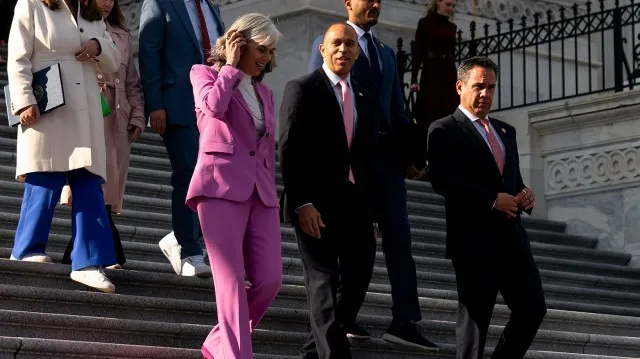
Democratic leaders are racing to rally their troops behind legislation limiting President Trump's war powers in Iran, hoping to minimize the defections ahead of Thursday's vote.
The war powers resolution seems likely to fail, given the opposition from virtually all of the Republicans who control the House, combined with a handful of Democrats who are expected to hop the aisle. But the Democratic defections have been a moving target, and the lines of opposition appear to be shifting in the wake of Trump's strikes on Iran over the weekend.
Before the attack, the loudest Democratic opposition was coming from those lawmakers with long track records of support for Israel. Reps. Josh Gottheimer (D-N.J.) and Jared Moskowitz (D-Fla.), who fall squarely in that camp, had both announced that they would vote against the measure.
But on Wednesday, Gottheimer and Moskowitz both softened that opposition. While they have offered an alternative war powers resolution, they also declined to say how they'll vote on Thursday when the initial resolution, which is sponsored by Reps. Ro Khanna (D-Calif.) and Thomas Massie (R-Ky.), hits the floor.
"I haven't taken a position since the strikes," Gottheimer said.
"I've decided. I'm just not ready to say what my vote is," echoed Moskowitz.
The vacillations highlight the competing pressures facing some Democratic lawmakers when it comes to issues involving the Middle East. While Democrats are united in the effort to push back on Trump's claims of unilateral power to use military force, some are treading cautiously to ensure they don't inadvertently heighten the security risk for U.S. troops and other interests abroad, including the national security of Israel.
"It's not an easy vote for someone like me. So many of my constituents have people who live in Israel. And they're under threat now, and they are under threat all the time from Iran. So we think about that," said Rep. Lois Frankel (D-Fla.).
Frankel described herself as "about as hard-core 'security of Israel' as you're going to find." Still, she said she plans to vote for the Khanna-Massie resolution in order to reassert Congress's authority to declare war.
"It's a difficult vote, because I do recognize the dangers of Iran -- there's no question about it. But the president should have come to us," Frankel said.
"I think you're going to see an interesting split -- people who are very, very pro-Israel, they're torn between our own Constitution, our own democracy, the president."
It's unclear how many Democrats will ultimately cross the aisle. Party leaders are bracing for a handful of defectors, including vulnerable centrist lawmakers who are facing tough reelection contests in November.
Rep. Don Davis (D-N.C.), who is among the most threatened Democrats, said Wednesday that he's typically supported war powers resolutions in the past. But he's still weighing his vote on reining in Trump's powers on Iran.
Rep. Tom Suozzi (D-N.Y.), who's also in a competitive race, was also non-committal.
Khanna, who's been hopeful that on-the-fence lawmakers will swing to his side, said he's made some progress in the days since Trump's strikes.
"There's movement," he said. "We're going to have a strong Democratic showing."
Still, he's not overly optimistic that the measure will pass, putting the odds at 40/60 -- the same prediction he'd given several days earlier. And Democratic leaders, who are fighting to send a strong signal to the White House that Congress can't be ignored in matters of war, are also girding for a few defectors.
"Unity doesn't mean unanimity," Rep. Pete Aguilar (Calif.), chairman of the House Democratic Caucus, told reporters Wednesday.
The long odds facing the Khanna-Massie resolution were foreshadowed on Wednesday in the Senate, where Republicans killed a similar resolution requiring the Pentagon to terminate military operations in Iran.
Given the Republican control of Congress, some observers have questioned the wisdom of forcing votes on war powers resolutions, since their failure can be interpreted as an indirect authorization of continued operations.
Most Democrats have rejected that argument, saying Congress has a responsibility to assert its unique war powers, as delineated by the Constitution.
"Iran is a murderous theocratic regime. They want to get a nuclear weapon. They fund terrorist networks and their stated aim is to destroy the United States and Israel," Rep. Ted Lieu (Calif.), vice chairman of the Democratic Caucus, said Wednesday. "At the same time, under our Constitution, only one entity can declare war, and that is Congress.
"And this is a war."