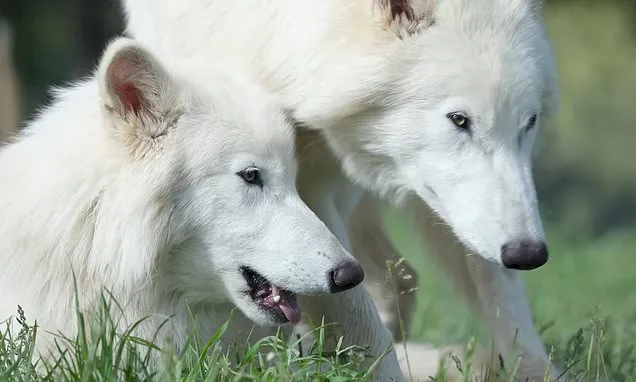
Dire wolf pups that were brought back from extinction are now ready to breed, the company behind the breakthrough has revealed.
Last year, Colossal Biosciences announced it had managed to 'de-extinct' the species, 12,000 years after it vanished from Earth.
The first litter included two male pups, Romulus and Remus, who were joined six months later by a female called Khaleesi.
The apex predators, made famous by Game of Thrones, are healthy and have continued to thrive under the watchful eye of keepers at a secure preserve in the US.
They have reached several milestones so far, including learning how to pick apart a whole deer carcass. And now, another landmark moment has been reached - as they are ready to breed.
The company has announced plans to create more pups later this year to expand the gene pool of the group and allow the animals to begin naturally growing their pack.
'The plan is to create an inter-breedable population of dire wolves in which they would eventually breed naturally to create a sustainable population of the world's first de-extinct species,' Matt James, the company's chief animal officer, told The Telegraph.
'We will grow the population through assisted reproduction initially and then eventually only rely on natural breeding.'
Colossal Biosciences says it has plans to engineer two to four more dire wolf pups to introduce into the pack before they will be allowed to breed.
Romulus, Remus, and Khaleesi, the first genetically engineered dire wolf pups, are growing bigger than most gray wolves.
To create the dire wolves, Colossal Biosciences started by reconstructing their genome from DNA found in ancient fragments of bone.
Using this genome as a reference, scientists then genetically modified grey wolf embryos so that they closely resembled the extinct dire wolf.
This meant inserting traits for a white coat, larger teeth, a more muscular build and a distinctive howl.
The hybrid embryos were then implanted in surrogate dog mothers, who gave birth by caesarean section to minimise the risk of complications.
'The dire wolves are doing great,' Ben Lamm, the chief executive and co-founder of the company said.
'The three dire wolves live on a 2,000-acre secure, expansive ecological preserve that allows us to monitor and manage them while providing them a semi-wild habitat to thrive in.'
'We hope to have more dire wolf pups by the end of the year.'
The wolves are being kept in an undisclosed location where they are fed beef, deer, horse meat and a specially formulated dried pet food.
The dire wolves were created by Colossal Biosciences, a Texas-based company using cutting-edge genetic engineering to bring extinct species back to life, including the woolly mammoth, dodos, and Tasmanian tigers.
After being extinct for around 12,000 years, Colossal Biosciences turned Game of Thrones' author George R. R. Martin's dire wolves into a reality.
What is the dire wolf?
The dire wolf (Aenocyon dirus) is an extinct wolf species that roamed the Americas as recently as 12,000 years ago.
Dire wolves were as much as 25 per cent larger than grey wolves and had a slightly wider head, light thick fur and stronger jaw.
As hyper-carnivores, their diet comprised at least 70 per cent meat from mostly horses and bison.
Dire wolves went extinct at the end of the most recent ice age.
'The dire wolf pack is actually breeding-aged at this point,' Mr James continued.
'But we will initially grow the pack through assisted reproduction while we create new, genetically diverse individuals to grow our pack.'
The company has said it plans to engineer two to four more dire wolves over the coming years.
Future wolves will be engineered from different cell populations so that the pack has more genetic diversity.
Once the pack contains multiple dire wolves at different ages, natural pack dynamics and hierarchies should start to emerge.
Experts have previously warned a large pack of ice age predators could become dangerous.
Nic Rawlence, a palaeontologist at the University of Otago, previously told the Daily Mail: 'If released into the wild in large enough numbers to establish a self-sustaining population, this new wolf could potentially take down prey larger than that hunted by grey wolves.
'There would also be the potential for increased human and wolf conflict. This sort of conflict is increasing as wolf populations recover in the USA.'
Some critics have also pointed out that animals scientists had created were not 'dire wolves' but simply genetically modified grey wolves.
Likewise, ecologists have questioned whether a species can safely be reintroduced to an ecosystem that has changed so thoroughly in its absence.
After the company revealed it was planning to bring back the giant Moa bird, experts pointed out that this could lead to unintended consequences.
Professor Stuart Pimm, an ecologist at Duke University who was not involved in the study, told AP at the time: 'Can you put a species back into the wild once you've exterminated it there?
'I think it's exceedingly unlikely that they could do this in any meaningful way.'
Inside the ambitious plan to 'de-extinct the Dodo'
It's one of the most famous extinct animals of all time, ruthlessly hunted to extinction by humans in just a few decades.
Now, scientists are edging closer to bringing the famous dodo back to its original home of Mauritius, the island east of Madagascar in the Indian Ocean.
US startup Colossal Biosciences, based in Dallas, Texas, is using stem cell technology and genome editing to create a modern approximation of the species.
At a cost of over $225 million (£180 million), it is 'de-extincting' the dodo more than 350 years after it was wiped out from Mauritius by European explorers.
Scientists have already achieved the monumental feat of sequencing the full genome of the extinct species, from bone specimens and other fragments.
The next step is to gene-edit the skin cell of a close living relative, which in the dodo's case is the Nicobar pigeon, so that its genome matches that of the extinct bird.