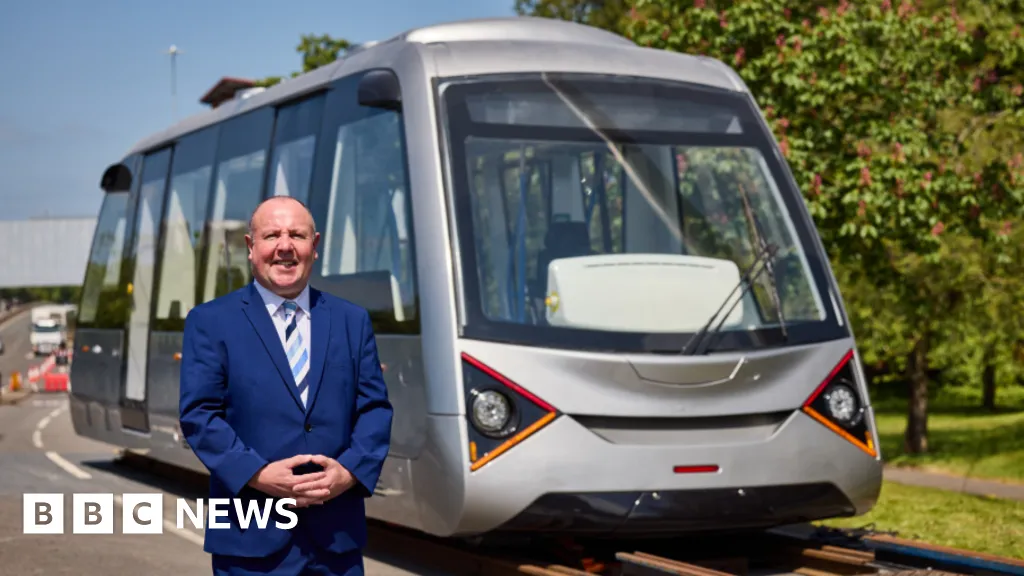
Concerns have been raised about potential disruption to businesses and residents when the next phase of a city's Very Light Rail (VLR) is built.
Coventry's VLR system has been described by the city council as like a tram but more flexible and affordable, as well as being an alternative to cars.
There was cross-party backing at Tuesday's full council meeting for the latest 800m (875yd) stretch of test track that will link the city's main railway station to Coventry University Technology Park, where the vehicles will travel alongside traffic.
However opposition councillors said they have concerns about the impact from that next phase of construction.
A number said they were contacted by those living or working in the area to voice their fears.
"Undoubtedly this is an asset for Coventry but I want to highlight a few issues that are think are important," councillor John Blundell said.
"There is no doubt that this will cause disruption to residents and businesses, particularly in the Park Road and Mile Lane area.
"My ward colleagues in Cheylesmore have raised concerns and I think it is extremely important that we actually listen to what the businesses and residents say, to ensure we mitigate any disruption as far as possible."
It was previously highlighted how technology meant the vehicles travelling along the new twin track section could be driverless and an autonomous service would be more attractive to the public, due to it running more frequently.
A report written by the council's director of innovation, Colin Knight, explained that that consultation was ongoing.
Conservative councillor for Cheylesmore, Barbara Mosterman, said: "Apparently, consultation has taken place but residents and businesses are telling us that the solutions offered do not address the real problems that they will face."
Reform's councillor Marcus Lapsa said he wanted to raise concerns on behalf of businesses on Park Road and the surrounding areas who had been in touch.
"Residents have taken time out to canvass businesses and not one of them wanted the scheme to go ahead because of what they feel has been a lack of consultation," he said.
"A key question repeatedly raised is whether there will be financial support for businesses threatened with closure.
"At present there appears to be no clear guarantee of compensation despite the real risk of prolonged disruption, reduced access and loss of customers during construction and testing."
Labour councillor Jim O'Boyle, the authority's cabinet member for regeneration, said the disruption faced would be nothing compared to that suffered by those living near to the Midland Metro.
"It is important that we consult and work with residents and businesses but the whole point of doing this is to limit the disruption," he said.
"So we may close part of a road for a very short period of time but compare that to two or three years in Birmingham and the extension to the Midland Metro."