Daily Mail journalists select and curate the products that feature on our site. If you make a purchase via links on this page we will earn commission - learn more
From a foot spa that will 'never become a self-care habit' to a £3,000 coffee machine 'that dominates the worktop' whilst quickly becoming useless, an interior designer has revealed the middle class gadgets that most people eventually come to regret.
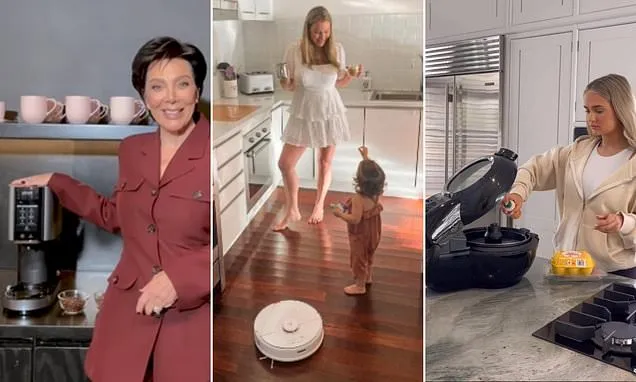
They include robot vacuum cleaners, of which Stacey Solomon and Australian TV personality Hannah Ferrier are both fans, as well as a £250 ice cream maker, which counts Kris Jenner as an admirer.
But while these celebrities embrace the high-tech, costly accessories, Jordana Ashkenazi, founder and design director of Element One House, insists that everyday people will soon find them troublesome.
She told the Daily Mail: 'As an interior designer, I see it time and time again. Clients invest in gadgets they believe will improve their lifestyle, make their homes more efficient or add a sense of luxury.
'But in reality, many of these items end up unused, taking up space and quietly contributing to what I would call a gadget graveyard.
'Families are often struggling to find space for everyday essentials, yet we continue to fill our homes with large, bulky items that do not earn their place. But it is not just about clutter, it is about how these things disrupt the way a home actually functions.
'The most successful homes are the ones that feel calm, considered and easy to live in, not filled with things that over complicate simple routines.'
Read on for some of the most common culprits of middle class gadget regret that Jordana has spotted recently...
Occasion Kitchen Gadgets
Jordana said: 'Waffle makers, panini presses, ice cream makers, bread makers. These are the items that tend to live in cupboards. They are bulky, awkward to store and often only come out once every year or two.'
THE EXPERT'S VERDICT: 'If it only comes out occasionally, it probably does not need a permanent place in the kitchen.'
Foot Spa
Jordana said: 'A well intentioned purchase that feels like self-care at the time. But the reality involves filling it, emptying it, cleaning it and actually sitting still long enough to use it.
'With the number of nail salons now on every high street, it also raises a simple question. There is so much competition that you can usually get a good treatment at a reasonable price, and it is often more enjoyable to go out, have it done properly and leave all the mess there.'
THE EXPERT'S VERDICT: 'For most people, it quickly becomes something that lives under the sink or in a cupboard, more of an idea than a habit.'
High-End Coffee Machines
Jordana said: 'The idea of having barista quality coffee at home is strong, but the reality is often a large machine that dominates the worktop, requires regular cleaning and maintenance, and feels like effort first thing in the morning.'
THE EXPERT'S VERDICT: 'If something is too complicated to use when you are half asleep, it tends not to last. Most people just want a coffee, not a process.'
Oversized Air Fryers
Jordana said: 'While they can be useful, the larger versions tend to dominate kitchen worktops. If something is too big to store and not used daily, it becomes visual clutter.'
THE EXPERT'S VERDICT: 'Visually, clutter is one of the quickest ways to make a space feel smaller and less calm.'
Stand Mixers
Jordana said: 'This is the ultimate aspirational kitchen purchase. People imagine baking regularly, hosting and creating everything from scratch.
'In reality, these machines are large, heavy and take up significant amount space. Unless you are baking consistently, they often end up sitting out permanently becoming more of visual feature than something that is actually used.'
THE EXPERT'S VERDICT: 'In smaller kitchens especially, they can feel more like an eyesore than a necessity.'
Bathroom TVs
Jordana said: 'This is one of those features that sounds luxurious, particularly in a showroom or a high-end hotel.
'But in reality, how many people actually sit in the bath and watch television? It is hard to think of anyone who genuinely does.'
THE EXPERT'S VERDICT: 'A bathroom should be a place to switch off, not another space filled with screens. Not every room needs entertainment.'
Robot Vacuum Cleaners
Jordana said: 'These promise effortless cleaning, but in practice they often require more involvement than expected. They get stuck, miss areas and rarely replace a proper clean.
'They also have a tendency to roam around unpredictably, which for some people feels more distracting than helpful.'
THE EXPERT'S VERDICT: 'There is something slightly unsettling about them moving around the house on their own, without ever quite doing the full job.'
Smart Toilets
Jordana said: 'These are perhaps the most over-engineered of all. Automated lids, heated seats, multiple settings and buttons for every possible function.
'In reality, they can feel unnecessarily complicated. You are often standing there waiting for the lid to open, or it is closing when you do not want it to.'
THE EXPERT'S VERDICT: 'Sometimes, you just want to go to the loo without the full tech experience.
'A toilet should not need instructions. It should be immediate, simple and reliable. When something so basic becomes complicated, it stops feeling like a luxury.'
Clothes Steamers
Jordana said: 'Particularly the large standing versions. They are bought as a more stylish alternative to ironing, but if they are not quick and easy to use, they become inconvenient. And anything inconvenient simply does not get used.'
The expert added: 'There is a wider pattern here. Many of these gadgets promise a better version of ourselves. More organised, more efficient, more in control.
'But often, they do the opposite. They take up space, add complexity and do not integrate naturally into everyday life. We are filling our homes with things that do not necessarily make our lives easier.
'A simple rule. Before buying any gadget, it is worth asking two simple questions. Will I use this every week? And where will it live?
'Because in most homes, especially in cities, space is limited. If we are struggling to store everyday essentials, it is worth questioning why we are making room for things we rarely use.'