In 2003, actress Barbra Streisand sued to remove an aerial photograph of her Malibu home from the internet, an ill-fated effort. Its legacy gave the internet a lasting phrase for the kind of attempted suppression that backfires into greater attention: the Streisand effect.
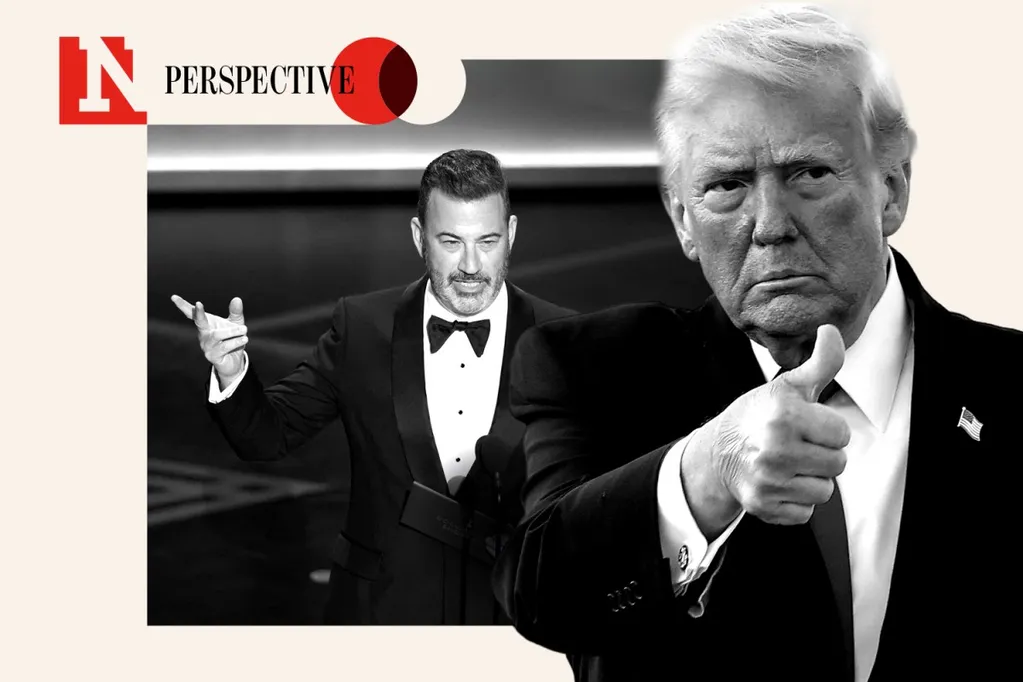
President Donald Trump is now Streisand-effecting the career of comedian Jimmy Kimmel, whose latest offense was an April 23 routine in which he said Melania Trump had "a glow like an expectant widow."
By demanding that ABC and Disney fire him, and not for the first time, Trump has turned a stale late-night joke into a live test of power and political overreaction.
But he has a better option.
The timing of Kimmel's joke was unfortunate but, crucially, not deliberate.
Two nights after the joke aired, the White House Correspondents' Association dinner was cut short when a man armed with guns and knives tried to enter the Washington ballroom where the president, first lady and much of the political class had gathered.
It was a close call. Fortunately, nobody was hurt. Shots were fired, but the suspect Cole Tomas Allen was detained before he could enter the dining room. He now faces multiple charges, including attempted assassination of the president.
Trump subsequently called Kimmel's joke a "despicable call to violence" and said he "should be immediately fired," while Melania Trump said "people like Kimmel shouldn't have the opportunity to enter our homes each evening to spread hate".
Kimmel replied that the line was "not, by any stretch of the definition, a call to assassination," but a "light roast about the first couple’s age difference".
The joke was made uglier by its proximity to the shooting, and caused upset among Trump’s supporters.
But the predictable angered attention of the Trumps, and the president’s demand for Kimmel’s firing, elevated its significance to a level well beyond what it deserved.
Traditional late night is not dying because presidents criticize or threaten it, but because the tired old broadcast ritual that your grandparents enjoyed no longer commands such cultural value.
LateNighter's 2025 Nielsen Live+7 data found that total late-night viewership across tracked shows was basically flat, at 13.025 million average nightly viewers that year compared with 13.056 million in 2024.
Adults aged 18-49 fell 17 percent, from roughly 1.8 million to 1.5 million.
That is the number Trump should remember, because it shows that late night is not being murdered -- it is aging out, replaced by podcasters and influencers who understand the real and biggest audience today is found through social media.
The monologue-desk-celebrity-plug format is no longer leading the American conversation. It's lukewarm porridge for aging liberals who want the cheap comfort food of obvious Trump jokes.
Kimmel was, however, a rare 2025 bright spot for late night shows, averaging 2.013 million total viewers -- up 14 percent -- and 230,000 adults aged 18-49.
But that spur was itself driven by a huge controversy that Trump and MAGA had amplified over comments Kimmel made about the killer of Charlie Kirk.
The incident was painful for Kimmel, who was suspended. But it ultimately saved his show.
In the fourth quarter of 2025, after his brief September suspension, Jimmy Kimmel Live! averaged 2.38 million total viewers, up 29 percent from the previous quarter, aided by heightened visibility of the show's sudden controversy.
Disney said his September return episode reached 6.26 million broadcast viewers, despite not airing on nearly a quarter of ABC affiliates, compared with his Q2 2025 average of 1.77 million.
Moreover, Disney said the comeback monologue drew more than 26 million views across YouTube and social platforms at the time.
Insight firm Tubular Labs later reported that Kimmel's return monologue reached 22.7 million YouTube views and became his most-seen video of 2025.
That is the whole business model in miniature: one smallish TV audience, one enormous outrage clip.
And therein is both Kimmel's greatest strength and his biggest vulnerability. The truth is that Kimmel's biggest moments now come when controversy supplies what the show itself cannot: relevancy.
The irony is that Trump is choosing hand-to-hand combat with a format whose real enemy is not censorship but boredom. Trump isn't killing the late-night machine he loathes; he's nourishing it.
The leap from condemning a bad joke to presidential pressure for corporate punishment is where Trump loses the plot. It transforms a banal comedian's throwaway joke into a free speech fight.
In a September 2025 Economist/YouGov poll after ABC pulled Kimmel off the air, 68 percent of Americans said it was unacceptable for the government to pressure broadcasters to remove shows containing speech it dislikes.
The same poll found that 17 percent of Americans watched Jimmy Kimmel Live! at least weekly, including 29 percent of Democrats and 8 percent of Republicans. That gap is the trap for Trump: he is turning a host many Americans rarely watch into a free-speech proxy many Americans understand.
CBS has already announced that The Late Show with Stephen Colbert will end in May 2026, calling it "purely a financial decision against a challenging backdrop in late night".
ABC has not commented on the latest Trump-Kimmel flare-up, and Kimmel's one-year extension is due to keep him on ABC until May 2027.
The future is probably not a late-night renaissance, but a smaller, more partisan, more clip-driven ecosystem in which outrage supplies the oxygen.
Trump's smartest move would be the one he seems least able to make: stop posting, stop demanding firings and stop making Kimmel matter. Let late night become what it is already becoming. Let it shrink. Let it clip itself into irrelevance.
Let Jimmy Kimmel's career die of natural causes: attention-starved.