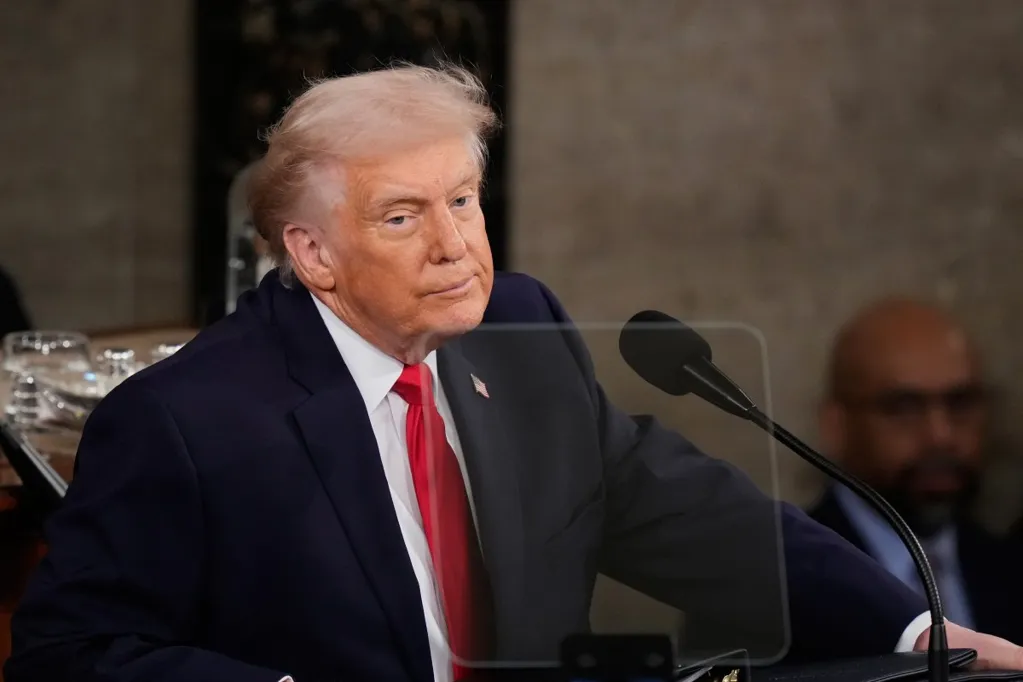
President Donald Trump's sprawling State of the Union address offered a characteristic mix of bombast and hyperbole while inviting immediate scrutiny given the bold assertions made about his second-term successes so far.
The speech -- the longest on record at nearly two hours -- was delivered before a divided Congress, punctuated by Republican applause and heckling from some Democratic lawmakers.
And as Trump went through a catalogue of achievements he said his administration had accomplished, the president took time to castigate his detractors for failing to recognize that the U.S. was, within just 13 months of his second term, "bigger, better, richer and stronger than ever before."
Newsweek has contacted the White House via email for comment.
Below, Newsweek examines several of the president's key claims from the speech and how they compare with available data.
Early in the speech, Trump said he had inherited a "stagnant economy" from President Joe Biden with "inflation at record levels."
While inflation peaked at 9.1 percent in June 2022 -- the highest annual rate in around 40 years -- the economy was on much stronger footing by the end of Biden's term. According to recent findings from the Bureau of Economic Analysis, real gross domestic product (GDP) grew 2.2 percent in 2025, a deceleration from 2.8 percent in 2024.
And though Trump later said that inflation was "plummeting" under his watch, the annual rate has slowed to 2.4 percent from 3 percent when he returned to office last January and remains higher than the 2.3 percent recorded in April.
"More Americans are working today than at any time in the history of our country," the president said at the 10-minute mark.
While the total number of working Americans is now at a record high -- 165 million, according to the latest Labor Department data -- the share of the country in work has steadily declined from a peak of 65 percent in mid-2000 and was at just under 60 percent in January.
Meanwhile, the unemployment rate has edged up to 4.3 percent from 4 percent in the 12 months to January, and revisions published by the Bureau of Labor Statistics (BLS) show that the economy added only 181,000 jobs in 2025, down from 1.5 million in 2024 and marking one of the weakest years for job growth outside of a recession this century.
Before criticizing the country's Supreme Court Justices -- four of whom were present for Trump's speech -- over their recent tariff ruling, the president bragged that he was able to get "commitments for more than $18 trillion pouring in from all over the globe."
"In four long years, the last administration got less than $1 trillion in new investment in the United States," Trump said. "And when I say less, substantially less."
Trump has repeatedly cited this figure without evidence, and past analysis shows that the amounts tied to mutual trade commitments struck with other nations are several times smaller and that these deals serve as pledges or upper-end projections rather than secured commitments.
The White House's own website currently puts "total U.S. and foreign investments" at $9.7 trillion, and The Associated Press reports that part of this total reflects investment pledges secured under the previous administration.
"Nobody can believe when they see the kind of numbers and especially energy, when they see energy going down to numbers like that," the president said.
While energy prices have been falling, the BLS data shows that electricity prices rose 6.3 percent in the 12 months which ended January, and reporting from CBS reveals that regulatory changes are expected to push up household utility bills for millions in 2026.
Trump also mentioned low gas prices, saying these are "now below $2.30 a gallon in most states and in some places $1.99 a gallon." According to AAA, the current regular gas price average is around $3, with the lowest being $2.41 in Oklahoma.
Thanks to the newly launched, government-run portal TrumpRx, the president said that prices for prescription drugs had fallen "from the highest price in the entire world to the lowest," with differences of "300, 400, 500, 600 percent and more."
But a new report from Democrats on the House Energy & Commerce Committee considers such statements "misleading or completely false" for nearly half of the drugs listed on the portal.
Moreover, Trump's assertion that some prices have fallen by over 100 percent is mathematically impossible, as a drop of this size would mean the price fell below zero and that vendors were paying customers to take the product.
In an appeal to the lawmakers present at his speech, Trump said that the SAVE America Act -- enforcing stricter ID requirements on voters -- was necessary to address "rampant" cheating in U.S. elections.
"That cheating is rampant in our elections. It's rampant," Trump said. "It's very simple; all voters must show voter ID. All voters must show proof of citizenship in order to vote."
There is currently no evidence of widespread fraud in U.S. elections, as Trump asserts, with analysis from several think tanks -- including the conservative Heritage Foundation -- indicating that instances of ballot fraud represent only a tiny share of votes cast.
In another defense of his now-annulled tariffs, Trump said that revenue from the duties -- and "other things" -- had been used to finance a $1,776 payment to America's active-duty and reserve service members.
However, the Department of Defense in December confirmed that the payments came from money allocated through Trump's One Big Beautiful Bill Act rather than tariffs and would be delivered as a "nontaxable supplement to their regular monthly housing allowance."
Trump said that, thanks to his deployment of the National Guard, there was now "almost no crime" in the nation's capital.
Although crime in Washington, D.C. has fallen considerably in recent years according to the Metropolitan Police Department, it would be an overstatement to say that this is now at near-zero.
However, Trump's claim that the nationwide murder rate "saw its single largest decline in recorded history" in 2025 was true according to the Council on Criminal Justice. The independent think tank wrote in a recent analysis that pending further data from the FBI there was a "strong possibility" that homicides last year fell to "the lowest rate ever" in records going back to 1900.
Around one hour into his address, Trump said that the 23-year-old Ukrainian refugee Iryna Zarutska, who was fatally stabbed in August while aboard a train in North Carolina, had been killed by someone who "came in through open borders."
The suspect in the murder, 34-year-old DeCarlos Brown Jr., is a U.S. citizen who was born in Charlotte according to local media reports and his own social media profiles.