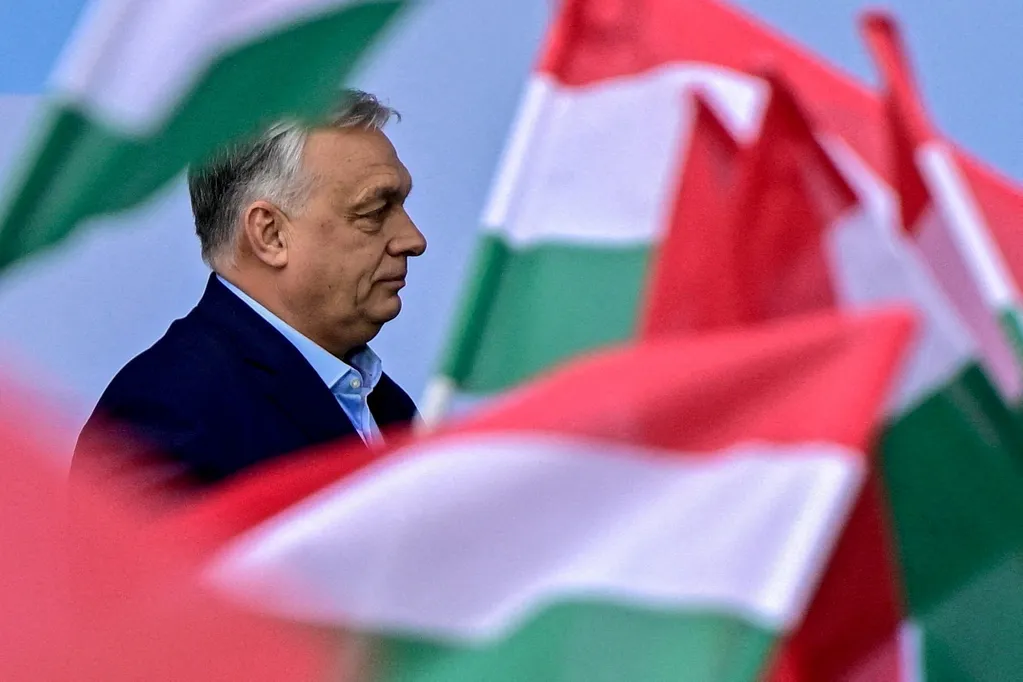
WASHINGTON -- On April 12, Hungarians will head to the polls in what will be their country's most competitive national election in over a decade. Péter Magyar, a former member of the ruling Fidesz party turned opposition figure, represents the first genuine challenger to Prime Minister Viktor Orbán's rule in the past fifteen years. Across Europe, many leaders are quietly banking on Orbán's defeat. His exit would remove the European Union's (EU's) most persistent spoiler on a range of issues, including sanctions on Russia and support for Ukraine.
Magyar is the leader of the center-right Tisza party, and independent polling puts Tisza ahead of Orbán's Fidesz by 11 percentage points. Yet despite this sizeable lead, the polling may not fully capture all of the dynamics involved in this election. Magyar's lead in the polls may overlook the entrenched electoral advantages structured to favor Orbán and Fidesz.
Hungary has a unique electoral model that advantages the largest party, which for years has been Fidesz. Hungary's National Assembly has 199 members elected through a mixed-member majoritarian system in which voters cast two ballots. The first ballot fills 106 individual seats, and the candidate with the most votes wins the seat. The second ballot fills the remaining 93 seats, and votes are cast for political parties.
In addition to ballots cast for party seats, party list totals are also calculated from votes cast for losing district candidates and unused votes from winning candidates through a "surplus votes" mechanism. Rather than discarding votes for losing candidates as most mixed systems do, Hungary adds these votes to the winning party's national list tally. For example, if Fidesz dominates individual-member contests, it will receive extra votes toward list seats, as well. This mechanism helps explain how Fidesz secured 68 percent of the parliamentary seats in 2022 while only receiving around 53 percent of the vote.
Tisza, therefore, may need to outperform Fidesz by as much as 6 percent simply to secure a parliamentary majority, making the real lead Tisza enjoys much tighter than the polls indicate.
Structural disadvantages for opposition parties are also built into Hungary's electoral system. After securing a supermajority in 2010, the Fidesz-led government redrew districts to pack opposition voters into larger urban constituencies, while creating additional smaller rural constituencies of Fidesz-leaning voters. This helped Fidesz retain its supermajority in 2014 with 70 percent of parliamentary seats despite winning less than 45 percent of the vote.
Concerns over Hungary's electoral integrity go beyond these aspects of the system. In the 2018 election, testimony from more than 170 ballot counters revealed instances of vote buying, voter intimidation, irregularities in postal voting, missing ballots, and technical issues with election software. Separately, bus convoys reportedly transported hundreds of Hungarian passport holders from Ukraine across the border to vote for Fidesz, while electoral rolls reportedly listed 110 people living in a single two-bedroom house and 200 at a single-story family home.
Against this backdrop, current polling data deserves scrutiny. While independent polling places Tisza in a comfortable lead, government-aligned polling shows a different story, with Fidesz up 7 percent from Tisza. There are also structural limitations to polling. Diaspora Hungarians, who historically vote overwhelmingly for Fidesz, are not captured in domestic polls but are counted in the national vote threshold.
The prospect of foreign interference also looms over the election, as well. Russia, for example, might want to keep the Kremlin's closest European ally in power and take steps to influence the outcome. Reports indicate that operatives from Russia's foreign military intelligence agency are currently in Budapest assisting in a targeted operation designed to sway the election in Orbán's favor. Russian agents even suggested staging an assassination attempt against Orbán to boost support for him in the race.
Meanwhile, US President Donald Trump has publicly endorsed Orbán. In February, Secretary of State Marco Rubio traveled to Budapest to show his support for Orbán's campaign. Vice President JD Vance may soon do the same. With covert Russian and overt US support for Fidesz, polling that shows Tisza ahead provides only a partial view of the forces shaping this campaign.
None of this is to say that Magyar cannot win. Polling should not be ignored, and there are concrete data points that point to Magyar's genuine momentum. Tisza secured nearly 30 percent of the vote in the 2024 European Parliament elections, and reportedly one hundred thousand people attended one of its rallies in Budapest last month. But the lesson of fifteen years of Orbán governance is that pre-election poll leads by opposition parties do not necessarily translate into parliamentary seats in Hungary. While opposition parties have historically struggled to poll ahead of Fidesz, the party has typically translated its vote share into disproportionately larger shares of parliamentary seats. Tisza presents an unusually unified opposition front, placing Fidesz's favorable electoral system under unfamiliar pressure.
Brussels has grown accustomed to Orbán playing spoiler on some of the EU's most important legislative initiatives, blocking or slowing their implementation. Many European leaders may view the April 12 election as a solution to their problems, but Orbán's departure is not guaranteed. The EU's ability to overcome political deadlock should not hinge on an election conducted on an uneven playing field. Should Orbán retain power, the EU should consider imposing stronger penalties on Budapest for continued obstruction and end its repeated practice of offering concessions in exchange for compliance.
April 12 may yet produce a historic outcome. Magyar's Tisza party has mobilized a broader and more energized opposition than anything Hungary has seen in the past decade. But the election is not over until all the votes are counted. European leaders should plan accordingly.