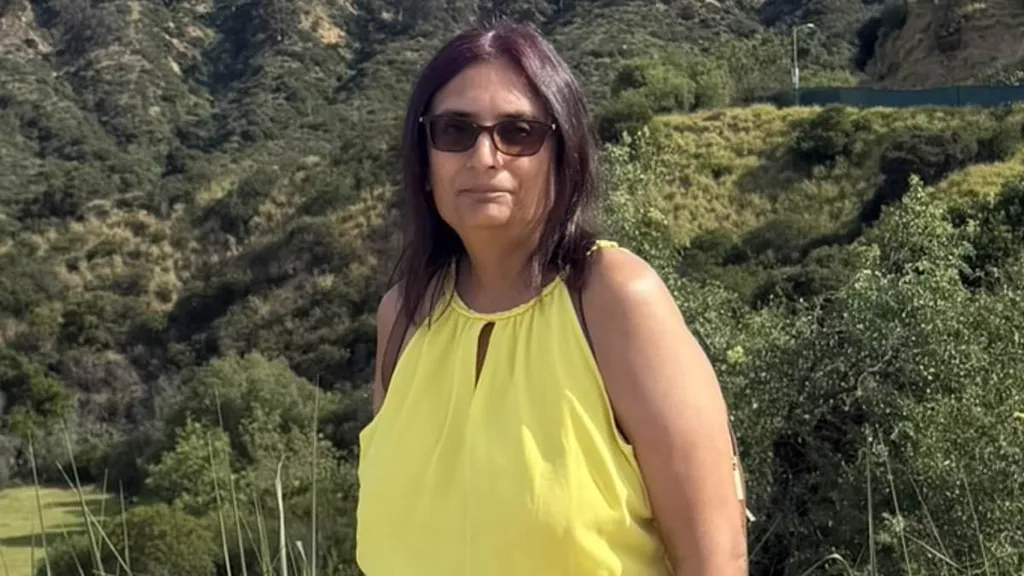
Sapna Bidwall had never been the sort of person who craved a caffeine-laden drink - until doctors told her that they were going to help stop her crippling headaches.
The mother-of-one, 45, from Milton Keynes, Buckinghamshire, ended up drinking three coffees, a caffeine tablet and a Coke Zero every day in order to combat her splitting headaches after she was diagnosed with a rare neurological disorder.
Ms Bidwall, who works as an accountant, started experiencing headaches in July 2023 while on a family holiday to Croatia with her husband Palvinder and now-13-year-old daughter Diya.
After spending long days in the sun during the country's hottest months, she dismissed the symptoms as 'dehydration' - even when she continued feeling sick in the coming days.
Determined not to let it ruin the trip, she dragged herself out and even attempted a hike the following day - which made her feel even worse.
But upon returning to their hotel, Ms Bidwall noticed something strange: her symptoms disappeared when she lay down.
Without realising it at the time, she had spontaneous intracranial hypotension - a condition caused by a leak of cerebrospinal fluid (CSF) through a small tear in the membrane surrounding the brain.
The condition causes the brain to sag slightly within the skull, leading to severe headaches that worsen when standing or sitting upright and ease when lying flat.
Sapna Bidwall had spontaneous intracranial hypotension - a condition caused by a leak of cerebrospinal fluid (CSF) through a small tear in the membrane surrounding the brain
It is rare, affecting around five in every 100,000 people in the UK - most of whom are women - and it is thought to be often misdiagnosed.
Ms Bidwall said: 'People really don't understand what a CSF leak is and patients are ignored.
'I know so many people who have been told they've just got migraines, when it goes deeper.
'I feel really sad about that because it's a condition that people are just so unaware about.'
Ms Bidwall continued to suffer with the headaches after returning from her holiday in Croatia to the UK, where she was referred to a physiotherapist.
By her own admission, she felt like those sessions were a waste of time - and continued to believe her symptoms - which also included a loss of appetite and frequent vomiting - were as a result of other things, such as menopause or using her phone before bed.
Months passed with no improvement and Ms Bidwall tried to keep living her daily life.
Then, during another family holiday, this time to the Turks and Caicos Islands in December 2023, her condition worsened significantly.
She said: 'I think it was day two when I went on the water slides there and then I woke up the next day and I felt my head was blasting.
'It was really quite bad and intense and that's when I thought there must be something seriously wrong.
'Luckily, because I was lying down a lot, I managed to get back to the UK, but I wasn't feeling right.'
Just days before the New Year, she went to her GP and told them that her head 'was bursting' and that 'there's definitely something wrong'.
Ms Bidwall was instructed to go to A&E, where she said she was admitted and had a CT scan and two MRIs over the course of a week.
On January 2, 2024, she was told that she had 'brain sag' - and received her diagnosis of spontaneous intracranial hypotension, which she was advised could be helped with rest and bizarrely, caffeine.
Ms Bidwall says she thought to herself at the time: 'What sort of condition encourages you to have Coke?'
But caffeine is recommended because it narrows blood vessels in the brain which can temporarily relieve symptoms, and may also help stimulate CSF levels.
However, anyone looking to increase their caffeine intake should discuss it with a doctor as this may not be suitable for everyone.
It required a massive change to Ms Bidwall's daily habits, especially because she 'never used to drink a lot of coffee'.
She said: 'I started realising, if I'm having caffeine towards the end of the day, around six o’clock, I’m not waking up with a headache. So I started making all these adjustments to make myself better.'
Ms Bidwall was also encouraged to stay at home for at least nine weeks to see if her condition improved, which she described as 'like being in prison'.
During this time, Ms Bidwall looked up her SIH diagnosis online and found a Facebook group for people with CSF leaks, where she began 'asking so many questions' for support.
It was through this group that she decided to see a private consultant neuroradiologist named Lalani Carlton Jones in March 2024.
After two myelograms - tests that use dye to identify where the leak originates from - Dr Carlton Jones referred Ms Bidwall to consultant neurosurgeon Dr Grahovac.
In June 2024, Dr Grahovac looked at Ms Bidwall's tests and said her leak was 'really small' and that it 'might self-heal' so he recommended just monitoring it.
Three months later, a follow-up MRI revealed it was still leaking, so she had to decide if she wanted to go through with spinal surgery.
Ms Bidwall said: 'It was now a year after my headaches started and I was still suffering.
'If I didn't have caffeine, my life was just not possible. I was caffeine-dependent.'
Ms Bidwall decided to go ahead with a thoracic laminoplasty procedure - a type of spinal surgery which reduces or eliminiated CSF leakage - in March 2025.
After the three-hour successful surgery, Ms Bidwall said she found out her leak was 10mm but that she was a 'functional leaker', meaning she was 'still able to do so much' compared to other people she has spoken to online.
Today, she now wakes up without headaches - even without the need for caffeine.
She said: 'My whole journey after surgery has been brilliant. I have never, ever woken up with a headache.'
As for her caffeine intake, she's now 'got a taste for coffee' and likes 'having one every now and then'.
She continued: 'I can say all the positive words in the dictionary to express my gratitude to Dr Carlton Jones and Dr Grahovac.
'I know I've got life because of them and I have a second chance. It's like I've won a lottery.'