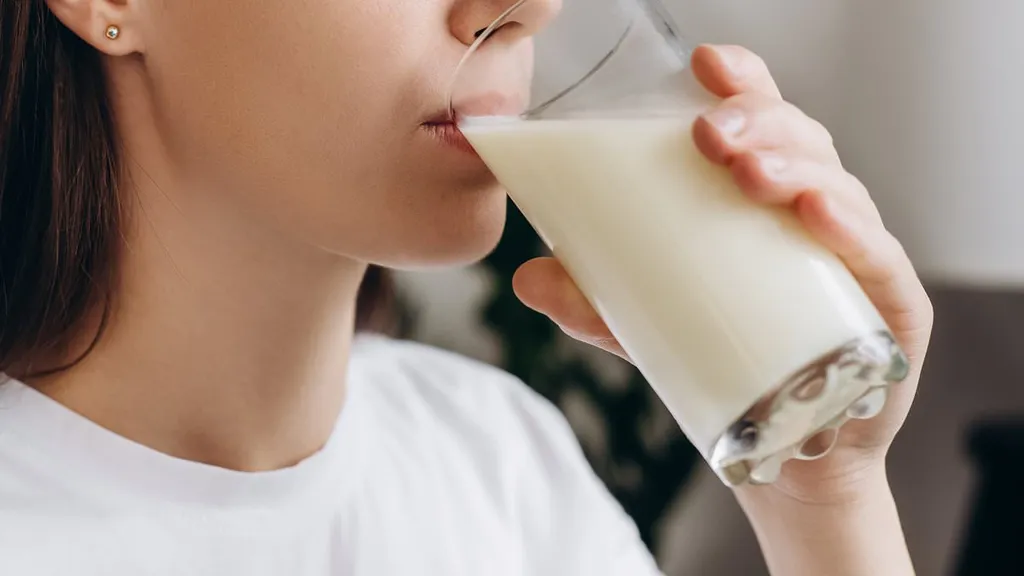
Drinking milk after exercising could help protect older adults from life threatening fractures, promising new research suggests.
As the global population ages, maintaining muscle mass and bone density has become a major health challenge, with more than three million people in the UK living with osteoporosis.
But far more than that are expected to be at risk, with up to 40 per cent of over-50s thought to have osteopenia, the earliest stage of bone thinning.
Engaging in regular exercise, particularly resistance training, has long been considered one of the most effective interventions against musculoskeletal disease.
But now Chinese scientists say pairing a strength based exercise routine with an after workout glass of milk could help prevent bone thinning.
Protein has long been linked with bone health as it helps boost calcium absorption which is crucial for bone strength, reducing the risk of breaking a bone from a fall later in life.
The study, published in the Journal of Nutrition, Health and Aging, compared the efficacy of cow's milk and soy milk as easily consumable protein sources.
A total of 82 healthy adults aged 60 and above who were free from any medical conditions that would impact their protein intake were included in the final study.
All participants completed an eight-week exercise programme, comprising of three sessions of resistance and balance training a week.
Participants were then split into one of four groups: exercise only; exercise with nutrition education; exercise with nutrition education and cow's milk supplementation and; exercise with nutrition education and soy milk supplementation.
Groups one and two received no additional dietary intervention and ate as normal.
Participant's in the cow's milk group drank 240ml of low fat milk 30 minutes to an hour after finishing their workout.
Participants drinking soy milk received slightly less, to ensure both groups were getting around 7-8g of protein per session.
These groups also ate 60g of steamed sweet potato after each training session to balance out the protein with carbohydrates.
Nutritional education sessions were held weekly and focused on healthy eating patterns with adequate protein intake, oral health, and injury prevention.
After eight weeks, all groups showed significant improvements in walking speed, suggesting that regular exercise improves mobility and performance.
Those who made no changes to their diet, but exercised regularly experienced significant improvements in handgrip strength and moving from sitting to standing.
This, the researchers said, indicates enhanced neuromuscular function and lower-limb strength.
But the greatest improvements were seen in participants who drank a glass of cow's milk after exercising and attended weekly nutrition classes.
These participants demonstrated significant improvements not only in hand-grip strength, but how quickly they could stand up from a chair and sit back down five times in a row, and walking speed over a six-meter distance.
The researchers said: 'This indicates that combining exercise with milk supplementation may be more beneficial for muscle function than soy milk supplementation.'
Notably, handgrip strength - which has been associated with a range of health outcomes, from type 2 diabetes to depression - in group 2 who attended nutrition classes but didn't change their diet was significantly lower.
This suggests that knowledge-based interventions alone are not enough, without accompanying diet changes.
The researchers concluded: 'This study suggests that combining resistance exercises with immediate post-exercise supplementation of protein-rich whole foods, particularly milk, may improve bone health and physical function in community-dwelling older adults.'
However, they acknowledged that despite its strengths, the study has several limitations including its relatively short duration.
Bone thinning is diagnosed with a Dexa scan, which measures how much bone mineral - mainly calcium - you have compared with a healthy person in their 20s. A score of zero is normal. Between -1 and -2.5 indicates osteopenia, while anything below -2.5 is classed as osteoporosis.
Over time, osteoporosis weakens bones making them fragile and more likely to break. It develops slowly over years and s often only diagnosed when a fall causes a bone to break.
Treatment is based on taking medicine to strengthen the bones, but regular exercise, healthy eating, supplementing vitamin D and giving up smoking and cutting back on alcohol can all help support bone health.