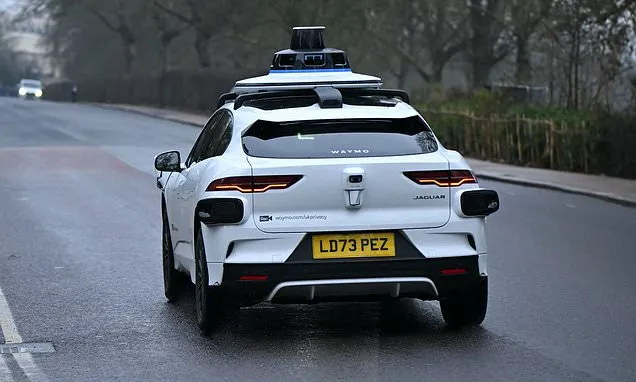
Driverless cars have slammed on the brakes after confusing an advertisement with real people.
The worrying news comes as a trial of self-driving taxis looms in London in April, and tests have already been conducted in British locations, including York.
Despite the fact that the computer-controlled vehicles are being unleashed, concerns about their safety controls remain high.
Government self-driving vehicles advisor Professor John McDermid, a software expert based at York University, told journalists at London's Science Media Centre that the cars continued to be confused easily.
In particular, he explained, one driverless car had mistaken a life-size advertisement for the 2015 film The Man from U.N.C.L.E, on the side of a bus, featuring several actors, for a group of actual pedestrians in the road.
As a result, the vehicle's Artificial Intelligence made it perform an emergency stop - potentially endangering vehicles behind it.
Prof McDermid told the Daily Telegraph: 'One of the automated vehicle companies I work with had a situation where their vehicle did a sudden emergency stop because it's all pedestrians in the road, except they weren't.
'It was a life-size advert on the side of a bus, but to an AI, it was human beings. That seems very obvious [to us], but actually, to the AI, it’s not..'
Even though computer-controlled vehicles are being unleashed, concerns about their safety controls remain high.
Prof McDermid added that in trials in his university city of York, driverless cars had been confused by unpredictable movements by pedestrians - including using a crossing when the traffic light has gone green, and the red 'no crossing' man is flashing.
In America, where self-drive cars are being pioneered, 'jaywalking' is a crime with potentially serious consequences, so pedestrians are perhaps more likely to adhere to crossing instructions.
In Britain, the pedestrian remains king - and the new-fangled robot vehicles seem not to grasp it.
Prof McDermid said of the driverless-car-crossing-confusion in York: 'It's seen that there's a traffic light, so identified the hazard, because the light is red. It changes to green, the vehicle is about to move off.
'But this is York, so the tourists - although the lights change to green - still walk across the road.
'Computer vision doesn't understand what it doesn't have models for in the world. It doesn't know what a roundabout is.'
American self-driving car company Waymo is to run its driverless taxi trials in London from Easter, with plans for Uber to take up the scheme and then provide robotaxis to the paying public.
But in Waymo driverless vehicles in San Francisco two years ago, school lollypop ladies reported multiple near misses with the futuristic cars.
A survey of 30 of the crossing attendants said around a quarter had suffered a 'close call' from an autonomous vehicle, with some having to run out of the way.
Veteran lollpop lady Theresa Dorn was victim to three driverless car near-misses in a year, saying of one, where a parent had to dash to the rescue: 'The parent grabbed the child, looked at the car - and there was nobody driving it.
'Why do they have these driverless cars? I think somebody should be driving them.'
In Britain, Government guidance says 'self-driving vehicles should be held to the same high standard behaviour as that expected of human drivers.'
But a majority of people surveyed suggest standards should be higher - and appear fearful of a rise in the 1,600 people a year killed on UK roads.
Prof McDermid has warned that pedestrians should not become a 'moral crumple zone' for robocars.