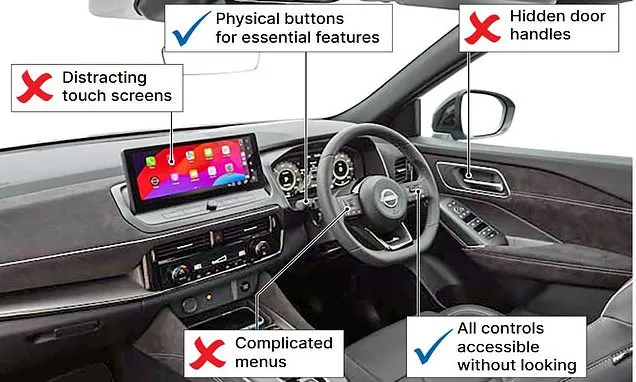
From touchscreen consoles to hidden door handles, most new cars today are packed with high-tech features.
While these futuristic tools might make you feel like James Bond out on the road, car safety experts have now warned that many of them can prove deadly.
Among these are the trendy pop-out handles, which were banned by authorities in China this week amid fears they can trap passengers inside the car after a crash.
Touchscreen 'infotainment' dashboards have also come into the firing line, as growing evidence shows they are a dangerous distraction.
Unlike a physical switch or knob, a screen creates a distraction by forcing drivers to take their eyes off the road.
Professor Milad Haghani, a car safety expert at the University of Melbourne, told the Daily Mail: 'They require visual attention and demand glance durations often longer than safe thresholds.
'That long glance duration can be deadly.'
Now, just as we've seen people turning to 'dumbphones' to safeguard their mental health, experts are calling for cars to be simplified to protect us on the road.
Hidden or pop-up door handles first made an appearance with the Tesla Model S in 2012.
These designs feature a handle which sits flush with the car body, only popping out when it is pressed or when the car is unlocked.
The big difference from a traditional car door is that these use an electronic button to open the car from the inside, rather than a mechanical lever.
However, if a crash affects the car's wiring, this can mean that the door handle cannot be opened from the inside or outside.
Most cars with hidden locks have a backup mechanical switch somewhere inside the car, but these are often extremely difficult to find.
The mechanism in a Tesla Model 3, for instance, requires moving a plastic panel in the door and tugging on a hidden cord.
There is now a serious concern that this means passengers could be unable to exit the car in the case of a crash, with potentially fatal consequences.
The ban in China, for instance, comes after two fatal crashes involving Xiaomi electric vehicles in which power failures were suspected to have prevented doors from being opened.
China has banned hidden door handles on new cars from January next year, following mounting concerns that they may not open in the event of a crash
The 5 changes safety experts say modern cars must make
- Get rid of touchscreen infotainment systems
- No more complicated 'all-in-one' interfaces
- Remove hidden 'pop-up' door handles
- Bring back physical buttons
- Place all essential controls within easy reach
China's ban will require all new cars sold from January 1 2027, to have enough space for a hand to operate their mechanical release from any angle.
Other countries are already considering following with their own action after a number of tragic accidents saw people unable to be rescued from cars due to problems unlocking door handles.
Tesla's door handles are already under investigation in the US by safety regulators, while authorities in Europe are considering their own rules.
The other feature that could be a target for future legislation is the in-car touchscreen interfaces that have recently become so popular.
Touchscreen interfaces, which used to be limited to high-end electric models, are now standard in almost every new car.
This might make cars look tidier and save carmakers money on wiring switches, but they also mean drivers have to take their eyes off the road to perform basic tasks.
'Essential features are the ones drivers often and frequently need to access during the drive, such as temperature control, wipers, demister, head lights and the like,' explains Professor Haghani.
'Drivers should be able to access these via quick tactile shortcuts that are easy to find and easy to manipulate.'
All cars with hidden door handles have a manual release on the inside, but these can be very difficult to find. The Tesla Model 3 (pictured) requires removing a panel and pulling a hidden cord
However, carmakers are shifting more and more of these essential features onto the touchscreen in an attempt to de-clutter the dashboard.
For example, Volvo's EX30 EV requires the driver to navigate to a sub-menu on the touchscreen just to adjust the electric mirrors and the rear window de-mister.
Likewise, Volkswagen's ID.7 completely ditches conventional air vents in favour of a complicated digital display that can only be controlled through the screen.
Professor Haghani says: 'It can be the difference between spotting a hazard and braking just in time, and a crash.'
A recent study showed that drivers' reaction times worsened by over 50 per cent when they had to use a touchscreen interface.
That is an even bigger impact on your safety than texting or taking a call on your mobile, which increases the time it takes to react by 35 per cent and 46 per cent respectively.
Likewise, a 2022 study put drivers through a simulated motorway test while they tried to perform basic in-car tasks.
The group that only used a touchscreen had markedly decreased reaction times, which would have meant travelling several extra car lengths before stopping at motorway speeds.
Cars like the Volkswagen's electric ID.7 have moved basic functions like controlling the air conditioning into a complicated digital interface
The solution, according to experts and regulators, is to ditch the touchscreens and complicated menus and bring back traditional buttons.
When car safety researchers talk about distraction, they describe it as having three aspects: visual, manual, or cognitive.
Essentially, you can take your eyes off the road, your hands off the wheel, your mind off the task at hand, or some combination of three.
Touchscreens are so dangerous because they combine all three elements: You have to look at the screen, tap on the menus, and think about what you are doing.
Buttons and dials, on the other hand, only create a manual distraction as you reach for the controls.
You don't need to look down or think about what you’re doing to turn the radio down or adjust the fan, making the distraction significantly less dangerous.
'The more intuitive and simpler the dashboard is, the safer it would be for driving,' says Professor Haghani.
There is also a growing body of evidence to show that consumers don't want complicated touchscreen interfaces.
An RAC survey found that nearly a quarter of people who have had an accident while driving say they were distracted by using a touchscreen interface
In an RAC survey of 2,395 drivers, nearly a quarter of respondents said that infotainment systems were one of their top three safety concerns.
Likewise, a 2024 survey found that 26 per cent of drivers admitted to making a mistake on the roads while interacting with a touch screen system.
Nicholas Lyes, director of policy and standards for road safety charity IAM RoadSmart, told the Daily Mail: 'Our research suggests that more than half of drivers find 'all-in-one screen' infotainment systems negatively impact their ability to change radio stations and climate controls in their vehicle.
'Thankfully, many manufacturers are starting to reinstall some of the more essential buttons in new vehicles, which should reduce in-car distraction.'
Back to buttons? Car touchscreens more dangerous than texting behind the wheel, experts warn
Outside of the UK, legislators are already stepping in to ensure that safer physical buttons return to our cars.
Euro NCAP, Europe's leading automotive safety industry body, ruled that new cars will only earn a five-star safety rating if they have separate physical controls for essential features.
Matthew Avery, director of strategic development at Euro NCAP, told the RAC: 'The overuse of touchscreens is an industry-wide problem with almost every vehicle-maker moving key controls onto central touchscreens obliging drivers to take their eyes off the road and raising the risk of distraction crashes.'
Likewise, in Australia and New Zealand, the car safety assessment program ANCAP Safety has announced that it will ask manufacturers to 'bring back buttons' from 2026.