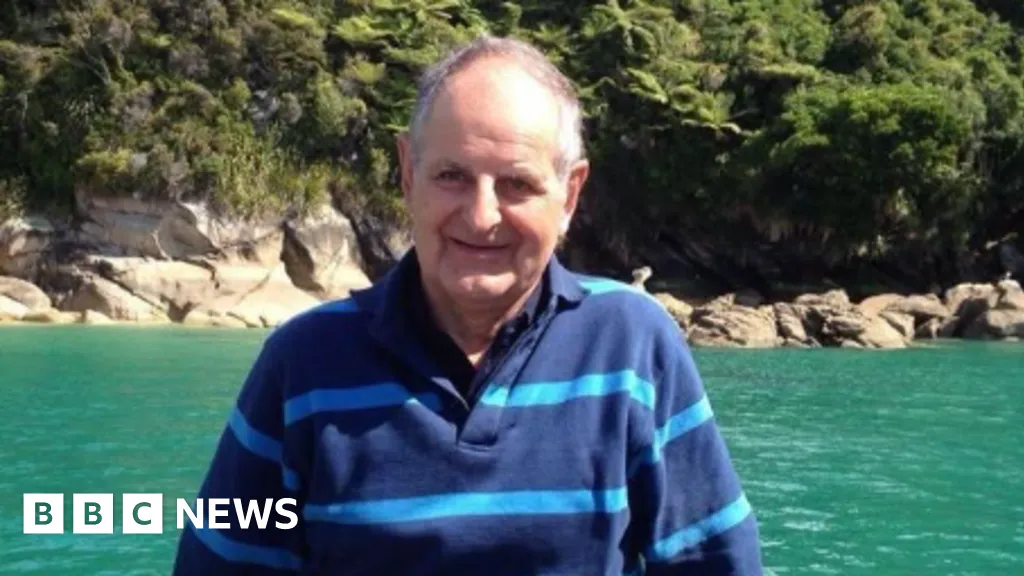
When the relatives of Robert Crozier learned they were entitled to claim damages from Scottish Power following his death from asbestos exposure, they believed their eight-year fight for justice was over.
The landmark Supreme Court judgement paved the way for other families to claim damages from other companies.
Scottish Power says it hopes to proceed in the coming weeks, but six months on, the Crozier family say they are "disgusted" that they have yet to receive a penny.
Robert, from Livingston, worked for Scottish Power as a mechanical fitter from 1969 until 1992.
Throughout his employment he was exposed to asbestos - a natural fibrous mineral that was often used in construction materials - but it is toxic and carcinogenic.
In 2014, Robert successfully claimed compensation from Scottish Power after developing pleural plaques - scar tissue on the lining of the lungs - and contracting asbestosis, a form of lung disease.
That settlement included damages relating to the risk of developing mesothelioma, an aggressive cancer primarily caused by asbestos exposure.
Robert's settlement would have prevented him from claiming damages if he did go on to develop mesothelioma, which is why he claimed for the risk.
Robert - who was known to loved ones as Elliot - died in 2018, aged 79.
His youngest daughter, Gwen Lamb, said watching his deterioration was "horrific".
She told BBC Scotland: "We watched him going from being a very healthy, happy person to a very frail, sick man that was in pain constantly.
"With the amount of painkillers he was taking, he was hallucinating.
"The worst day ever was the day that he was shouting at me, 'get Gwen, get Gwen', and I was standing in front of him."
Before his death, Robert made his family promise to pursue their own separate claim against Scottish Power.
Gwen said: "He felt that he wasn't going to be around to help us or to be there for us and he felt that this was the last thing that he could do for us.
"He knew that it would help other people to make sure this went through for him."
The company argued the family were not entitled to compensation because of the previously settled claim.
But their lawyers - Thompsons Solicitors - argued there was an exception under the Damages (Scotland) Act 2011, where the deceased died from mesothelioma.
It took almost almost eight years for the case to get to the Supreme Court. In December, judges rejected Scottish Power's argument and ruled in the family's favour.
At the time, a spokesperson for Scottish Power said: "We understand this has been a difficult time for Mr Crozier's family.
"This was an important test case as to how the legislation is interpreted and we welcome the clarity it provides."
However, Thompsons say they have had very little communication from Scottish Power since.
Associate Jennifer Lilly said while there was no precedent for a case like this, they would have expected Scottish Power to have a settlement proposal by now.
"We have no indication of what they're waiting on. We have no idea why it's taken them so long to make settlement proposals," she said.
Following the Supreme Court judgement, other families represented by Thompsons have successfully claimed damages from other firms for deaths caused by mesothelioma.
Gwen Lamb says that's compounded her frustration: "I'm just completely disgusted by the company.
"Because at the time they made out that the reason they were doing this was a point of law they wanted to have confirmed, that there was really no malice towards the family.
"You would have thought if that was the case, once it was confirmed, what was the reason then not to just pay out and put an end to our suffering?
"But they haven't done, so it is now starting to feel very personal. Why are they doing this to us?"
A Scottish Power spokesperson said: "We understand this has been a difficult time for Mr Crozier's family while the final legal procedures between solicitors have been ongoing to together resolve some outstanding issues related to the UK Supreme Court determination.
"We have responded promptly to the family's solicitors and expect to be able to proceed in the coming weeks once the ongoing court matters have concluded."