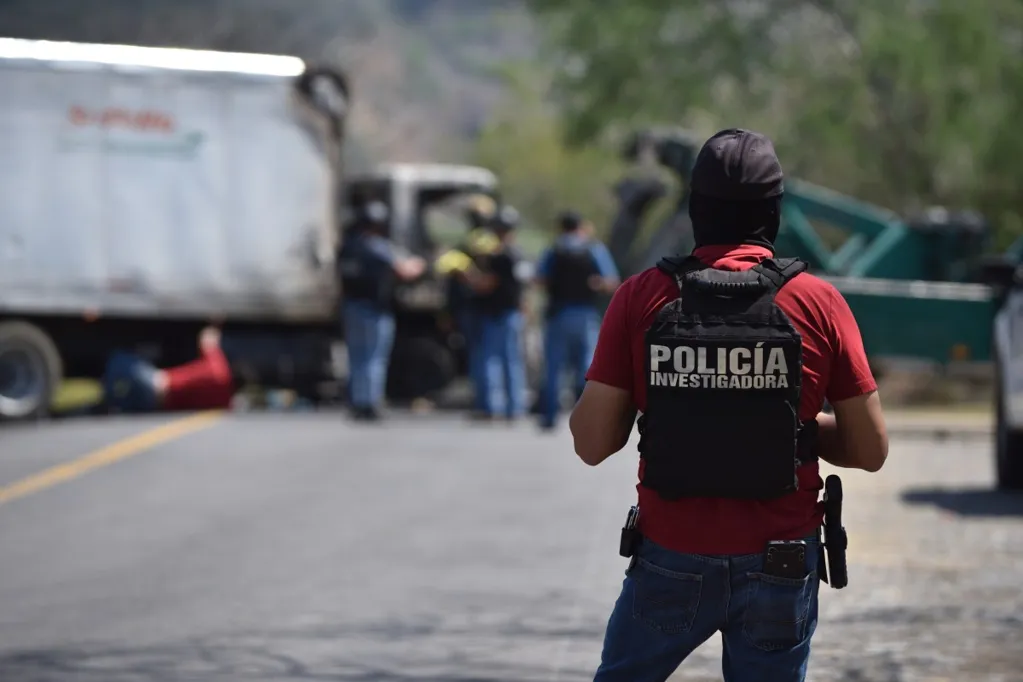
Authorities in Mexico discussed the extent U.S. intelligence played in the killing of one of the world's most wanted drug lords, Nemesio Oseguera Cervantes, known as El Mencho.
Newsweek reached out to the Mexican government for comment via email.
The killing of El Mencho, the leader of the Jalisco New Generation Cartel (CJNG), on Sunday sparked widespread unrest in Mexico and cartel retaliation in multiple states. Officials said the attacks left 25 National Guard members and several others dead across Jalisco. Numerous countries have issued travel warnings for Mexico in light of the violence.
Oseguera Cervantes had decades of involvement in drug trafficking and multiple U.S. indictments, including charges under the Drug Kingpin Enforcement Act. U.S. and Mexican authorities had pursued him for alleged fentanyl and methamphetamine trafficking.
The White House said the United States supported the Mexican operation with intelligence but did not provide further details about that involvement.
Mexican authorities, including President Claudia Sheinbaum, discussed U.S. involvement in the attack, The Wall Street Journal reported. Sheinbaum said there was no direct U.S. involvement and that U.S. boots were not on the ground during the operation, though her administration has strengthened intelligence cooperation with the U.S.
Defense Secretary General Ricardo Trevilla also said Mexico has "strengthened our relationship with the U.S. Northern Command," according to the Journal.
"The intelligence process is very complex. It requires a great deal of time to gather a lot of information from diverse national and international sources," he said.
That intelligence is a "very important flow of information, and that's how we arrived at this specific case," he said, according to the newspaper.
The Mexican Embassy in the U.S. wrote on X that the operation was "carried out within the framework of bilateral cooperation, with U.S. authorities providing complementary intelligence."
Since the operation, CJNG members have launched more than 250 roadblocks in 20 states. They also have set fire to vehicles and paralyzed major cities, including Guadalajara and Puerto Vallarta, a major tourist destination. Airlines canceled flights to Puerto Vallarta amid the retaliation.
Omar García Harfuch, Mexico's secretary of security and citizen protection, said Monday that dozens of people were killed in the attacks. He said there were six attacks across Jalisco and at least one civilian woman died, he said.
The violence has also left tourists stranded in Puerto Vallarta. The U.S. State Department urged Americans in the region to shelter in place after the airport halted operations.
The cartel is widely regarded by U.S. and Mexican authorities as a dominant force in the global drug trade. It was formed in 2009 after the breakup of the Milenio Cartel and had established large operations by 2012.
It was organized under the leadership of Cervantes, who became one of the most wanted cartel leaders in the world. Under his command, the cartel built a multibillion‑dollar empire rooted in the trafficking of fentanyl and other drugs.
The cartel is known for its militarized structure and use of advanced weaponry. It has spread into more than 20 Mexican states, including strongholds in Jalisco, Colima, Michoacán and Guanajuato. The U.S. government has designated CJNG as a foreign terrorist organization, citing its global reach, extreme violence and central role in fentanyl trafficking.
In 2025, the State Department described it as a "transnational organization with a presence in nearly every part of Mexico."
"In addition to trafficking fentanyl, the group engages in extortion, migrant smuggling, oil and mineral theft, as well as weapons trade," the State Department wrote. "The group has contacts across the Americas, as well as in Australia, China, and Southeast Asia. CJNG has conducted intimidating acts of violence, including attacks on Mexican military and police with military grade weaponry, the use of drones to drop explosives on Mexican law enforcement, and assassinations or attempted assassinations of Mexican officials."
Mexican President Claudia Sheinbaum, on X on Sunday: "The Secretariat of National Defense reported on the operation carried out this morning by federal forces, which resulted in various blockades and other reactions. There is absolute coordination with the governments of all states; we must remain informed and calm. The social media accounts of the Security Cabinet provide permanent updates. In the vast majority of the national territory, activities are proceeding with complete normality. My recognition to the Mexican Army, National Guard, Armed Forces and Security Cabinet. We work every day for peace, security, justice and the well-being of Mexico."
White House press secretary Karoline Leavitt, on X: "The United States provided intelligence support to the Mexican government in order to assist with an operation in Talpalpa, Jalisco, Mexico, in which Nemesio 'El Mencho' Oseguera Cervantes, an infamous drug lord and leader within the Jalisco New Generation Cartel, was eliminated. 'El Mencho' was a top target for the Mexican and United States government as one of the top traffickers of fentanyl into our homeland. Last year, President Trump rightfully designated the Jalisco New Generation Cartel as a Foreign Terrorist Organization -- because that's exactly what it is."
Authorities in Mexico said they deployed thousands of additional troops to Jalisco and neighboring states and reported clearing most roadblocks. The U.S. Embassy in Mexico wrote on X on Monday that it "has no higher priority than the safety and security of U.S. citizens."
"If you are an American in Mexico who needs consular assistance, you can call the Department of State's Bureau of Consular Affairs at +1-202-501-4444 from outside the United States or +1-888-407-4747 from the United States or Canada," it said.