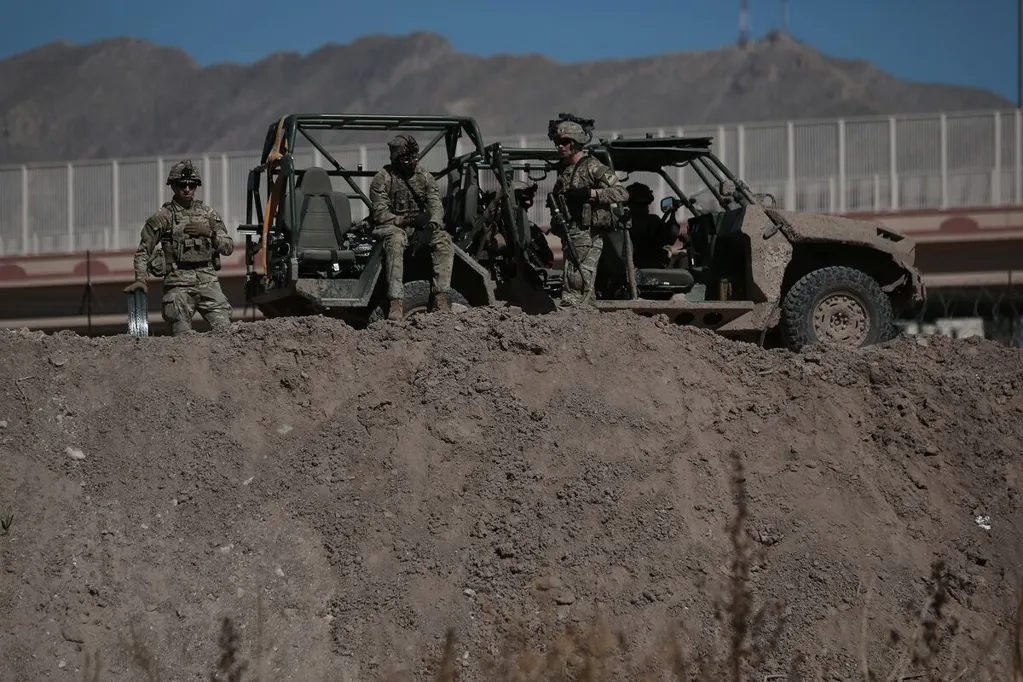
The incident highlights the Pentagon's struggle to defeat low-cost drone threats and the need for greater cooperation and clarity between military and federal agencies on the use of counter-drone technologies in US airspace.
The US military has spent years working to defeat increasingly numerous and capable drones with directed-energy systems that cost less and offer more rounds than traditional missiles. One of those systems was at the center of the confusing airspace closure in El Paso, Texas last week.
A US Army-owned LOCUST system, manufactured by AeroVironment Inc., was used by the Department of Homeland Security to target drones from a site in New Mexico, according to a person familiar with the situation who spoke on condition of anonymity.
But a lack of communication between government agencies meant that DHS's tests prompted the Federal Aviation Administration to close the airspace around El Paso on Tuesday for "special security reasons."
Transportation Secretary Sean Duffy said the closure -- initially scheduled to continue for 10 days -- was due to a Mexican drug cartel drone entering US airspace. The restriction was lifted hours later after, Duffy said, the threat was neutralized. But other officials pointed to testing of the counter-drone technology that the FAA feared would affect safety of civilian aircraft at El Paso International Airport.
The confusing turn of events -- even White House and Texas officials seemed surprised by the airspace's closure -- overshadowed a deeper issue: the Pentagon's struggle to defeat low-cost threats without relying on a costly and limited supply of high-end missiles.
Drone warfare is center-stage in the Russia-Ukraine conflict, allowing off-the-shelf technology to quickly punch back against multi-million dollar weapons systems that took years or decades to develop. And thanks to their small size and low cost, drone use is spreading well beyond the confines of battlefields.
"Along the border, they are being used increasingly by transnational criminal organizations for surveillance and smuggling operations," said Bella Grabowski of the America First Policy Institute, adding that military installations and critical infrastructure can be targets for surveillance as well as potential intelligence collection.
To counter the rising threat, Defense Secretary Pete Hegseth has directed his department to pursue "drone dominance" by accelerating and expanding production of drones for US military use, while seeking to speed up purchases of counter-drone technologies.
Yet the military has so far struggled to find solutions that can be sustained in dirty and rough battlefield environments -- and industry is not yet fully ready to build them in meaningful quantities.
For instance, the Army has been working for years to develop and field directed-energy weapons such as high-powered microwaves and high-energy lasers, with the aim of saving costly missiles for more complex threats.
As part of that effort, the service appeared close to fielding a 50kW laser weapon on a Stryker combat vehicle. The laser performed well in desert test environments in the US. But when sent to the Middle East for further evaluation, the system’s reliability didn’t hold up and the Army realized it had problems trying to fix it in the field.
LOCUST has seemed like another promising option. The technology, which can be mounted on a number of different vehicles, consists of two parts: a laser system and a tracking system. An artificial intelligence program locks onto drones as far as two miles (3.2 km) away, deciphering targets and boasting greater beam control than more powerful lasers.
AeroVironment has delivered more than a dozen LOCUST systems, with 20kW lasers, to the US Army, including two as recently as last summer on GM Defense-made Infantry Squad Vehicles.
That was the system at the heart of the confusion in Texas.
People familiar with the matter, speaking on condition of anonymity to discuss nonpublic information, said the FAA was concerned about drones that the Pentagon was flying in the area and testing of the counter-drone technology. One of the people said the drones had been operating outside of normal flight paths and that the FAA was unable to predict where they might be flying.
In the incident's aftermath, the Army and DHS continue to assess how many drones were actually shot down, a US official said. People familiar withthe technology say that it's unlikely that the use of a laser weapon like the LOCUST would pose a threat to commercial aircraft.
Still, the incident underscores the hazards of deploying military technology at home as drone threats multiply. It also raises questions over how aligned the military and federal agencies are in understanding the various risks or safety issues such weapons may or may not have in airspace.
The Pentagon in January published new guidance for identifying and classifying drones and paved the way for greater cooperation with other agencies including DHS. The guidance also expanded the ability of commanders to counter drones near military installations.
But those directives didn't provide the clarity needed last week, and the FAA seems to have been left in the dark.