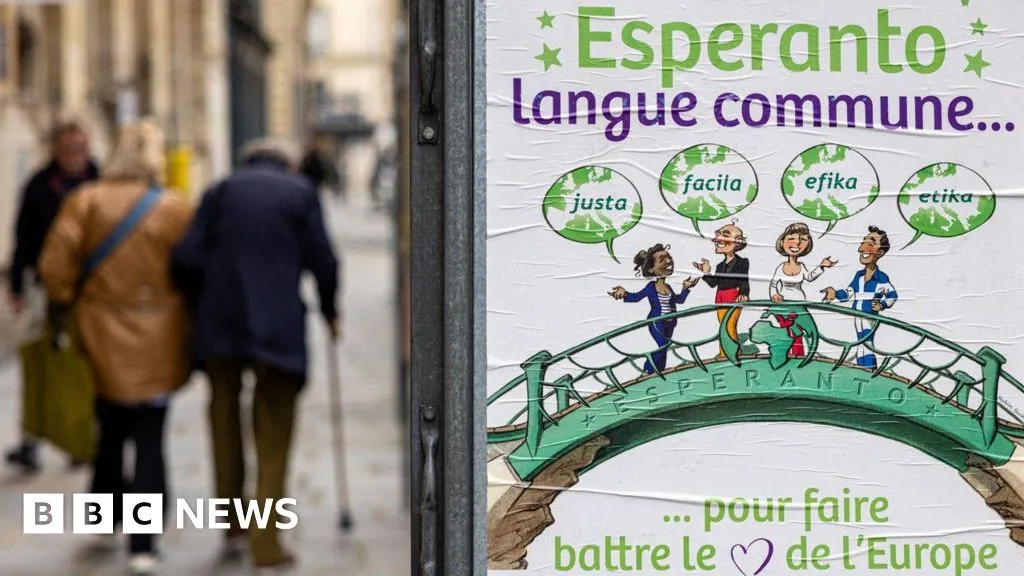
Launched in 1887, Esperanto aimed to offer a constructed language that was easy to learn, understand and even help to promote world peace. Despite the passing of almost 140 years, speakers say it's still going strong and are sharing the story of its Yorkshire roots.
First proposed by Warsaw-based Ludwik L Zamenhof, the ophthalmologist hoped his linguistic creation would become the global second language.
Despite its Polish beginnings, the first Esperanto society in the UK was established in West Yorkshire in 1902.
"People learned Esperanto to get a taste of what it would be like to go abroad and meet foreigners, without any realistic prospect of doing so," says Jack Warren, a fluent Esperantist.
The 78-year-old recalls how his mother learned the language in the early 1930s.
"It was a cheap alternative to learning French and going to France for a holiday, which they couldn't afford anyway," Warren, from Sheffield, says.
Zamenhof developed the language in his 1887 book Unua Libro, written under the pseudonym Doktoro Esperanto - 'doctor bearing hope'.
It made its way to the UK via Keighley when local journalist Joseph Rhodes discovered it and launched the nation's first formal society.
He went on to become an influential figure in British Esperanto and published the first English-Esperanto dictionary, with the 500-page document arguably becoming the standard text for early British learners.
Warren, the president of the Yorkshire Federation of Esperantists, was given a dictionary from his mother as a boy but did not begin to learn the language until the 1980s - eventually being drawn in by a community that "wanted to make the world a better place".
"Given that it's the first place in Britain, you would have thought it would be somewhere like Cambridge, Oxford or London," says John Goodwin, a Todmorden-based trustee of the Esperanto Association of Britain (EAB).
"But no, it was this little town in West Yorkshire."
Malcolm Jones, from North Yorkshire, says the language is easy to learn because of its simple grammar, a lack of irregular verbs and a phonetic spelling system.
The retired teacher and former EAB board member mastered it through postal lessons in 1984 and "soon became fluent".
He created the Skipton Esperanto group in 1995, with the group still holding regular events.
"It's all in Esperanto, we don't speak any English," says group member Cally Berry, the former head of languages at Skipton Girls' High School.
Precise numbers of current global speakers are difficult to gauge, with estimates generally falling between the wide range of 100,000 to two million.
Many learners have become fluent through apps including Duolingo, with the language said to have found a recent second life online.
According to the World Esperanto Youth Organization (TEJO), it has thousands of members in more than 90 countries.
Tolkien's classic Lord of the Rings trilogy, Roald Dahl's Matilda, nearly all of Shakespeare's plays and the Bible are among the books to have been translated into Esperanto editions.
This weekend, speakers from across England and beyond are gathering in Leicester for the annual Brita Kongreso de Esperanto (British Esperanto Congress) - the largest UK gathering of speakers.
Tyron Surmon, 26, a former president of TEJO, has been speaking Esperanto for a decade and started to learn it after he "stumbled across it on Wikipedia".
"Within two weeks I knew more of it than the French I had been learning for seven years," he says.
"I thought it was cool; I started learning it the day after my French GCSE exam."
He says its online presence had increased awareness of the language but echoed the difficulty of pinpointing the exact number of new speakers.
"It seems to be pensioners and students - people with a lot of free time," he says.
"It has given me so many opportunities - jobs, meeting people I never would have otherwise met and I have travelled the world."
So while its popularity remains difficult to assess, Yorkshire's current Esperanto community may prove the alternative way of communicating still holds value.
"It's really cool when you meet other Esperantists," Berry adds.
"You just speak Esperanto and nobody's got an advantage."