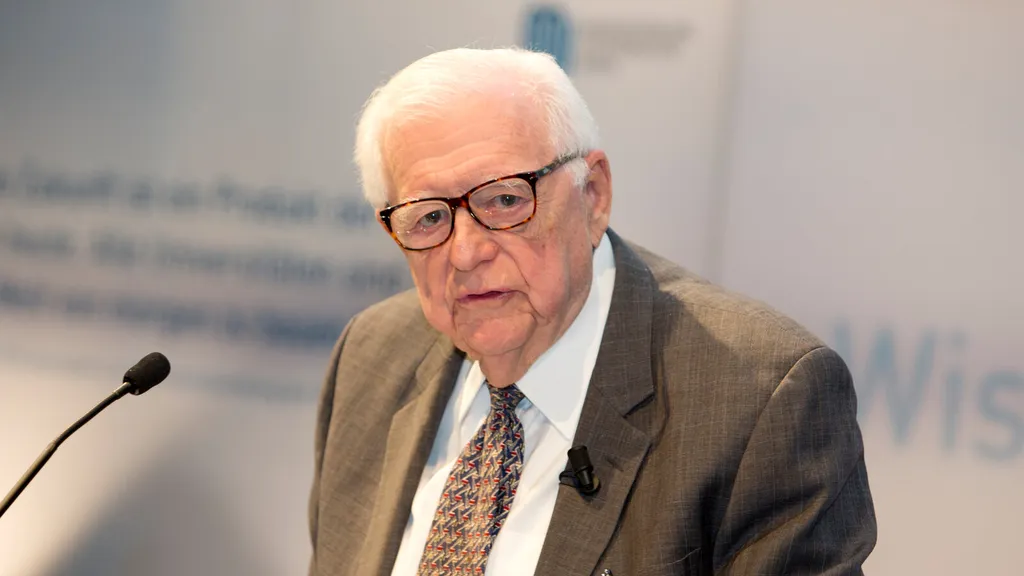
His work changed how doctors understood heart attacks, heart failure and coronary artery disease, and helped lead to therapies that saved millions of lives.
Eugene Braunwald, a groundbreaking cardiologist whose research helped transform heart disease from a near-certain killer into a condition often manageable with medications, procedures and careful monitoring, died on Wednesday in Newton, Mass. He was 96.
His death, at a hospital, was confirmed by his daughter Jill Braunwald Porter. He lived in Weston, Mass.
Widely regarded as one of the most influential cardiologists of the 20th and early 21st centuries, Dr. Braunwald helped establish his field as a rigorous scientific discipline grounded in physiology, clinical trials and evidence-based medicine.
His research reshaped how doctors understood heart attacks, heart failure and coronary artery disease, and helped lead to therapies that saved millions of lives, including medications that lowered the heart's workload and reduced blood pressure and treatments that reopened blocked arteries.
Since its first edition in 1980, "Braunwald's Heart Disease: A Textbook of Cardiovascular Medicine" has served as a foundational yet continuously updated reference. Many doctors refer to it simply as "Braunwald," shorthand for a vast and evolving body of knowledge.
"He made his entire life about answering questions that were important to improving the health of people with cardiovascular disease," Dr. Thomas H. Lee, the author of the 2013 biography "Eugene Braunwald and the Rise of Modern Medicine," told the American Heart Association for a 2024 tribute to Dr. Braunwald.
Dr. Braunwald's contributions were conceptual and practical. He helped redefine heart attacks as dynamic processes that could be interrupted or limited. He pioneered the idea that reducing the heart's workload after a heart attack could limit damage. Rather than simply treating symptoms of heart disease, he helped demonstrate the value of drugs that altered the disease's course.
In the 1960s, many physicians believed heart attacks were sudden, irreversible events. In 1971, Dr. Braunwald and his colleagues at the University of California, San Diego, published their finding that damage to the heart muscle often progressed over hours. This insight helped pave the way for treatments aimed at restoring blood flow quickly, including clot-busting drugs and other emergency interventions.
He also helped introduce rigorous randomized clinical trials into cardiology, modernizing the field.
"He led a series of studies that transformed the face of cardiovascular medicine," Dr. Douglas Vaughan, who was part of Dr. Braunwald's research team in the late 1980s, said in a 2007 interview with Vanderbilt Health News. "Every practicing cardiologist has to appreciate the impact of Dr. Braunwald's insights and research in the mechanisms and treatment of acute myocardial infarction."
Over a long career, including a half-century association with Harvard, Dr. Braunwald's name appeared on more than 1,000 scientific papers. His research ranged from basic physiology to large-scale clinical trials involving tens of thousands of patients.
His influence extended beyond research and writing. As a teacher and mentor, he trained generations of cardiologists who went on to lead departments, conduct landmark studies and shape clinical guidelines. Many of his trainees became leaders in academic medicine.
It was as a mentor, though, that he was involved in one of the first high-profile academic research scandals. In 1981, a young researcher under his supervision at Harvard, John R. Darsee, was found to have faked experimental data.
Dr. Braunwald terminated Dr. Darsee's fellowship and notified the medical school dean, but he did not inform the National Institutes of Health, which was funding the research.
When the N.I.H. discovered what had happened, it began an investigation. The fraud was found to have been more extensive than Dr. Braunwald had believed.
Harvard, which had absolved Dr. Braunwald of blame, was asked to return the federal funds it had received for the study. A string of papers based on Dr. Darsee's work was retracted.
In its report, the N.I.H. criticized Dr. Braunwald and his lab director for not supervising researchers closely enough, saying that "a hurried pace and emphasis on productivity, coupled with limited interaction with senior scientists, have contributed to the disappointing events." Dr. Braunwald denied that he had been lax in his supervision.
Eugene Braunwald was born on Aug. 15, 1929, in Vienna. His father, Wilhelm, ran a wholesale clothing business; his mother, Clara (Wallach) Braunwald, managed the home.
They were Jewish, and Eugene's childhood was disrupted by the rise of Nazism. After the annexation of Austria by Germany in 1938, his mother masterminded the family's perilous escape, first to England and then to the United States, where they settled in Brooklyn.
With his mother pressing him toward medicine, he attended New York University, graduating when he was just 19; then entered N.Y.U.'s School of Medicine, from which he graduated at the top of his class in 1952. He completed his residency at Mount Sinai Hospital in New York and did fellowship study under Dr. André Cournand, who in 1956 was awarded the Nobel Prize in Physiology or Medicine for his work on cardiac catheterization.
In 1955, Dr. Braunwald joined the National Heart Institute (now the National Heart, Lung and Blood Institute), where he conducted important studies on the physiology of heart failure and coronary artery disease. He would eventually serve as its chief of cardiology and as one of the youngest clinical directors in the agency's history.
His work helped clarify how the heart responds to stress, exercise and disease; how changes in blood flow and pressure affect heart function; laying the groundwork for modern approaches to diagnosing and treating heart disease.
In 1968, Dr.Braunwald moved to University California San Diego where he helped establish department medicine . He returned east 1972 joining Harvard Medical School its teaching hospital Peter Bent Brigham Hospital (now Brigham Women’s Hospital) where built one world’s leading cardiology programs served chair department medicine 24 years . A 16-story tower hospital named him 2019 .
At Harvard , led major clinical trials , including studies demonstrating drugs like beta blockers ACE inhibitors could improve survival after heart attacks heart failure patients .
Dr.Braunwald was also instrumental advancing understanding unstable angina , chest pain caused reduced blood flow heart . His research helped show aggressive treatment could prevent heart attacks high-risk patients .
In1952 ,Dr.Braunwald marriedDr.NinaStarr ,cardiac surgeonhadmetundergraduates togetherN.Y.U .Shebecamefirstwomansuccessfullyimplantartificialheartvalve ,anddied1992 .
Twoyearslater ,Dr.BraunwaldmarriedElaineSmith ,formerchiefoperatingofficerBrighamWomen’sHospital .
InadditiontohiswifeandhisdaughterJill ,hesurvivedbytwootherdaughtersfromhisfirstmarriage ,KarenBraunwaldandAllisonGoldfine ;sevengrandchildren ;andfourgreat-grandchildren .
Dr.Braunwaldremaineddeeplyinvolvedinresearchwell21stcentury ,publishingpapers ,mentoringyoungerphysiciansandcontributingclinicaltrials .
In2014 ,hewasleaderstudyfoundalternativecholesterol-loweringdrugcouldprotectpeopleheartattacksandstrokes .Thestudyvalidatedpreviousfindingsloweringcholesterolpreventsheartdisease--settlingissue ,Dr.Braunwaldinsisted ,onceforall .
"People,"he said,"canstopyapping."