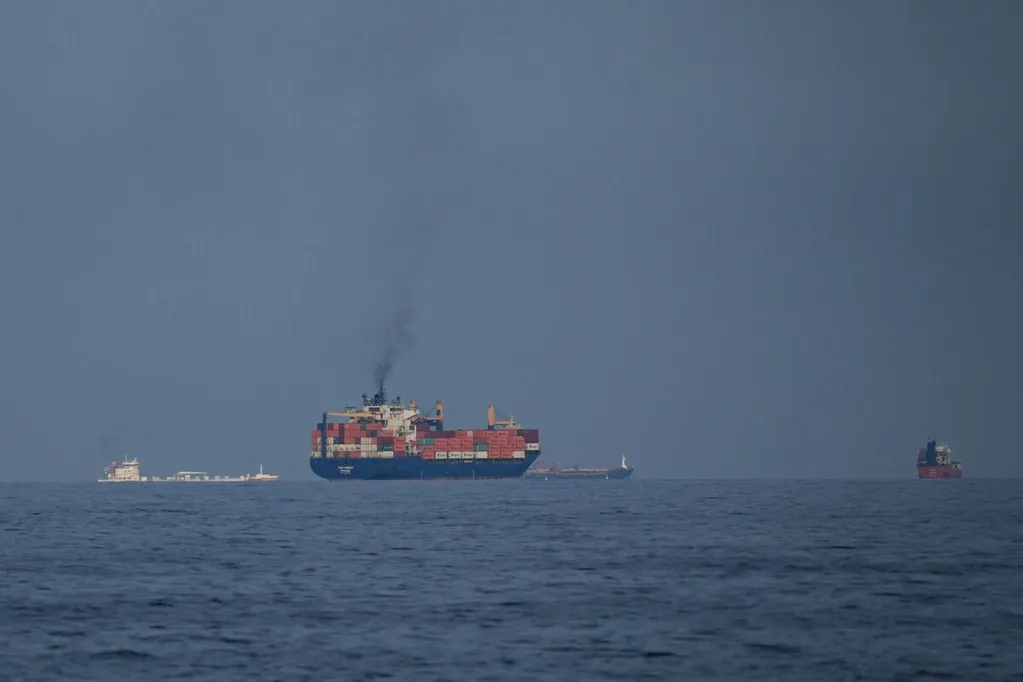
A European-led coalition offered military help to secure safe passage through the Strait of Hormuz hours after Iran said it would open the critical waterway, even as US President Donald Trump warned NATO members to keep a distance.
French President Emmanuel Macron hosted the leaders of the UK, Germany and Italy in Paris and reinforced demands for an "immediate and unconditional" opening of Hormuz and "full respect" for maritime law.
More than three dozen other delegates tuned in via video conference, including leaders of Australia, Canada and Indonesia -- as well as lower-level representatives from countries including China, Saudi Arabia, Kuwait and Qatar.
The French leader organized the meeting as the announcement of the opening was rapidly unfolding in the Middle East, with little detail over how or when a mission would come together or what the circumstances for such an effort would be.
Macron called for "a neutral mission, clearly separate from the belligerents, to escort and protect merchant ships transiting the Gulf." He spoke alongside UK Prime Minister Keir Starmer, German Chancellor Friedrich Merz and Italy's premier, Giorgia Meloni on Friday.
Iran said earlier it would open the strait for the duration of a 10-day ceasefire between Israel and Hezbollah in Lebanon, boosting the prospect of an end of the wider conflict. Hormuz is "completely open" for commercial shipping, Iranian Foreign Minister Abbas Araghchi said in a post on X.
Trump said the waterway is "open and ready for business," though a US naval blockade would remain in place until a broader agreement is reached.
In a separate post on Truth SocialBloomberg Terminal, the US president said that, after he received a "call from NATO," he told the alliance to "STAY AWAY" unless they aimed to "LOAD UP THEIR SHIPS" with oil.
"They were useless when needed," Trump said, posting as European leaders spoke in the French capital. It was unclear who in the 32-member alliance phoned Trump.
For their part, Macron, Merz and other leaders spoke despite differences between Germany and France over US participation. The German leader warned that the Iran war and the ensuing peace mission "must not become a transatlantic stress test," repeating his demand the US participate in any mission.
France insisted that only "non-belligerent" nations should join.
German action, which would require a parliamentary mandate from Berlin, could consist of mine clearance and sea reconnaissance, Merz said.
Italy's prime minister said her country was prepared to "dispatch naval assets," also pending parliamentary approval.
"It's clear that an international naval presence in Hormuz can begin only when hostilities cease, in close coordination with regional and international partners, and in a strictly defensive posture," Meloni said.