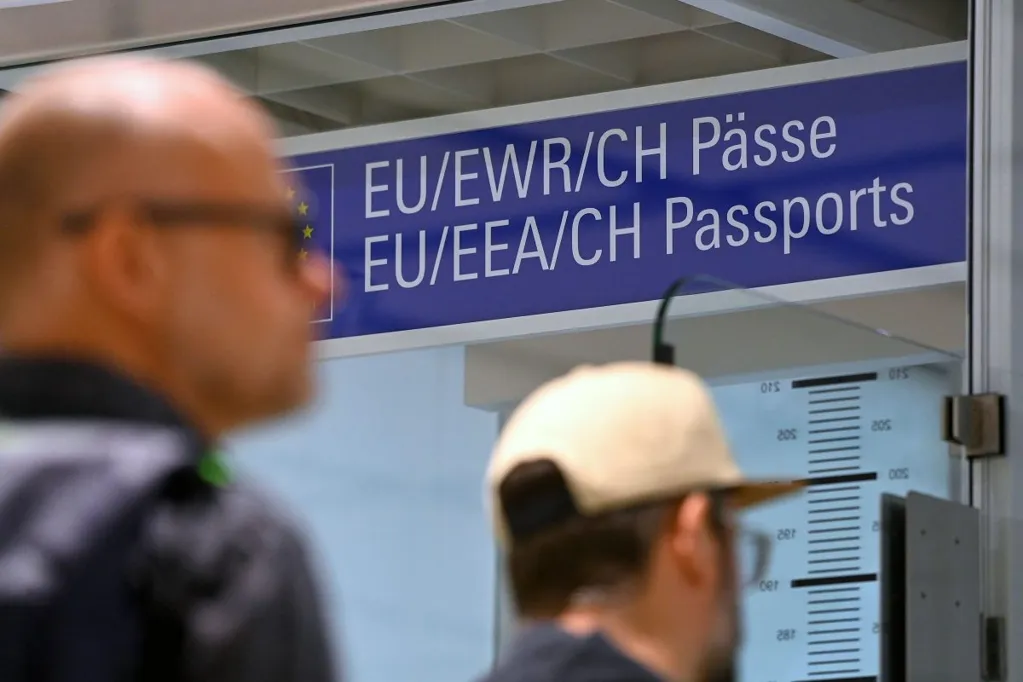
American travelers will have to pay for travel authorization to visit 30 European countries, starting from the fourth quarter of 2026, but this does not mark the end of visa-free travel for U.S. citizens as some reports are suggesting.
Some reports have been circulating online that suggest the European Union is set to end visa-free travel for the U.S. on February 1, in a response to President Donald Trump's tariffs -- effective from the same date -- on certain European nations who have opposed his plans to take control over Greenland.
Newsweek has found no such information declaring any change for U.S. travel to EU -- or Schengen Area -- countries from February 1. The Schengen Area allows free travel between the participating countries, i.e. EU nations plus a few others.
The only change in travel requirements is that the U.S. will be included in the list of countries needing European Travel Information and Authorisation System (ETIAS) pre-travel authorization to visit 30 European countries, a change that will begin in the last quarter of 2026. Basically, travelers who have not needed a visa to visit certain European countries will need to apply for the pre-travel authorization.
Why It Matters
On February 1, Denmark, Norway, Sweden, France, Germany, the United Kingdom, the Netherlands, and Finland will face a 10 percent tariff, with an increase to 25 percent on June 1, for their opposition to Trump's push to acquire Greenland. These tariffs will remain in place until a deal for Greenland is completed, Trump said.
Tension over Trump's intention to take control over Greenland has been amplifying in recent weeks. Troops have been sent to the Artic island by Denmark as European NATO allies conducted military exercises in a show of unity against Trump's threats.
Trump refused to comment when asked if he would use force to take control of Greenland in an NBC News interview on Monday.
While no travel requirements are coming into effect on February 1, the circulating reports highlight the escalating tension and concern around the tense relations between the U.S. and the European Union.
What To Know
The ETIAS travel authorization is an entry-requirement for visa-exempt nationals traveling to: Austria, Belgium, Bulgaria, Croatia, Cyprus, Czechia, Denmark, Estonia, Finland, France, Germany, Greece, Hungary, Iceland, Italy, Latvia, Liechtenstein, Lithuania, Luxembourg, Malta, Netherlands, Norway, Poland, Portugal, Romania, Slovakia, Slovenia, Spain, Sweden, and Switzerland.
The authorization is linked with a traveler's passport and is valid for up to three years or until the passport expires. This means that if you need a new passport, you will have to get a new ETIAS travel authorization.
With the authorization, Americans can travel in the 30 European countries for up to 90 days in any 180-day period. The application costs 20 euros, equivalent to around $23.
However, according to the official website, ETIAS travel authorization "does not guarantee entry" into a country. "When you arrive, a border guard will ask to see your passport and other documents and verify that you meet the entry conditions," the website notes.
ETIAS travel authorization is similar to the U.S.'s Electronic System for Travel Authorization (ESTA). Both serve as travel authorization for visa-exempt travelers of certain countries.
The new requirement is not only in place for the U.S. but also for a number of other countries including: Australia, Canada, Japan, South Korea, Ukraine, the United Arab Emirates, the United Kingdom and others.
To apply for a ETIAS travel authorization, Americans need to fill in the application form on the official ETIAS website or via its mobile application. Applications are typically processed in minutes, but it can take longer.
Once you have applied, you will receive your ETIAS application number via email. It is advised that you apply for your ETIAS well in advance of the date of your intended travel.
What Happens Next
The new ETIAS requirements are set to come into effect in the last quarter of 2026.